College of Nursing, Pusan National University, Yangsan, South Korea.
School of Korean Medicine, Pusan National University, Yangsan, South Korea.
PLoS One. 2020 Nov 5;15(11):e0241857. doi: 10.1371/journal.pone.0241857. eCollection 2020.
Organ transplantation is the most effective treatment for patients with end-stage organ failure. It has been actively carried out all over the world. Recently, eHealth interventions have been applied to organ transplant patients. This systematic review and meta-analysis aimed to evaluate the effects of eHealth interventions for improving medication adherence in organ transplant patients as compared to usual or conventional care alone.
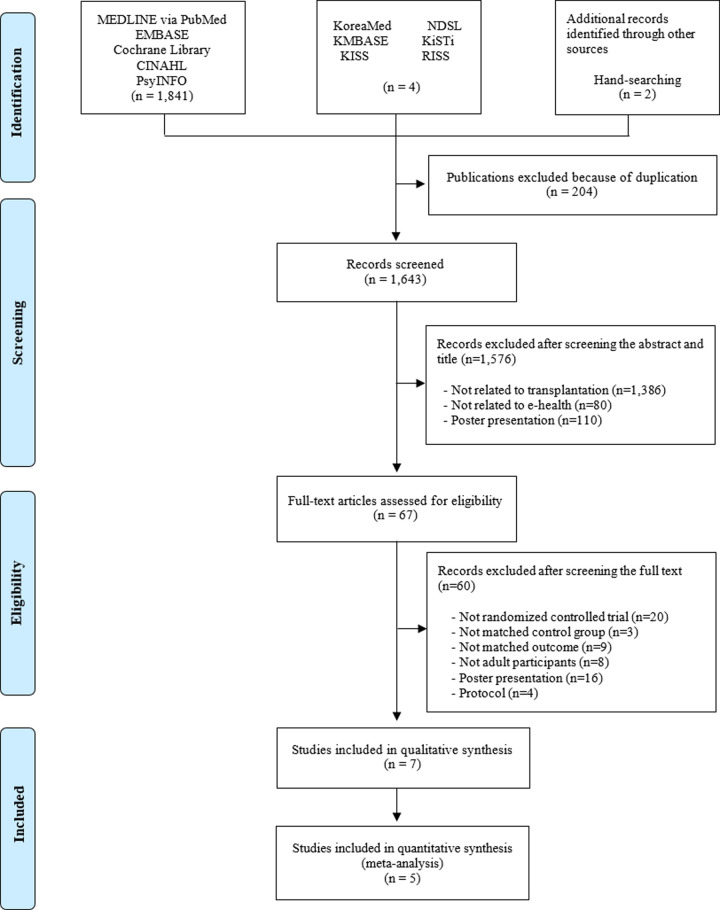
We searched MEDLINE via PubMed, Excerpta Media dataBASE (EMBASE), the Cochrane Register Controlled Trials, the Cumulative Index to Nursing and Allied Health Literature (CINAHL), PsycINFO, and six domestic Korean databases to identify randomized controlled trials (RCTs) published up to April 17, 2020. Two reviewers independently selected relevant studies and extracted data. The quality and bias of the identified studies were assessed. To estimate the effect size, a meta-analysis of the studies was performed using the Cochrane Collaboration software Review Manager 5.3. PRISMA guidelines were followed. When statistical heterogeneity was greater than 80%, narrative synthesis was performed.
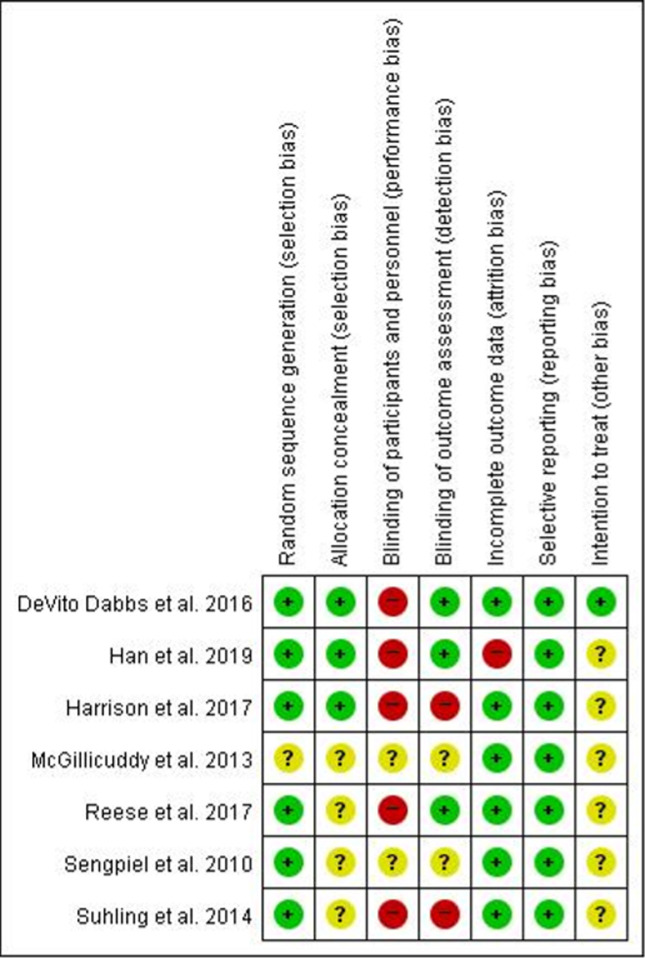
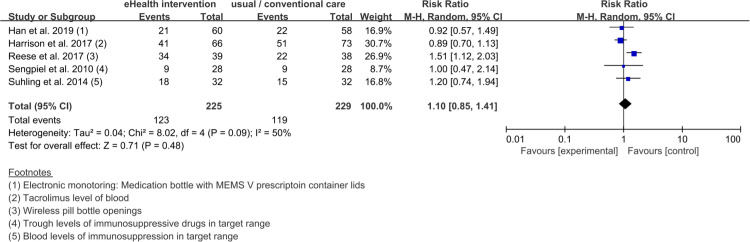
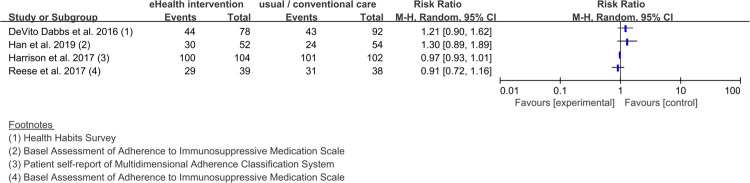
Of the 1,847 articles identified, seven RCTs with a total of 759 participants met the inclusion criteria. The risk of bias assessment showed that the blinding of participants and personnel was high. In six studies, medication adherence (effect size = -0.18-1.30) and knowledge scores were not significantly different between those receiving eHealth interventions and the controls.
Our findings suggest that eHealth interventions were similar to standard care or advanced care for improving medication adherence, and they faired equally well for improving medication knowledge. Therefore, eHealth interventions can be used for medication adherence of organ transplant patients. More research is needed to provide well-designed eHealth intervention to improve the medication adherence and knowledge of organ transplant patients.
CRD42017067145 16/05/2017.
器官移植是治疗终末期器官衰竭患者的最有效方法。它已在全球范围内得到积极开展。最近,电子健康干预措施已应用于器官移植患者。本系统评价和荟萃分析旨在评估与常规护理相比,电子健康干预措施对改善器官移植患者用药依从性的效果。
我们通过 PubMed 中的 MEDLINE、Excerpta Media dataBASE(EMBASE)、Cochrane 对照试验注册库、护理学和相关健康文献累积索引(CINAHL)、PsycINFO 和六个国内韩国数据库,检索截至 2020 年 4 月 17 日发表的随机对照试验(RCT)。两名评审员独立筛选相关研究并提取数据。评估了所确定研究的质量和偏倚。使用 Cochrane 协作软件 Review Manager 5.3 对研究进行荟萃分析,以评估效应大小。遵循 PRISMA 指南。当统计异质性大于 80%时,进行叙述性综合分析。
在 1847 篇文章中,有 7 项 RCT 共 759 名参与者符合纳入标准。偏倚风险评估显示,参与者和人员的盲法较高。在六项研究中,接受电子健康干预的患者与对照组的用药依从性(效应量=-0.18-1.30)和知识评分无显著差异。
我们的研究结果表明,电子健康干预措施与标准护理或高级护理在改善用药依从性方面相似,并且在改善用药知识方面同样有效。因此,电子健康干预措施可用于改善器官移植患者的用药依从性。需要进一步的研究提供精心设计的电子健康干预措施,以提高器官移植患者的用药依从性和知识水平。
CRD42017067145 16/05/2017.