Pardo-Hernández Miriam, López-Delacalle Maria, Rivero Rosa M
Department of Plant Nutrition, Center of Edaphology and Applied Biology of Segura (CEBAS-CSIC), Campus Universitario Espinardo, Espinardo, 30100 Murcia, Spain.
Antioxidants (Basel). 2020 Nov 3;9(11):1078. doi: 10.3390/antiox9111078.
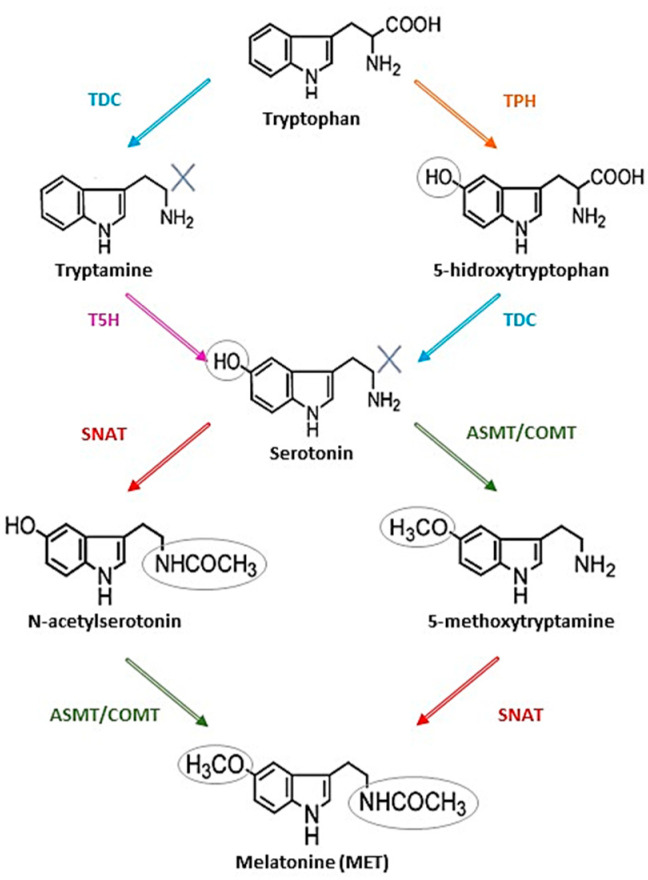
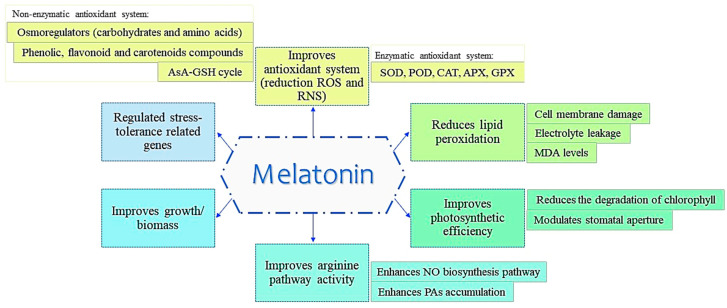
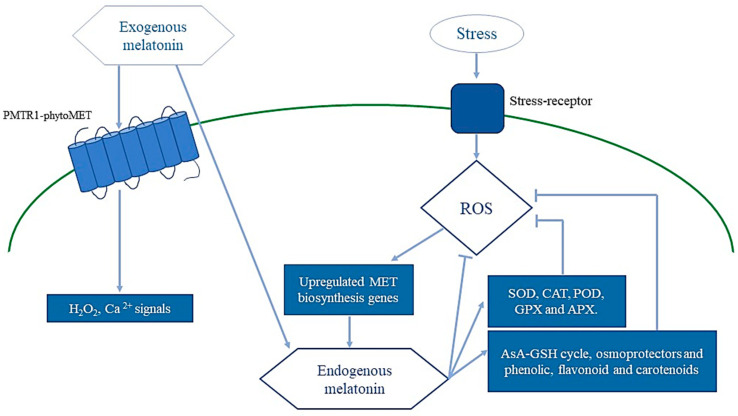
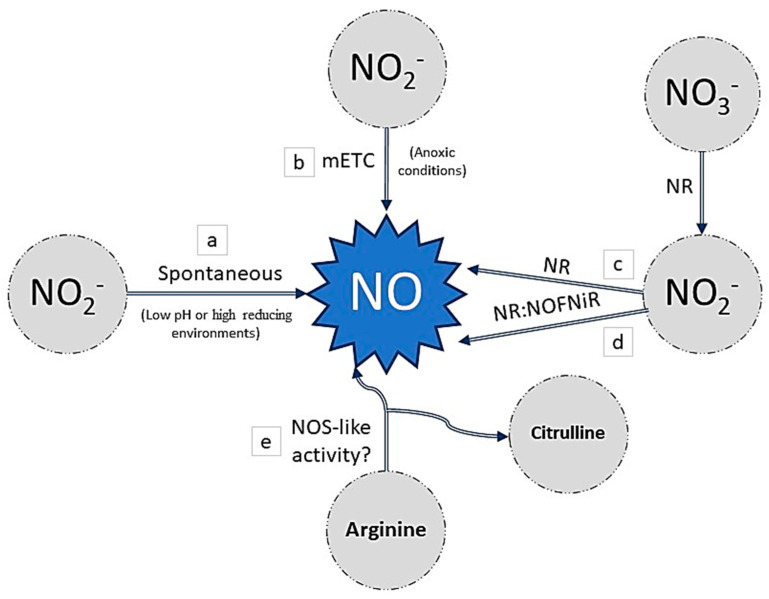
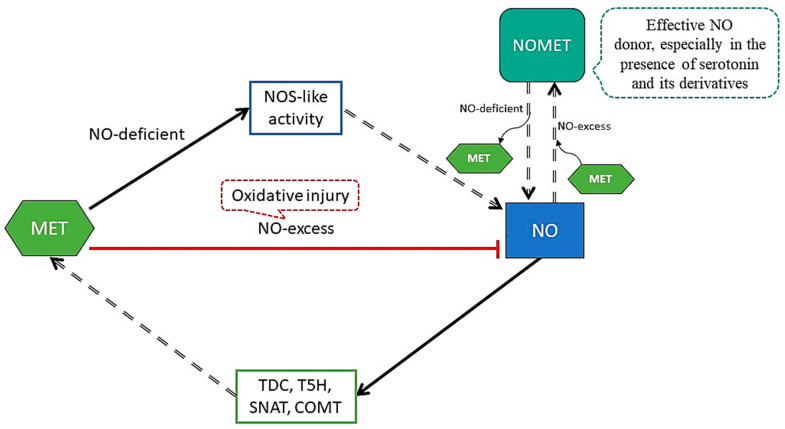
Abiotic stress in plants is an increasingly common problem in agriculture, and thus, studies on plant treatments with specific compounds that may help to mitigate these effects have increased in recent years. Melatonin (MET) application and its role in mitigating the negative effects of abiotic stress in plants have become important in the last few years. MET, a derivative of tryptophan, is an important plant-related response molecule involved in the growth, development, and reproduction of plants, and the induction of different stress factors. In addition, MET plays a protective role against different abiotic stresses such as salinity, high/low temperature, high light, waterlogging, nutrient deficiency and stress combination by regulating both the enzymatic and non-enzymatic antioxidant defense systems. Moreover, MET interacts with many signaling molecules, such as reactive oxygen species (ROS) and nitric oxide (NO), and participates in a wide variety of physiological reactions. It is well known that NO produces S-nitrosylation and NO-Tyr of important antioxidant-related proteins, with this being an important mechanism for maintaining the antioxidant capacity of the AsA/GSH cycle under nitro-oxidative conditions, as extensively reviewed here under different abiotic stress conditions. Lastly, in this review, we show the coordinated actions between NO and MET as a long-range signaling molecule, regulating many responses in plants, including plant growth and abiotic stress tolerance. Despite all the knowledge acquired over the years, there is still more to know about how MET and NO act on the tolerance of plants to abiotic stresses.
植物中的非生物胁迫在农业中是一个日益普遍的问题,因此,近年来关于用特定化合物处理植物以减轻这些影响的研究有所增加。褪黑素(MET)的应用及其在减轻植物非生物胁迫负面影响方面的作用在过去几年中变得十分重要。MET是色氨酸的衍生物,是一种与植物相关的重要反应分子,参与植物的生长、发育和繁殖以及不同胁迫因子的诱导。此外,MET通过调节酶促和非酶促抗氧化防御系统,对盐度、高温/低温、高光、涝害、营养缺乏和胁迫组合等不同的非生物胁迫起到保护作用。此外,MET与许多信号分子相互作用,如活性氧(ROS)和一氧化氮(NO),并参与多种生理反应。众所周知,NO会使重要的抗氧化相关蛋白发生S-亚硝基化和NO-Tyr化,这是在硝基氧化条件下维持AsA/GSH循环抗氧化能力的重要机制,本文在不同非生物胁迫条件下对此进行了广泛综述。最后,在本综述中,我们展示了NO和MET作为一种远程信号分子之间的协同作用,调节植物中的许多反应,包括植物生长和非生物胁迫耐受性。尽管多年来已经获得了所有这些知识,但关于MET和NO如何作用于植物对非生物胁迫的耐受性仍有更多需要了解的地方。