Integrative Biology Laboratory, Salk Institute for Biological Studies, 10010 N. Torrey Pines Rd, La Jolla, CA, 92037, USA.
Department of Surgery and the Lineberger Comprehensive Cancer Center, University of North Carolina School of Medicine, Chapel Hill, North Carolina, 27599, USA.
Cell Commun Signal. 2020 Nov 5;18(1):179. doi: 10.1186/s12964-020-00645-3.
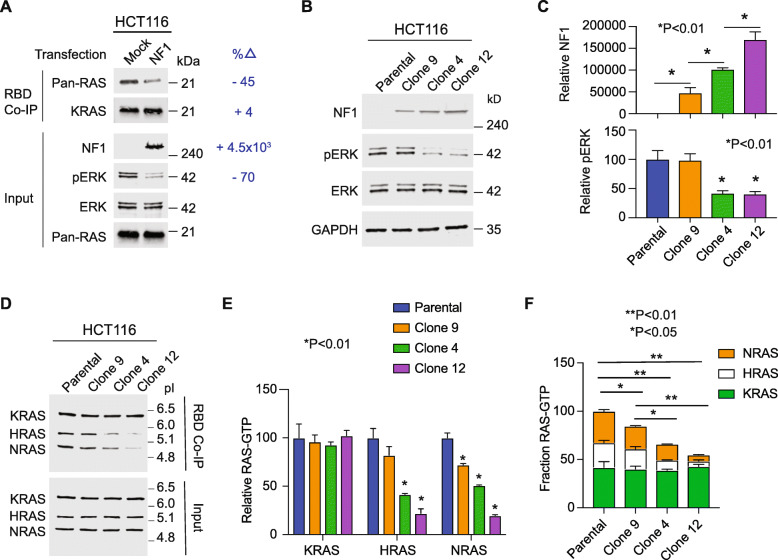
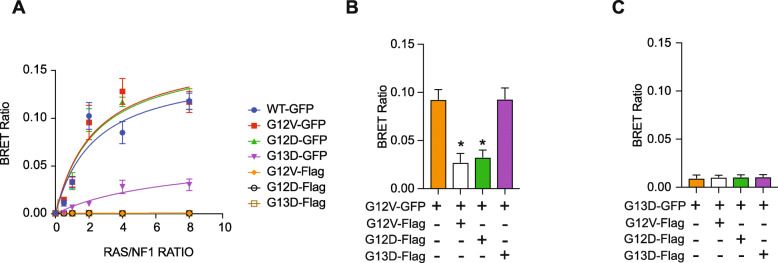
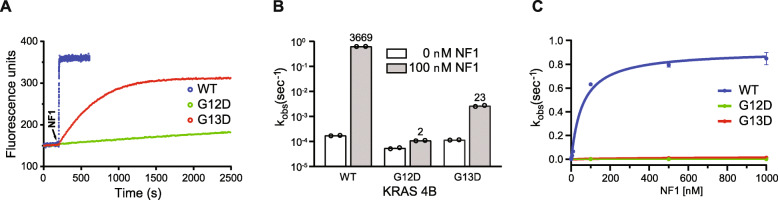
Phase three clinical trial evidence suggests that colorectal cancers with the KRAS G13D mutation may benefit from EGFR inhibitors, like cetuximab, in contrast to the other most common KRAS mutations. A mechanism to explain why this mutation behaves differently from other KRAS mutations had long been lacking. Two recent studies have reproduced KRAS G13D specific sensitivity to cetuximab in cellular models, and both have implicated the tumor suppressor NF1 as a critical variable in determining sensitivity and resistance. One study proposes a mechanism that focuses on the inhibition of active, GTP-bound wild-type RAS, which is proposed to occur to a greater extent in KRAS G13D tumors due to the inability of KRAS G13D to bind NF1 well. The other study suggests NF1 can convert GTP-bound KRAS G13D to inactive, GDP-bound KRAS G13D. Here, we report an inability to reproduce cellular and biophysical studies that suggested NF1 has strong GTPase activity on KRAS G13D. We also report additional data that further suggests only WT RAS-GTP levels are reduced with EGFR inhibition and that KRAS G13D is impaired in binding to NF1. These new experiments further support a mechanism in which cetuximab inhibits wild-type (HRAS and NRAS) signals in KRAS G13D colorectal cancers. Video Abstract.
三期临床试验证据表明,具有 KRAS G13D 突变的结直肠癌可能受益于 EGFR 抑制剂,如西妥昔单抗,与其他最常见的 KRAS 突变相反。长期以来,缺乏一种可以解释为什么这种突变与其他 KRAS 突变表现不同的机制。最近的两项研究在细胞模型中重现了 KRAS G13D 对西妥昔单抗的特异性敏感性,并且都暗示肿瘤抑制因子 NF1 是决定敏感性和耐药性的关键变量。一项研究提出了一种机制,该机制侧重于抑制活性、GTP 结合的野生型 RAS,由于 KRAS G13D 不能很好地与 NF1 结合,因此在 KRAS G13D 肿瘤中更有可能发生这种情况。另一项研究表明,NF1 可以将 GTP 结合的 KRAS G13D 转化为非活性、GDP 结合的 KRAS G13D。在这里,我们报告了无法重现表明 NF1 对 KRAS G13D 具有很强 GTPase 活性的细胞和生物物理研究。我们还报告了其他数据,进一步表明只有 WT RAS-GTP 水平随着 EGFR 抑制而降低,并且 KRAS G13D 与 NF1 的结合受到损害。这些新实验进一步支持了一种机制,即西妥昔单抗抑制 KRAS G13D 结直肠癌中的野生型(HRAS 和 NRAS)信号。视频摘要。