Ranatunga Iddamalgoda Dissanayakage Jayani Chalindra, Jayaratne Kapila
Postgraduate Institute of Medicine, University of Colombo, 160, Prof. NandadasaKodagoda Rd, Colombo, Sri Lanka.
Family Health Bureau, Ministry of Health, 231 De Saram Place, Colombo 10, Sri Lanka.
BMC Pregnancy Childbirth. 2020 Nov 5;20(1):667. doi: 10.1186/s12884-020-03259-2.
Unplanned pregnancy is a significant public health issue in both low- and high-income countries. The burden of unplanned pregnancy is reflected in women opting for pregnancy terminations and it can be detrimental to the women and her family as well as the health system and society. Solid data on the proportion of unplanned pregnancies are using more specific tools such as the London Measure of Unplanned Pregnancy (LMUP) needed to address the issue in Sri Lankan contexts. The objective was to describe the proportion of unplanned pregnancies, their determinants and the health outcomes of women delivering at Colombo North Teaching Hospital-Ragama (CNTH).
A cross-sectional study was carried out among 494 consecutive pregnant women selected by non-probability consecutive sampling who were admitted for the confinement at CNTH. A pre-tested structured interviewer-administered questionnaire was used to collect data on antenatal women and intentionality measured by self-administered six-item LMUP. Maternal and newborn health outcomes were ascertained in each post-partum women before discharge. Data were analyzed with the Mann-Whitney U tests, Kruskal-Wallis tests and spearman rank correlation. We also evaluated the psychometric properties of the Sinhalese version of LMUP.
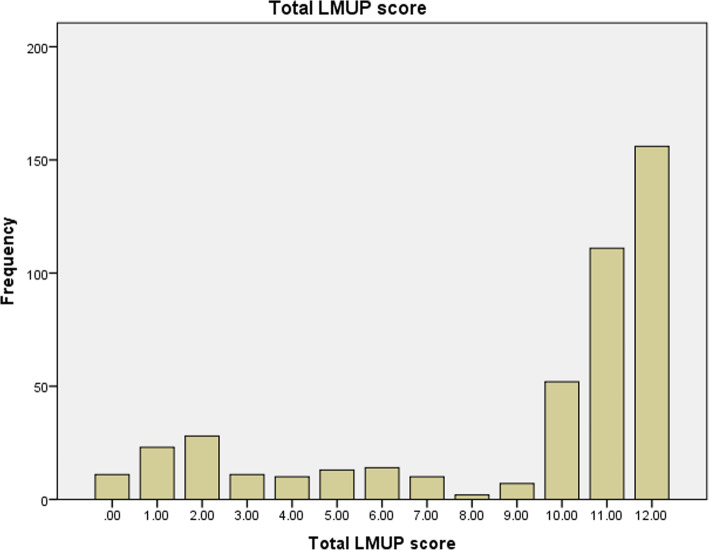
The response rate was 97.8 and 17.2% of pregnancies ending at birth were unplanned, 12.7% were ambivalent and 70.1% were planned. Associated factor profile of women with unplanned pregnancies includes; not married women (p = 0.001), educated up to the passing of GCE ordinary level by women (p < 0.001) and spouse (p < 0.001), primiparity (p = 0.002) and inadequate knowledge on emergency contraceptives (p = 0.037). Less planned pregnancies were also significantly associated with anemia (p = 0.004), low mood for last 2 weeks (p < 0.001), having a partner with problematic alcohol consumption (p < 0.001), presence of Gender-Based Violence (GBV) (p < 0.001), poor relationship satisfaction with partner (p < 0.001) and family (p < 0.001). Inadequate pre-pregnancy preparation and antenatal care were associated with an unplanned pregnancy. No differences were found in neonatal outcomes. Sinhalese version of the LMUP scale was found to be accepted, valid and reliable with the Cronbach's alpha of 0.936.
A sizeable proportion of pregnancies were unplanned. Teenage pregnancies, non-marital relationships and inadequate knowledge on emergency contraceptives, maternal anemia, low mood, and GBV were modifiable associated factors which could be prevented by evidence-based locally applicable approaches.
意外怀孕在低收入和高收入国家都是一个重大的公共卫生问题。意外怀孕的负担体现在女性选择终止妊娠上,这对女性及其家庭以及卫生系统和社会都可能有害。在斯里兰卡的背景下,需要使用更具体的工具,如伦敦意外怀孕衡量标准(LMUP),来获取关于意外怀孕比例的确切数据。目的是描述在科伦坡北部教学医院 - 拉加马(CNTH)分娩的女性中意外怀孕的比例、其决定因素和健康结果。
对通过非概率连续抽样选取的494名在CNTH住院分娩的连续孕妇进行了一项横断面研究。使用经过预测试的结构化访谈者管理的问卷收集关于产前女性的数据以及通过自我管理的六项LMUP测量的意向性。在每位产后女性出院前确定母婴健康结果。数据采用曼 - 惠特尼U检验、克鲁斯卡尔 - 沃利斯检验和斯皮尔曼等级相关性进行分析。我们还评估了僧伽罗语版LMUP的心理测量特性。
回复率为97.8%,17.2%的出生结局为意外怀孕,12.7%为矛盾心态,70.1%为计划内怀孕。意外怀孕女性的相关因素包括:未婚女性(p = 0.001)、女性(p < 0.001)及其配偶(p < 0.001)教育程度达到普通教育证书普通水平、初产(p = 0.002)以及对紧急避孕药知识不足(p = 0.037)。计划内怀孕较少还与贫血(p = 0.004)、过去两周情绪低落(p < 0.001)、伴侣有饮酒问题(p < 0.001)、存在基于性别的暴力(GBV)(p < 0.001)、与伴侣关系满意度低(p < 0.001)和与家人关系满意度低(p < 0.001)显著相关。孕前准备不足和产前护理不足与意外怀孕有关。新生儿结局未发现差异。僧伽罗语版的LMUP量表被认为是可接受、有效且可靠的,克朗巴哈系数为0.936。
相当比例的怀孕是意外怀孕。青少年怀孕、非婚姻关系以及对紧急避孕药知识不足、孕妇贫血、情绪低落和GBV是可改变的相关因素,可以通过基于证据的适用于当地的方法来预防。