Dubé Marc-Olivier, Desmeules François, Lewis Jeremy, Roy Jean-Sébastien
Department of Rehabilitation, Faculty of Medicine, Université Laval, Quebec City, Quebec, Canada.
Center for Interdisciplinary Research in Rehabilitation and Social Integration, Quebec City, Quebec, Canada.
BMJ Open. 2020 Nov 5;10(11):e039976. doi: 10.1136/bmjopen-2020-039976.
Lifetime prevalence of shoulder pain is 70%, and approximately 50% of people with shoulder pain will experience pain for more than a year. Rotator cuff-related shoulder pain (RCRSP) is the most common shoulder condition and the main non-surgical intervention is exercise therapy. For approximately 30% of people with RCRSP, this approach does not lead to a significant reduction in symptoms. This may be due to an inappropriate dosage or choice of exercises. The aim of this investigation is to compare the short, mid and long-term effects, in terms of symptoms, functional limitations, kinesiophobia and pain catastrophising, of three different shoulder rehabilitation approaches (education, strengthening, motor control) in adults with RCRSP.
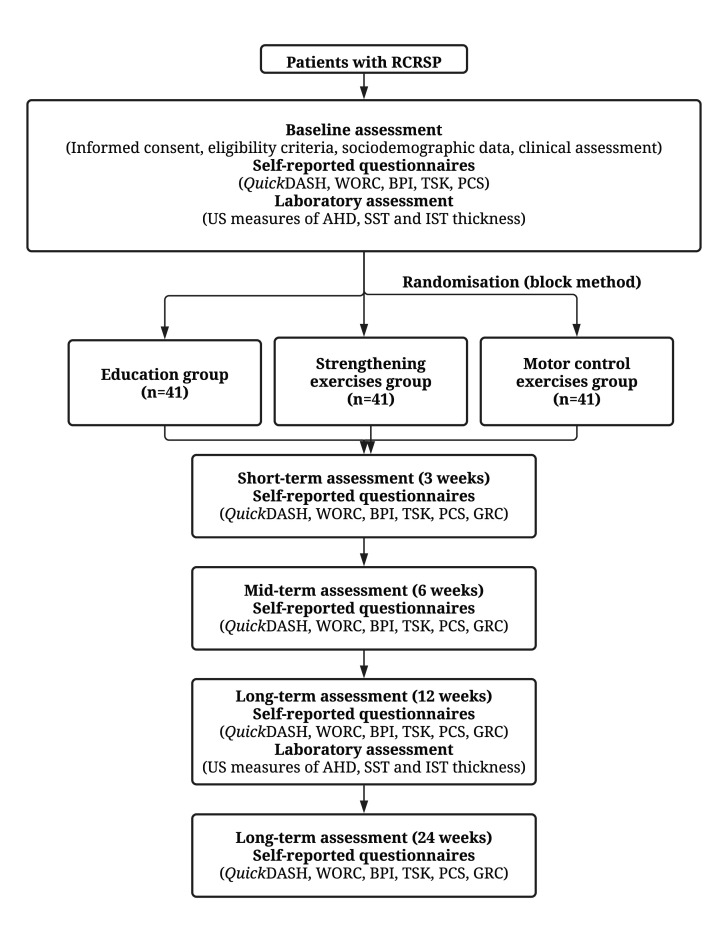
In this single-blind (assessor), parallel-group, randomised clinical trial, 123 adults presenting with RCRSP will take part in a 12-week rehabilitation programme. They will be randomly assigned to one of three groups (education only, strengthening approach or motor control-focused approach). Abbreviated version of the Disabilities of the Arm, Shoulder and Hand Questionnaire, the primary outcome, Western Ontario Rotator Cuff Index and Brief Pain Inventory will evaluate symptoms and functional limitations, while Tampa Scale of Kinesiophobia and Pain Catastrophizing Scale will evaluate pain-related fear and catastrophising at baseline and at 3, 6, 12 and 24 weeks. Ultrasonographic acromiohumeral distances and tendon thickness will be assessed at baseline and 12 weeks. Intervention groups will be compared on outcomes with intention-to-treat analyses using two-way repeated measures analysis of variance if the data are normally distributed or non-parametric analysis of longitudinal data if they are not.
Ethics approval was obtained from the Sectorial Rehabilitation and Social Integration Research Ethics Committee of the Centre Intégré Universitaire de Santé et de Services Sociaux de la Capitale Nationale (CIUSSS-CN). Results will be disseminated through international publications in peer-reviewed journals, in addition to international conference presentations.
NCT03892603; pre-results.
肩部疼痛的终生患病率为70%,约50%的肩部疼痛患者疼痛会持续一年以上。肩袖相关肩部疼痛(RCRSP)是最常见的肩部疾病,主要的非手术干预措施是运动疗法。对于约30%的RCRSP患者,这种方法并不能显著减轻症状。这可能是由于运动剂量不当或运动选择不当。本研究的目的是比较三种不同的肩部康复方法(教育、强化、运动控制)对RCRSP成年患者在症状、功能受限、运动恐惧和疼痛灾难化方面的短期、中期和长期影响。
在这项单盲(评估者)、平行组、随机临床试验中,123名患有RCRSP的成年人将参加为期12周的康复计划。他们将被随机分配到三组之一(仅教育组、强化方法组或运动控制为主的方法组)。主要结局指标——《手臂、肩部和手部功能障碍问卷简版》、西安大略肩袖指数和简明疼痛量表将评估症状和功能受限情况,而坦帕运动恐惧量表和疼痛灾难化量表将在基线以及第3、6、12和24周评估与疼痛相关的恐惧和灾难化情况。将在基线和第12周评估超声肩峰下间隙距离和肌腱厚度。如果数据呈正态分布,将使用双向重复测量方差分析对干预组的结局进行意向性分析比较;如果数据不呈正态分布,则使用纵向数据的非参数分析进行比较。
已获得国家首都综合大学卫生与社会服务中心(CIUSSS-CN)部门康复与社会融合研究伦理委员会的伦理批准。除了在国际会议上报告外,研究结果将通过在同行评审期刊上发表国际论文进行传播。
NCT03892603;预结果。