Dupuis Frédérique, Barrett Eva, Dubé Marc-Olivier, McCreesh Karen M, Lewis Jeremy S, Roy Jean-Sébastien
Faculty of Medicine, Laval University, Quebec City, Canada.
Centre for Interdisciplinary Research in Rehabilitation and Social Integration, Quebec City, Canada.
BMJ Open Sport Exerc Med. 2018 Dec 26;4(1):e000477. doi: 10.1136/bmjsem-2018-000477. eCollection 2018.
Rotator cuff tendinopathies are the most common shoulder disorders. As persistent symptoms lasting more than 3 months have been shown to be a strong indicator of poor outcomes, it is important to have successful interventions in the acute stage. However, there is no evidence yet to guide clinical interventions in an acute pain context. The objective of this study was to compare the short-term effect of a 2-week gradual reloading exercises programme with the use of cryotherapy on symptoms and function for acute rotator cuff tendinopathy.
This simple-blind, randomised controlled trial included 44 participants with acute rotator cuff tendinopathy who were randomly allocated to either the exercises or cryotherapy group. Symptoms and functional limitations were evaluated at weeks 0, 2 and 6 using self-reported questionnaires (Disabilities of the Arm, Shoulder and Hand, Western Ontario Rotator Cuff, and Brief Pain Inventory), while acromiohumeral distance, shoulder strength and active range of motion were evaluated at weeks 0 and 2.
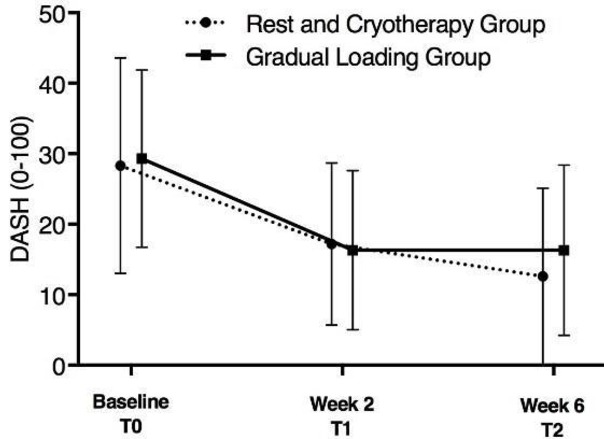
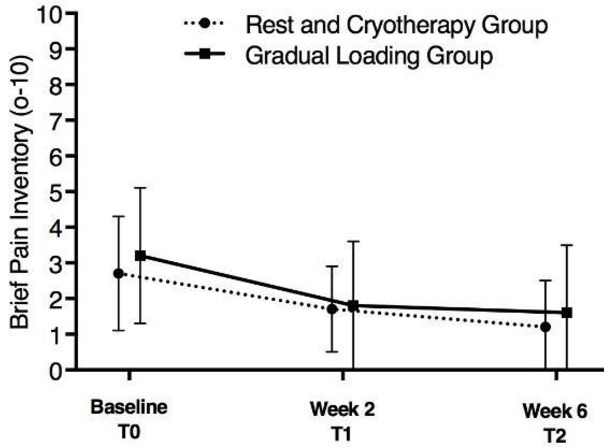
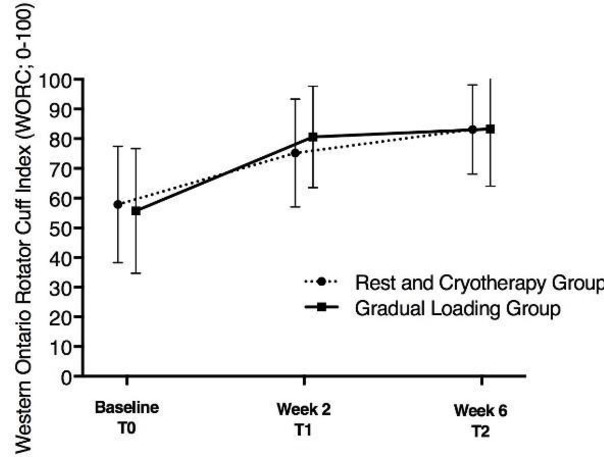
Following interventions, both groups showed statistically significant improvements on symptoms and function at week 2 and week 6 compared with baseline. However, there was no significant group × time interaction. There was no time effect on acromiohumeral distance, shoulder strength and active range of motion, as well as no time × group interaction.
The results showed a statistically significant improvement in symptoms and function in both groups, but there was no difference between the short-term effect of a cryotherapy based-approach and a gradual reloading exercises programme.
NCT02813304.
肩袖肌腱病是最常见的肩部疾病。由于持续症状超过3个月已被证明是预后不良的有力指标,因此在急性期进行成功的干预很重要。然而,尚无证据指导急性疼痛情况下的临床干预。本研究的目的是比较为期2周的逐渐增加负荷运动计划与冷冻疗法对急性肩袖肌腱病症状和功能的短期影响。
这项单盲随机对照试验纳入了44名急性肩袖肌腱病患者,他们被随机分配到运动组或冷冻疗法组。在第0、2和6周使用自我报告问卷(手臂、肩部和手部功能障碍问卷、西安大略肩袖问卷和简短疼痛量表)评估症状和功能受限情况,同时在第0和2周评估肩峰下间隙、肩部力量和主动活动范围。
干预后,与基线相比,两组在第2周和第6周时症状和功能均有统计学意义的改善。然而,组×时间交互作用不显著。肩峰下间隙、肩部力量和主动活动范围没有时间效应,也没有时间×组交互作用。
结果显示两组症状和功能均有统计学意义的改善,但基于冷冻疗法的方法与逐渐增加负荷运动计划的短期效果之间没有差异。
NCT02813304。