Department of Psychological Medicine, Institute of Psychiatry, Psychology and Neuroscience, King's College London, London, United Kingdom.
South London and Maudsley NHS Foundation Trust, London, United Kingdom.
J Psychopharmacol. 2021 Feb;35(2):109-123. doi: 10.1177/0269881120959644. Epub 2020 Nov 6.
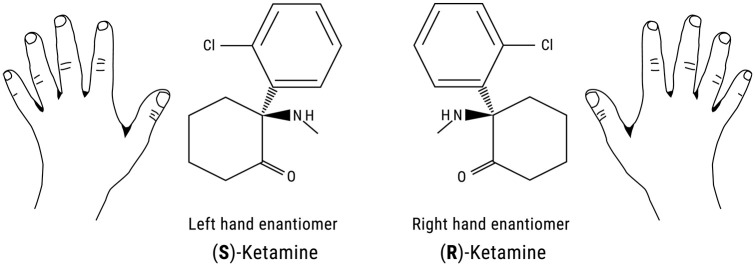
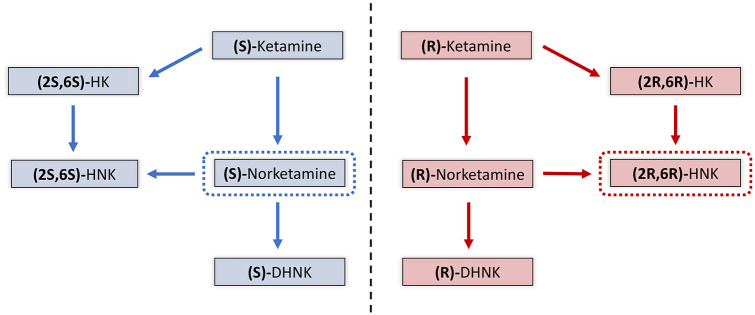
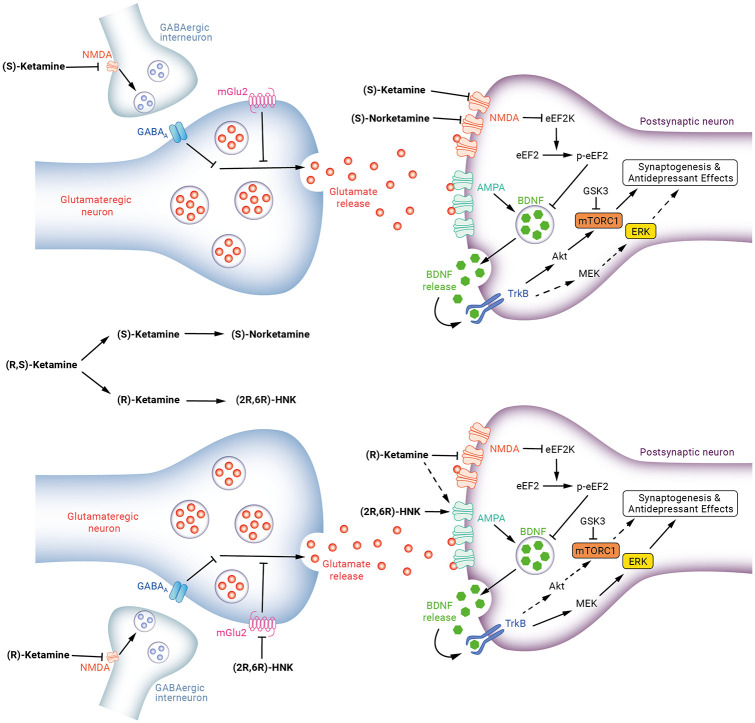
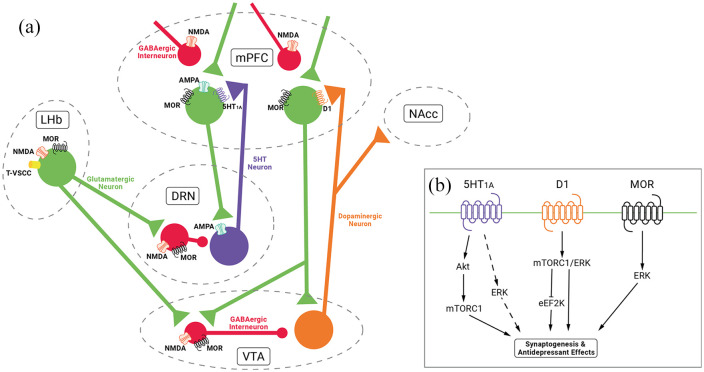
The discovery of the rapid antidepressant effects of the dissociative anaesthetic ketamine, an uncompetitive N-Methyl-D-Aspartate receptor antagonist, is arguably the most important breakthrough in depression research in the last 50 years. Ketamine remains an off-label treatment for treatment-resistant depression with factors that limit widespread use including its dissociative effects and abuse potential. Ketamine is a racemic mixture, composed of equal amounts of (S)-ketamine and (R)-ketamine. An (S)-ketamine nasal spray has been developed and approved for use in treatment-resistant depression in the United States and Europe; however, some concerns regarding efficacy and side effects remain. Although (R)-ketamine is a less potent N-Methyl-D-Aspartate receptor antagonist than (S)-ketamine, increasing preclinical evidence suggests (R)-ketamine may have more potent and longer lasting antidepressant effects than (S)-ketamine, alongside fewer side effects. Furthermore, a recent pilot trial of (R)-ketamine has demonstrated rapid-acting and sustained antidepressant effects in individuals with treatment-resistant depression. Research is ongoing to determine the specific cellular and molecular mechanisms underlying the antidepressant actions of ketamine and its component enantiomers in an effort to develop future rapid-acting antidepressants that lack undesirable effects. Here, we briefly review findings regarding the antidepressant effects of ketamine and its enantiomers before considering underlying mechanisms including N-Methyl-D-Aspartate receptor antagonism, γ-aminobutyric acid-ergic interneuron inhibition, α-amino-3-hydroxy-5-methyl-4-isoxazolepropionic receptor activation, brain-derived neurotrophic factor and tropomyosin kinase B signalling, mammalian target of rapamycin complex 1 and extracellular signal-regulated kinase signalling, inhibition of glycogen synthase kinase-3 and inhibition of lateral habenula bursting, alongside potential roles of the monoaminergic and opioid receptor systems.
氯胺酮作为一种非竞争性 N-甲基-D-天冬氨酸受体拮抗剂,具有快速抗抑郁作用,这一发现可以说是过去 50 年来抑郁症研究中最重要的突破。氯胺酮仍然是一种治疗难治性抑郁症的处方外用药,其限制广泛使用的因素包括分离作用和滥用潜力。氯胺酮是一种外消旋混合物,由等量的(S)-氯胺酮和(R)-氯胺酮组成。一种(S)-氯胺酮鼻喷雾剂已在美国和欧洲开发并批准用于治疗难治性抑郁症;然而,关于疗效和副作用仍存在一些担忧。虽然(R)-氯胺酮作为 N-甲基-D-天冬氨酸受体拮抗剂的效力比(S)-氯胺酮弱,但越来越多的临床前证据表明,(R)-氯胺酮可能比(S)-氯胺酮具有更强和更持久的抗抑郁作用,同时副作用更少。此外,最近一项(R)-氯胺酮的试点试验表明,在治疗抵抗性抑郁症患者中,(R)-氯胺酮具有快速起效和持续的抗抑郁作用。目前正在研究确定氯胺酮及其对映体发挥抗抑郁作用的具体细胞和分子机制,以期开发出缺乏不良作用的新型快速抗抑郁药。在这里,我们简要回顾了氯胺酮及其对映体的抗抑郁作用的发现,然后考虑了潜在的机制,包括 N-甲基-D-天冬氨酸受体拮抗作用、γ-氨基丁酸能中间神经元抑制、α-氨基-3-羟基-5-甲基-4-异恶唑丙酸受体激活、脑源性神经营养因子和原肌球蛋白激酶 B 信号转导、哺乳动物雷帕霉素靶蛋白复合物 1 和细胞外信号调节激酶信号转导、糖原合成酶激酶-3 抑制和外侧缰核爆发抑制,以及单胺能和阿片受体系统的潜在作用。