
TCRD 和 Pharos 2021:从人类蛋白质组中挖掘疾病生物学。
TCRD and Pharos 2021: mining the human proteome for disease biology.
机构信息
National Center for Advancing Translational Science, 9800 Medical Center Drive, Rockville, MD 20850, USA.
Translational Informatics Division, Department of Internal Medicine, University of New Mexico Health Sciences Center, Albuquerque, NM 87131, USA.
出版信息
Nucleic Acids Res. 2021 Jan 8;49(D1):D1334-D1346. doi: 10.1093/nar/gkaa993.
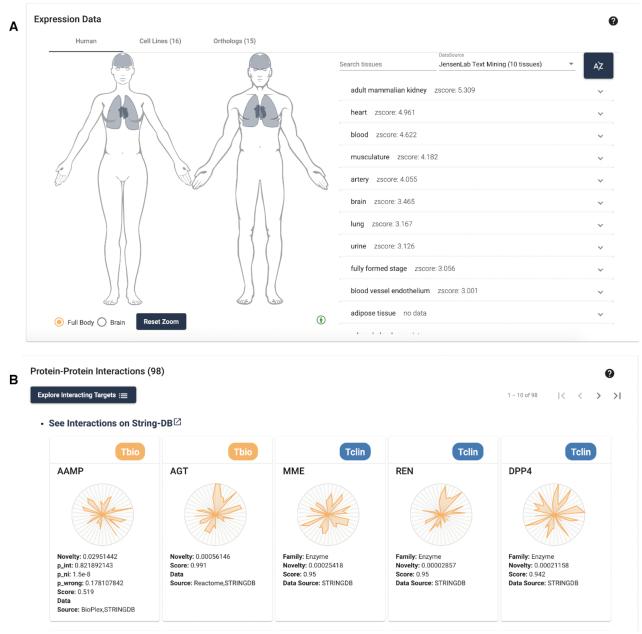
In 2014, the National Institutes of Health (NIH) initiated the Illuminating the Druggable Genome (IDG) program to identify and improve our understanding of poorly characterized proteins that can potentially be modulated using small molecules or biologics. Two resources produced from these efforts are: The Target Central Resource Database (TCRD) (http://juniper.health.unm.edu/tcrd/) and Pharos (https://pharos.nih.gov/), a web interface to browse the TCRD. The ultimate goal of these resources is to highlight and facilitate research into currently understudied proteins, by aggregating a multitude of data sources, and ranking targets based on the amount of data available, and presenting data in machine learning ready format. Since the 2017 release, both TCRD and Pharos have produced two major releases, which have incorporated or expanded an additional 25 data sources. Recently incorporated data types include human and viral-human protein-protein interactions, protein-disease and protein-phenotype associations, and drug-induced gene signatures, among others. These aggregated data have enabled us to generate new visualizations and content sections in Pharos, in order to empower users to find new areas of study in the druggable genome.
2014 年,美国国立卫生研究院 (NIH) 启动了“照亮可成药基因组”(IDG)计划,旨在识别和增进我们对那些可能通过小分子或生物制剂进行调控的、特征描述较差的蛋白的了解。这些努力产生了两个资源:靶标中央资源数据库(TCRD)(http://juniper.health.unm.edu/tcrd/)和 Pharos(https://pharos.nih.gov/),这是一个浏览 TCRD 的网络界面。这些资源的最终目标是通过聚合大量数据源,突出和促进对当前研究不足的蛋白的研究,并根据可用数据量对靶标进行排名,并以机器学习准备好的格式呈现数据。自 2017 年发布以来,TCRD 和 Pharos 都已经进行了两次重大更新,其中纳入或扩展了另外 25 个数据源。最近纳入的数据类型包括人类和病毒-人类蛋白-蛋白相互作用、蛋白-疾病和蛋白-表型关联,以及药物诱导的基因特征等。这些聚合数据使我们能够在 Pharos 中生成新的可视化和内容部分,以便为用户提供在可成药基因组中找到新的研究领域的能力。




 Zotero 插件