Lin Yu, Mehta Saurabh, Küçük-McGinty Hande, Turner John Paul, Vidovic Dusica, Forlin Michele, Koleti Amar, Nguyen Dac-Trung, Jensen Lars Juhl, Guha Rajarshi, Mathias Stephen L, Ursu Oleg, Stathias Vasileios, Duan Jianbin, Nabizadeh Nooshin, Chung Caty, Mader Christopher, Visser Ubbo, Yang Jeremy J, Bologa Cristian G, Oprea Tudor I, Schürer Stephan C
Center for Computational Science, University of Miami, Coral Gables, FL, USA.
Department of Applied Chemistry, Delhi Technological University, Delhi, India.
J Biomed Semantics. 2017 Nov 9;8(1):50. doi: 10.1186/s13326-017-0161-x.
One of the most successful approaches to develop new small molecule therapeutics has been to start from a validated druggable protein target. However, only a small subset of potentially druggable targets has attracted significant research and development resources. The Illuminating the Druggable Genome (IDG) project develops resources to catalyze the development of likely targetable, yet currently understudied prospective drug targets. A central component of the IDG program is a comprehensive knowledge resource of the druggable genome.
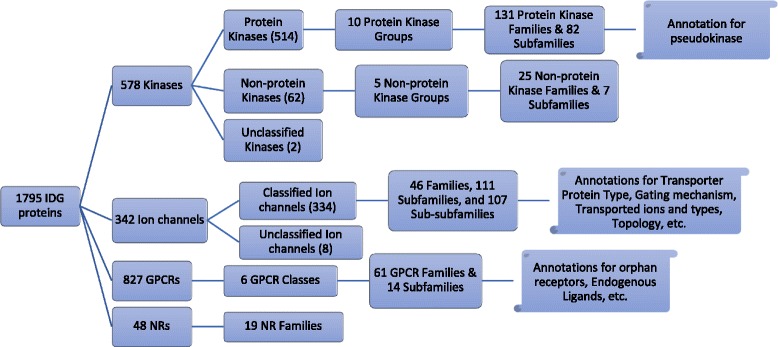
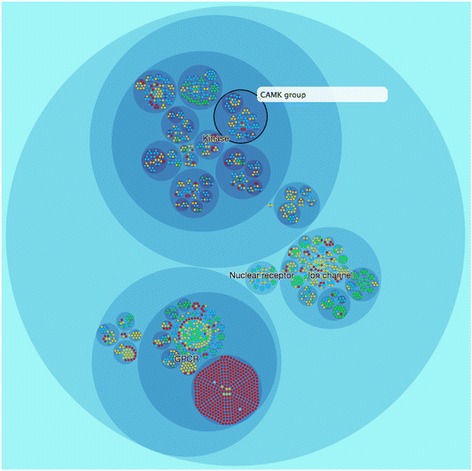
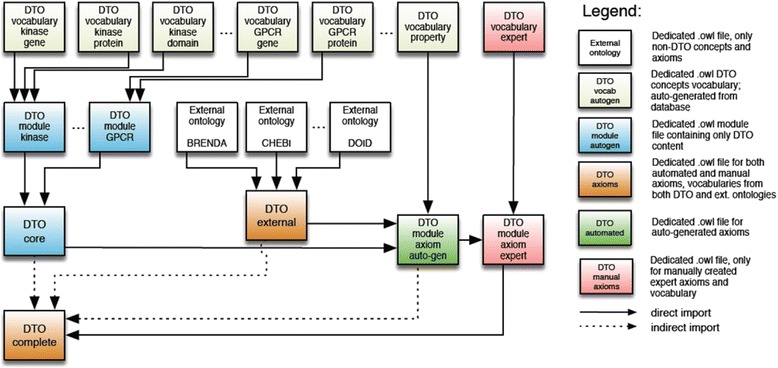
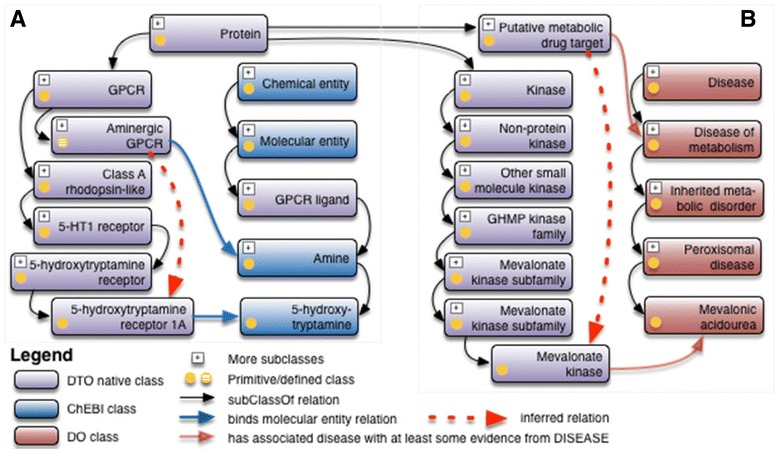
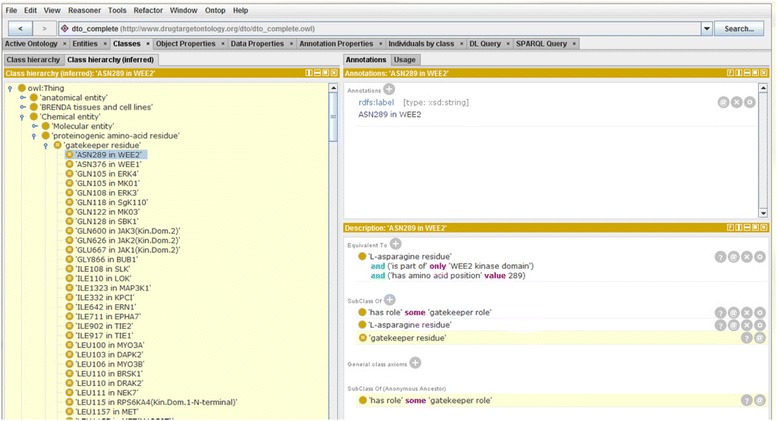
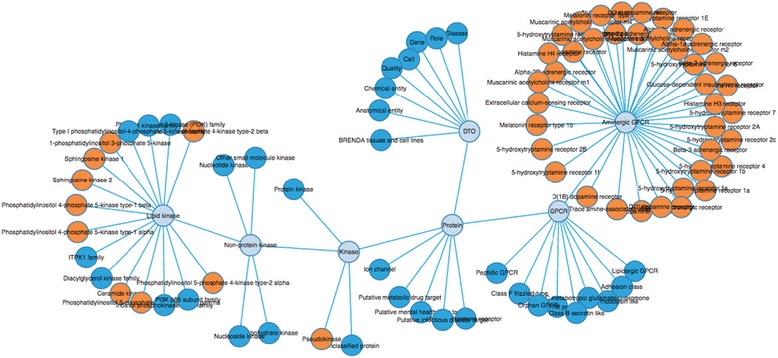
As part of that effort, we have developed a framework to integrate, navigate, and analyze drug discovery data based on formalized and standardized classifications and annotations of druggable protein targets, the Drug Target Ontology (DTO). DTO was constructed by extensive curation and consolidation of various resources. DTO classifies the four major drug target protein families, GPCRs, kinases, ion channels and nuclear receptors, based on phylogenecity, function, target development level, disease association, tissue expression, chemical ligand and substrate characteristics, and target-family specific characteristics. The formal ontology was built using a new software tool to auto-generate most axioms from a database while supporting manual knowledge acquisition. A modular, hierarchical implementation facilitate ontology development and maintenance and makes use of various external ontologies, thus integrating the DTO into the ecosystem of biomedical ontologies. As a formal OWL-DL ontology, DTO contains asserted and inferred axioms. Modeling data from the Library of Integrated Network-based Cellular Signatures (LINCS) program illustrates the potential of DTO for contextual data integration and nuanced definition of important drug target characteristics. DTO has been implemented in the IDG user interface Portal, Pharos and the TIN-X explorer of protein target disease relationships.
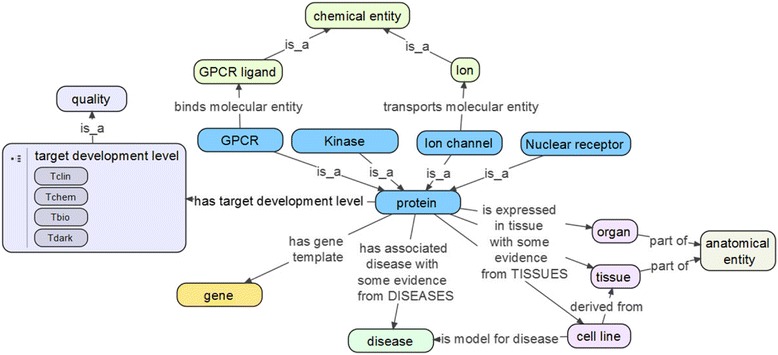
DTO was built based on the need for a formal semantic model for druggable targets including various related information such as protein, gene, protein domain, protein structure, binding site, small molecule drug, mechanism of action, protein tissue localization, disease association, and many other types of information. DTO will further facilitate the otherwise challenging integration and formal linking to biological assays, phenotypes, disease models, drug poly-pharmacology, binding kinetics and many other processes, functions and qualities that are at the core of drug discovery. The first version of DTO is publically available via the website http://drugtargetontology.org/ , Github ( http://github.com/DrugTargetOntology/DTO ), and the NCBO Bioportal ( http://bioportal.bioontology.org/ontologies/DTO ). The long-term goal of DTO is to provide such an integrative framework and to populate the ontology with this information as a community resource.
开发新型小分子疗法最成功的方法之一是从经过验证的可成药蛋白靶点入手。然而,只有一小部分潜在的可成药靶点吸引了大量的研发资源。“照亮可成药基因组”(IDG)项目开发相关资源,以推动对可能成为靶点但目前研究不足的潜在药物靶点的开发。IDG计划的一个核心组成部分是一个关于可成药基因组的综合知识资源。
作为这项工作的一部分,我们开发了一个框架,用于基于可成药蛋白靶点的形式化和标准化分类与注释(药物靶点本体论,DTO)来整合、浏览和分析药物发现数据。DTO是通过对各种资源进行广泛的整理和整合构建而成的。DTO根据系统发育、功能、靶点开发水平、疾病关联、组织表达、化学配体和底物特征以及靶点家族特异性特征,对四个主要的药物靶点蛋白家族(GPCR、激酶、离子通道和核受体)进行分类。这个形式化本体是使用一种新的软件工具构建的,该工具能从数据库自动生成大多数公理,同时支持人工知识获取。模块化的分层实现便于本体的开发和维护,并利用各种外部本体,从而将DTO整合到生物医学本体的生态系统中。作为一个形式化的OWL-DL本体,DTO包含断言公理和推理公理。对基于综合网络的细胞特征库(LINCS)项目的数据建模,说明了DTO在上下文数据整合以及对重要药物靶点特征进行细致定义方面的潜力。DTO已在IDG用户界面门户Pharos以及蛋白质靶点疾病关系的TIN-X浏览器中实现。
DTO是基于对可成药靶点的形式化语义模型的需求构建的,该模型包括各种相关信息,如蛋白质、基因、蛋白质结构域、蛋白质结构、结合位点、小分子药物、作用机制、蛋白质组织定位、疾病关联以及许多其他类型的信息。DTO将进一步促进原本具有挑战性的整合,并与生物测定、表型、疾病模型、药物多药理学、结合动力学以及许多其他药物发现核心的过程、功能和特性进行形式化链接。DTO的第一个版本可通过网站http://drugtargetontology.org/、Github(http://github.com/DrugTargetOntology/DTO)以及NCBO生物门户(http://bioportal.bioontology.org/ontologies/DTO)公开获取。DTO的长期目标是提供这样一个综合框架,并将这些信息作为社区资源填充到本体中。