Selby Kevin, Durand Marie-Anne, Gouveia Alexandre, Bosisio Francesca, Barazzetti Gaia, Hostettler Maxime, D'Acremont Valérie, Kaufmann Alain, von Plessen Christian
Center for Primary Care and Public Health (Unisanté), University of Lausanne, Lausanne, Switzerland.
University Toulouse III Paul Sabatier, Toulouse, France.
JMIR Form Res. 2020 Dec 3;4(12):e20871. doi: 10.2196/20871.
The success of government-recommended mitigation measures during the COVID-19 pandemic depends largely on information uptake and implementation by individual citizens.
Our aim was to assess citizens' knowledge and perceptions about COVID-19 recommendations in the Canton of Vaud, Switzerland.
A cross-sectional electronic survey with open and closed questions was disseminated by community-based partners prior to the relaxation of government restrictions. Outcomes included citizen knowledge (9-question measure) and worry about the virus, perception of government measures, and recommendations for improvements. Comparisons used linear regression, controlling for age, sex, education, and health literacy. Free-text answers were analyzed thematically.
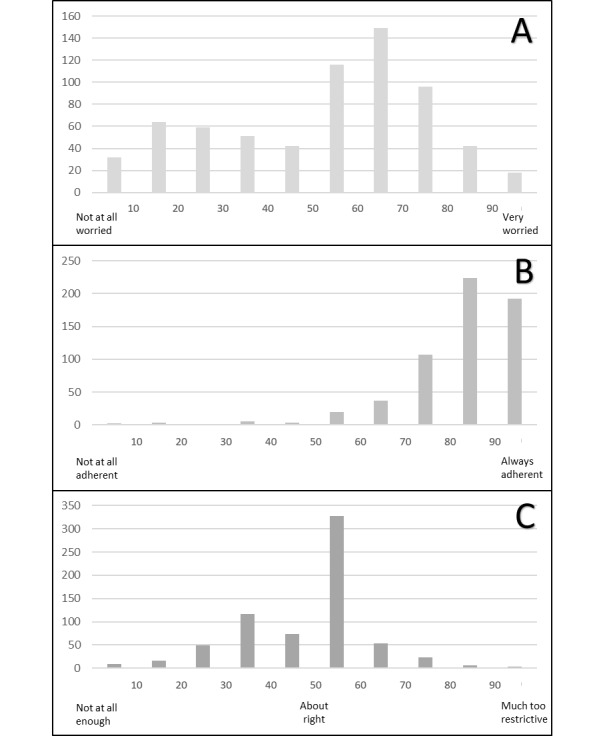
Of 807 people who accessed the survey, 684 (85%) completed all questions and 479 (60%) gave free-text recommendations. Overall, 75% were female, the mean age was 48 years, and 93% had high health literacy. Knowledge scores were high, with a median score of 8 out of 9. Mean levels of worry about the COVID-19 pandemic were higher in women than men (55/100 versus 44/100, P<.001), and in respondents with lower health literacy (57/100 versus 52/100, P=.03). Self-reported adherence to recommendations was high (85%) and increased with age and worry (both P<.001). Respondents rated their own adherence higher than others (85% versus 61%, P<.001). Moreover, 34% of respondents reported having self-quarantined; this rose to 52% for those aged ≥75 years. Those who had self-quarantined reported higher levels of fear. Nearly half (49%) of respondents felt the government response had been adequate, though younger age and higher levels of worry were associated with considering the response to be insufficient (both P<.001). Analysis of open-text answers revealed 4 major themes: access to and use of masks, gloves, and hand sanitizer; government messaging; lockdown and lockdown exit plan communication; and testing for COVID-19.
Knowledge, adherence, and satisfaction regarding government recommendations and response were high in this sample, but many desired greater access to personal protective equipment. Those with lower health literacy and those who have been in self-isolation reported greater concerns about the pandemic.
在新冠疫情期间,政府推荐的缓解措施的成功很大程度上取决于个体公民对信息的接受和实施情况。
我们的目的是评估瑞士沃州公民对新冠疫情相关建议的了解和看法。
在政府放宽限制之前,由社区合作伙伴开展了一项包含开放式和封闭式问题的横断面电子调查。结果包括公民的知识(9个问题的测量指标)、对病毒的担忧、对政府措施的看法以及改进建议。采用线性回归进行比较,并对年龄、性别、教育程度和健康素养进行控制。对自由文本答案进行主题分析。
在807名访问该调查的人中,684人(85%)完成了所有问题,479人(60%)给出了自由文本建议。总体而言,75%为女性,平均年龄为48岁,93%具有较高的健康素养。知识得分较高,中位数为9分中的8分。女性对新冠疫情的平均担忧程度高于男性(55/100对44/100,P<0.001),健康素养较低的受访者的担忧程度也更高(57/100对52/100,P = .03)。自我报告的对建议的遵守情况较高(85%),并且随着年龄和担忧程度的增加而增加(P均<0.001)。受访者对自己遵守情况的评分高于他人(85%对61%,P<0.001)。此外,34%的受访者报告进行了自我隔离;75岁及以上人群的这一比例升至52%。进行自我隔离的人报告的恐惧程度更高。近一半(49%)的受访者认为政府的应对措施是充分的,不过年龄较小和担忧程度较高与认为应对措施不足相关(P均<0.001)。对开放式文本答案的分析揭示了4个主要主题:口罩、手套和洗手液的获取与使用;政府信息传达;封锁及解封计划的沟通;以及新冠病毒检测。
在这个样本中,对政府建议和应对措施的了解、遵守和满意度较高,但许多人希望能更容易获得个人防护装备。健康素养较低的人群以及进行自我隔离的人群对疫情表现出更大的担忧。