Centre for Primary Health Care, University of Basel, Kantonsspital Baselland, Rheinstrasse 26, 4410, Liestal, Switzerland.
BMC Fam Pract. 2021 Sep 10;22(1):181. doi: 10.1186/s12875-021-01532-7.
In addition to the threat of the COVID-19 pandemic to physical health, mental health is challenged by the emotional response to the situation and the official measures taken to stop the pandemic. This study aimed to assess the prevalence of impaired mental well-being due to COVID-19 and explore associated factors.
The study was an observational, population-based, nationwide, cross-sectional online survey of a representative sample of the general Swiss population performed between March and April 2020. Participants reported on mental well-being, self-isolation/quarantine, their risk for developing severe COVID-19, and their work situation. Multivariable logistic regression analyses assessed risk factors for impaired mental well-being due to the pandemic.
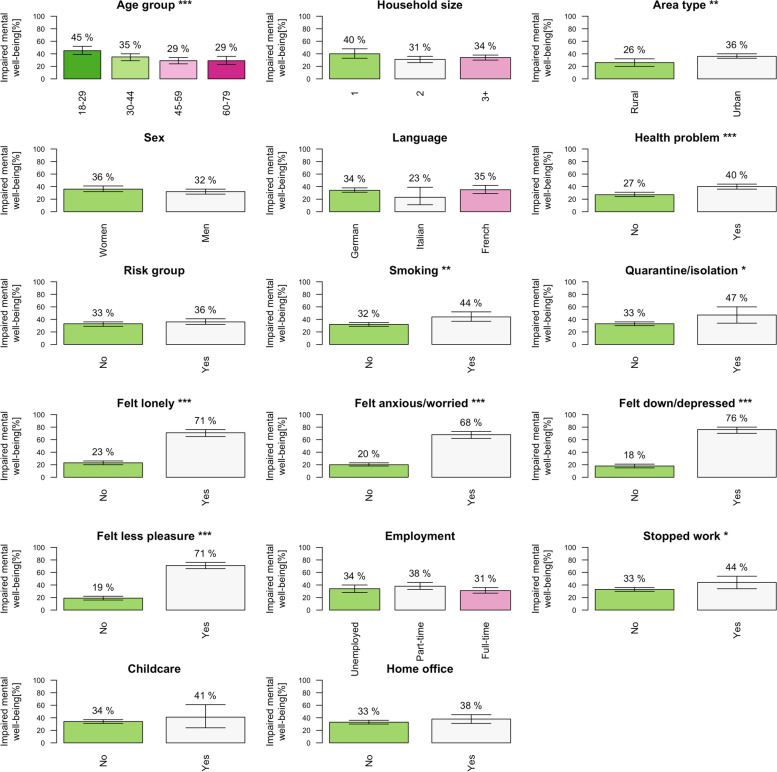
Data from 1022 individuals were analysed. The median age was 44 years (range 18 to 78) and 49% were women. A third of respondents reported that the COVID-19 pandemic impaired their mental well-being and almost half reported specific mental health concerns. Impaired mental well-being was associated with having health problems (OR = 1.88, 95% CI: 1.29-2.74, vs no problems), being or living with someone at risk for severe COVID-19 (OR = 1.38, 95% CI: 1-1.9,), smoking (OR = 1.8, 95% CI: 1.24-2.61), living in urban residential environments (OR = 1.62, 95% CI: 1.13-2.32, vs rural), not being able to work due to closed workplace (OR = 1.66, 95% CI: 1.04-2.67), aged between 18 and 29 years old (OR = 1.99, 95% CI: 1.32-3.01, vs 45 to 59 years old), and living in a single household (living with someone, OR = 0.65, 95% CI: 0.44-0.97,vs single household). Overall, the most significant covariates of impaired mental well-being were specific mental health concerns: feeling depressed (OR = 7.21, 95% CI: 4.5-11.55), feeling less pleasure in doing things than before (OR = 6.28, 95% CI: 4.1-9.62), feeling anxious (OR = 6.13, 95% CI: 3.91-9.59) and feeling lonely (OR = 4.08, 95% CI: 2.53-6.58).
Impaired mental well-being can carry long-term consequences. We encourage policymakers to implement strategies to promote mental health during this pandemic situation. Special attention should be addressed to the youngest, those at risk for severe COVID-19 and those with government-imposed work restrictions.
除了 COVID-19 大流行对身体健康的威胁外,人们对这一情况的情绪反应以及为阻止大流行而采取的官方措施也对心理健康构成了挑战。本研究旨在评估因 COVID-19 而导致心理健康受损的流行程度,并探讨相关因素。
这是一项在 2020 年 3 月至 4 月期间针对瑞士普通人群进行的具有观察性、基于人群的全国性横断面在线调查。参与者报告了他们的心理健康状况、自我隔离/检疫、他们患严重 COVID-19 的风险以及他们的工作状况。多变量逻辑回归分析评估了与大流行相关的心理健康受损的风险因素。
分析了 1022 名参与者的数据。中位年龄为 44 岁(范围 18 至 78 岁),其中 49%为女性。三分之一的受访者表示 COVID-19 大流行损害了他们的心理健康,近一半的人报告了特定的心理健康问题。心理健康受损与存在健康问题(OR=1.88,95%CI:1.29-2.74,vs 无问题)、有或与患严重 COVID-19 的风险人士同住(OR=1.38,95%CI:1-1.9,)、吸烟(OR=1.8,95%CI:1.24-2.61)、居住在城市居住环境(OR=1.62,95%CI:1.13-2.32,vs 农村)、因工作场所关闭而无法工作(OR=1.66,95%CI:1.04-2.67)、年龄在 18 至 29 岁(OR=1.99,95%CI:1.32-3.01,vs 45 至 59 岁)以及居住在单身家庭(与他人同住,OR=0.65,95%CI:0.44-0.97,vs 单身家庭)有关。总体而言,心理健康受损的最重要协变量是特定的心理健康问题:感到抑郁(OR=7.21,95%CI:4.5-11.55)、做事的乐趣比以前少(OR=6.28,95%CI:4.1-9.62)、感到焦虑(OR=6.13,95%CI:3.91-9.59)和感到孤独(OR=4.08,95%CI:2.53-6.58)。
心理健康受损可能会产生长期影响。我们鼓励政策制定者在这种大流行情况下实施促进心理健康的策略。应特别关注最年轻的人群、患严重 COVID-19 的风险人士和政府强制限制工作的人士。