Department of Biology, University of North Carolina at Chapel Hill, 250 Bell Tower Drive, Chapel Hill, NC 27599, USA.
Department of Biology, University of North Carolina at Chapel Hill, 250 Bell Tower Drive, Chapel Hill, NC 27599, USA; Curriculum in Genetics and Molecular Biology, University of North Carolina at Chapel Hill, Chapel Hill, NC, USA.
Curr Biol. 2021 Jan 11;31(1):220-227.e5. doi: 10.1016/j.cub.2020.10.008. Epub 2020 Nov 5.
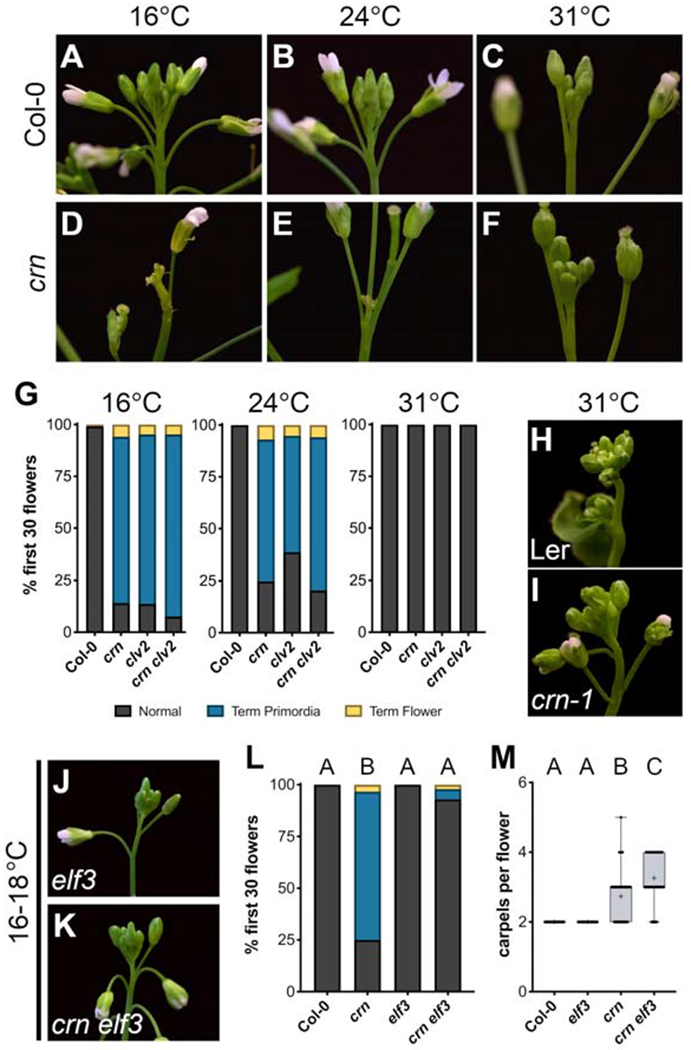
The ability to thrive in diverse environments requires that species maintain development and reproduction despite dynamic conditions. Many developmental processes are stabilized through robust signaling pathways that cooperatively ensure proper development. During reproduction, plants like Arabidopsis thaliana continuously generate flowers on growing indeterminate inflorescences. Flower primordia initiation and outgrowth depends on the hormone auxin and is robust across diverse environments. Here, we show that reproductive development under different thermal conditions requires the integration of multiple pathways regulating auxin-dependent flower production. In colder/ambient temperatures, the receptor complex CLAVATA2/CORYNE (CLV2/CRN) is necessary for continuous flower outgrowth during inflorescence development. CLV2/CRN signaling is independent of CLAVATA1 (CLV1)-related receptor signaling but involves the CLAVATA3 INSENSITIVE RECEPTOR KINASE (CIK) family co-receptors, with higher order cik mutant combinations phenocopying clv2/crn flower outgrowth defects. Developing crn inflorescences display reduced auxin signaling, and restoration of auxin biosynthesis is sufficient to restore flower outgrowth in colder and ambient temperatures. In contrast, at higher temperatures, both clv2/crn signaling and heat-induced auxin biosynthesis via YUCCA family genes are synergistically required to maintain flower development. Our work reveals a novel mechanism integrating peptide hormone and auxin signaling in the regulation of flower development across diverse thermal environments.
在多变的环境中茁壮成长的能力要求物种即使在动态条件下也要维持发育和繁殖。许多发育过程通过稳健的信号通路来稳定,这些通路协同作用以确保正常的发育。在繁殖过程中,拟南芥等植物在不断生长的不定花序上连续产生花朵。花原基的起始和生长取决于激素生长素,并且在各种环境中都很稳健。在这里,我们表明,在不同热条件下的生殖发育需要整合多个调节生长素依赖性花产生的途径。在较冷/环境温度下,受体复合物 CLAVATA2/CORYNE(CLV2/CRN)在花序发育过程中连续进行花生长所必需的。CLV2/CRN 信号传导独立于 CLAVATA1(CLV1)相关受体信号传导,但涉及 CLAVATA3 不敏感受体激酶(CIK)家族共受体,较高阶的 cik 突变体组合表现出与 clv2/crn 花生长缺陷相似的表型。发育中的 crn 花序显示出降低的生长素信号传导,并且生长素生物合成的恢复足以在较冷和环境温度下恢复花生长。相比之下,在较高温度下,clv2/crn 信号传导和通过 YUCCA 家族基因的热诱导生长素生物合成都需要协同作用以维持花的发育。我们的工作揭示了一种新的机制,该机制整合了肽激素和生长素信号在不同热环境下调节花发育的作用。