Key Lab of Chinese Medicine Resources Conservation, State Administration of Traditional Chinese Medicine of China, Institute of Medicinal Plant Development, Chinese Academy of Medical Sciences & Peking Union Medical College, Beijing 100193, China; Engineering Research Center of Chinese Medicine Resource, Ministry of Education, Beijing 100193, China.
Key Lab of Chinese Medicine Resources Conservation, State Administration of Traditional Chinese Medicine of China, Institute of Medicinal Plant Development, Chinese Academy of Medical Sciences & Peking Union Medical College, Beijing 100193, China.
Genomics Proteomics Bioinformatics. 2020 Jun;18(3):230-240. doi: 10.1016/j.gpb.2020.06.002. Epub 2020 Nov 4.
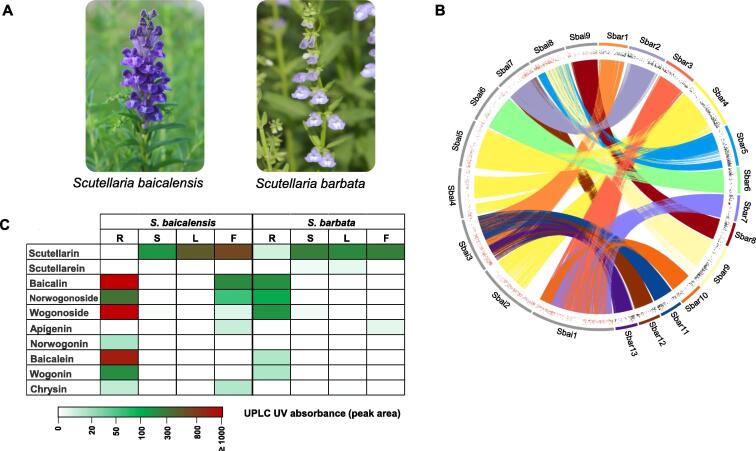
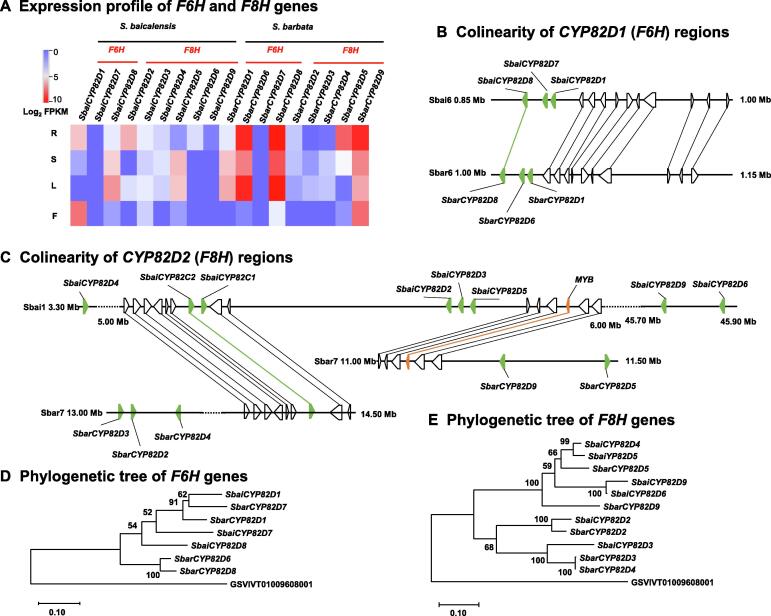
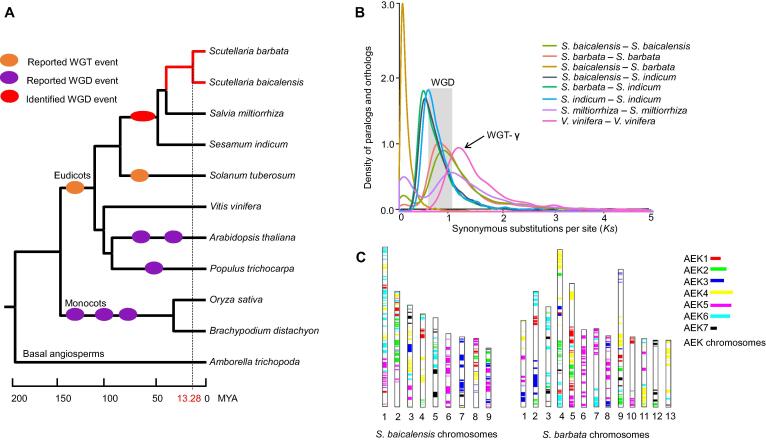
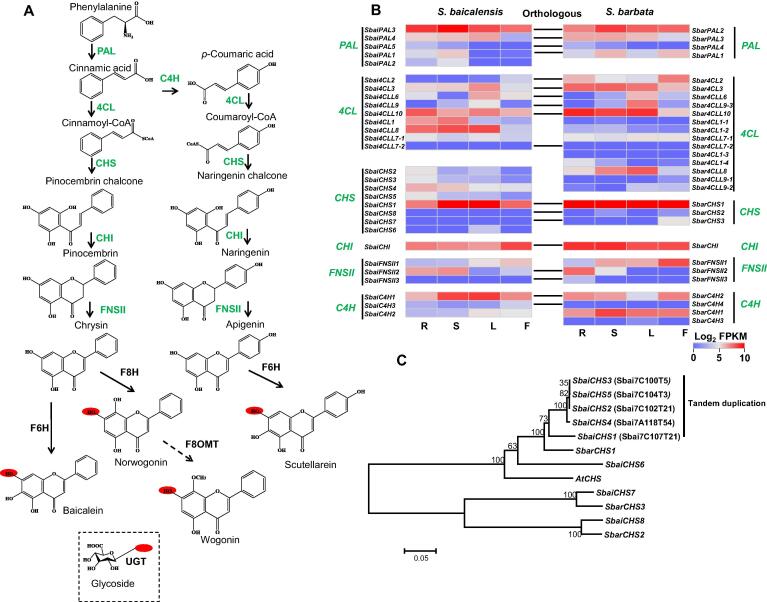
Scutellaria baicalensis (S. baicalensis) and Scutellaria barbata (S. barbata) are common medicinal plants of the Lamiaceae family. Both produce specific flavonoid compounds, including baicalein, scutellarein, norwogonin, and wogonin, as well as their glycosides, which exhibit antioxidant and antitumor activities. Here, we report chromosome-level genome assemblies of S. baicalensis and S. barbata with quantitative chromosomal variation (2n = 18 and 2n = 26, respectively). The divergence of S. baicalensis and S. barbata occurred far earlier than previously reported, and a whole-genome duplication (WGD) event was identified. The insertion of long terminal repeat elements after speciation might be responsible for the observed chromosomal expansion and rearrangement. Comparative genome analysis of the congeneric species revealed the species-specific evolution of chrysin and apigenin biosynthetic genes, such as the S. baicalensis-specific tandem duplication of genes encoding phenylalanine ammonia lyase and chalcone synthase, and the S. barbata-specific duplication of genes encoding 4-CoA ligase. In addition, the paralogous duplication, colinearity, and expression diversity of CYP82D subfamily members revealed the functional divergence of genes encoding flavone hydroxylase between S. baicalensis and S. barbata. Analyzing these Scutellaria genomes reveals the common and species-specific evolution of flavone biosynthetic genes. Thus, these findings would facilitate the development of molecular breeding and studies of biosynthesis and regulation of bioactive compounds.
黄芩(Scutellaria baicalensis)和夏枯草(Scutellaria barbata)是唇形科常见的药用植物。它们都产生特定的类黄酮化合物,包括黄芩素、黄芩苷、汉黄芩素和汉黄芩苷,以及它们的糖苷,具有抗氧化和抗肿瘤活性。在这里,我们报道了黄芩和夏枯草的染色体水平基因组组装,具有定量染色体变异(分别为 2n=18 和 2n=26)。黄芩和夏枯草的分化发生的时间远远早于之前的报道,并且鉴定出了一个全基因组加倍(WGD)事件。物种形成后长末端重复元件的插入可能是导致观察到的染色体扩张和重排的原因。对同属物种的比较基因组分析揭示了白杨素和芹菜素生物合成基因的种间特异性进化,例如编码苯丙氨酸解氨酶和查尔酮合酶的基因在黄芩中特异性串联重复,以及编码 4-辅酶 A 连接酶的基因在夏枯草中特异性重复。此外,CYP82D 亚家族成员的基因复制、共线性和表达多样性揭示了黄芩和夏枯草中黄酮羟化酶编码基因的功能分化。因此,这些发现将有助于分子育种的发展以及生物活性化合物的生物合成和调控的研究。