Zhang Kai-Ping, Fang Xiang, Zhang Yin, Chao Min
Department of Urology, Anhui Provincial Children's Hospital and Children's Hospital of Anhui Medical University, Hefei, Anhui, P. R. China.
Medicine (Baltimore). 2020 Nov 6;99(45):e21563. doi: 10.1097/MD.0000000000021563.
Previous studies examining the safety and efficacy of Q-value-guided laser-assisted in situ keratomileusis (LASIK) for treating myopia have yielded inconsistent results. We, therefore, performed a meta-analysis to clarify this issue METHODS:: Various databases were conducted up to November 21, 2018. All randomized controlled trials and cohorts that compared Q-value-guided LASIK with standard LASIK were selected. Mean differences (MDs) or odds ratios (ORs) with 95% confidence intervals (CIs) were calculated to evaluate the strength of the correlations. Additionally, different subgroup analyses and publication bias tests were performed. Data were extracted including the number of postoperative uncorrected visual acuity (UCVA) of 20/20 or better, postoperative UCVA, preoperative and postoperative Q-value, postoperative refractive spherical equivalent (SE), the number of postoperative SE within ±0.5D, higher order aberration (HOA), coma-like aberration and spherical-like aberration.
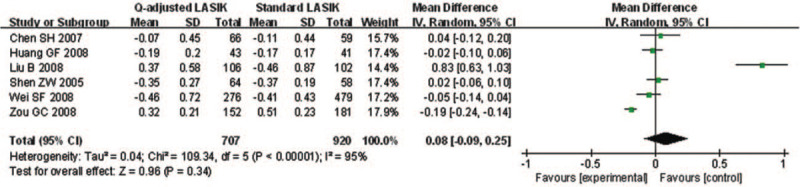
A total of seventeen studies with 2640 patients and 3,358 eyes were included. It has been shown that postoperative Q-value (MD = -0.42; 95% CI: -0.64, -0.21; P < .001), HOA (MD = -0.14; 95% CI: -0.23, -0.06; P = .001), spherical-like aberration (MD = -0.19; 95% CI: -0.32, -0.06; P = .004) rather than postoperative UCVA (MD = 0.04; 95% CI: 0.01, 0.07; P = .012) were significantly better in the Q-value-guided LASIK than standard LASIK. However, the pooled results revealed that no significant differences were found between the 2 paired groups of postoperative UCVA of 20/20 or better (OR = 1.09; 95% CI: 0.62, 1.92; P = .763), preoperative Q-value (MD = -0.00; 95% CI: -0.02, 0.02; P = .922), postoperative refractive SE (MD = 0.08; 95% CI: -0.09, 0.25; P = .336), coma-like aberration (horizontal: MD = -0.00; 95% CI: -0.03, 0.03; P = .966; vertical: MD = -0.01; 95% CI: -0.03, 0.01; P = .263) and postoperative SE within ±0.5 D (OR = 1.06; 95% CI: 0.48, 2.33; P = .886). Likewise, similar results were detected in some corresponding subgroups.
Q-value-guided LASIK is a safe, effective and predictable surgical option for treating myopia, especially showing superiority over standard LASIK in postoperative Q-value, HOA and spherical-like aberration. However, more detailed studies are required to confirm our conclusions in advanced researches.
以往关于Q值引导的准分子原位角膜磨镶术(LASIK)治疗近视的安全性和有效性的研究结果并不一致。因此,我们进行了一项荟萃分析以阐明这一问题。
检索截至2018年11月21日的各种数据库。选择所有比较Q值引导的LASIK与标准LASIK的随机对照试验和队列研究。计算95%置信区间(CI)的平均差(MD)或比值比(OR)以评估相关性强度。此外,进行了不同的亚组分析和发表偏倚检验。提取的数据包括术后最佳矫正视力(UCVA)达到或优于20/20的人数、术后UCVA、术前和术后Q值、术后等效球镜度(SE)、术后SE在±0.5D范围内的人数、高阶像差(HOA)、彗差样像差和球差样像差。
共纳入17项研究,涉及2640例患者和3358只眼。结果显示,与标准LASIK相比,Q值引导的LASIK术后Q值(MD = -0.42;95% CI:-0.64,-0.21;P <.001)、HOA(MD = -0.14;95% CI:-0.23,-0.06;P =.001)、球差样像差(MD = -0.19;95% CI:-0.32,-0.06;P =.004)明显更好。然而,汇总结果显示,术后UCVA达到或优于20/20的两组配对组之间(OR = 1.09;95% CI:0.62,1.92;P =.763)、术前Q值(MD = -0.00;95% CI:-0.02,0.02;P =.922)、术后屈光SE(MD = 0.08;95% CI:-0.09,0.25;P =.336)、彗差样像差(水平:MD = -0.00;95% CI:-0.03,0.03;P =.966;垂直:MD = -0.01;95% CI:-0.03,0.01;P =.263)以及术后SE在±0.5D范围内(OR = 1.06;95% CI:0.48,2.33;P =.886)均未发现显著差异。同样,在一些相应亚组中也检测到类似结果。
Q值引导的LASIK是一种安全、有效且可预测的治疗近视的手术选择,尤其在术后Q值、HOA和球差样像差方面优于标准LASIK。然而,需要更详细的研究在进一步的研究中证实我们的结论。