National Engineering Research Center for Marine Aquaculture, Zhejiang Ocean University, Zhoushan, 316022, China.
National Engineering Laboratory of Marine Germplasm Resources Exploration and Utilization, Zhejiang Ocean University, Zhoushan, 316022, China.
Sci Rep. 2020 Nov 6;10(1):19277. doi: 10.1038/s41598-020-76410-w.
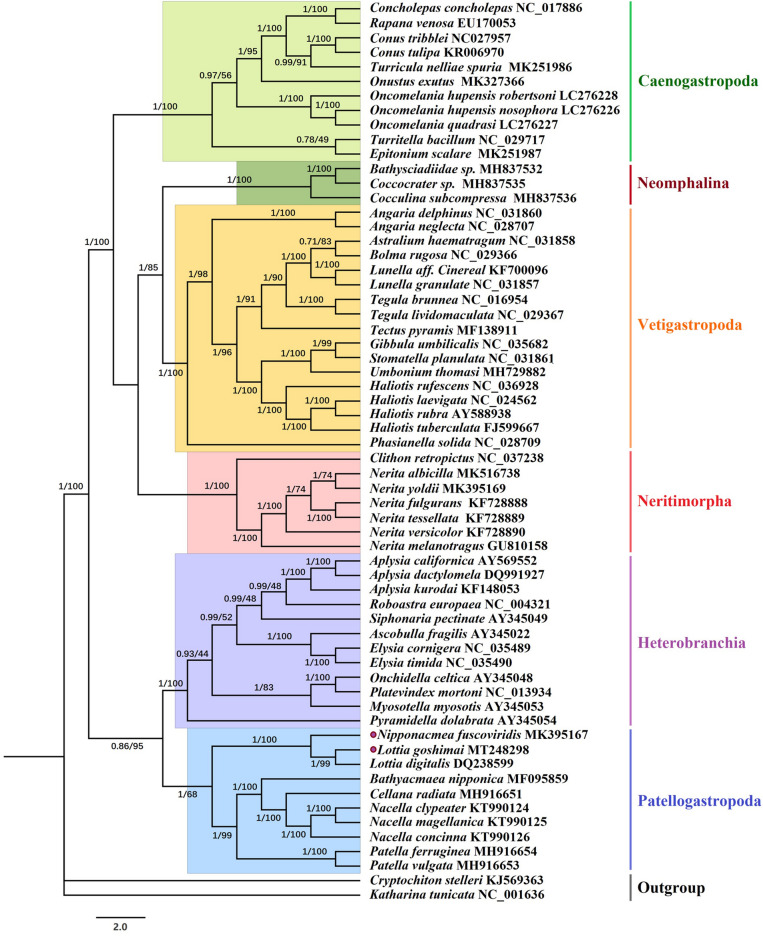
To improve the systematics and taxonomy of Patellogastropoda within the evolution of gastropods, we determined the complete mitochondrial genome sequences of Lottia goshimai and Nipponacmea fuscoviridis in the family Lottiidae, which presented sizes of 18,192 bp and 18,720 bp, respectively. In addition to 37 common genes among metazoa, we observed duplication of the trnM gene in L. goshimai and the trnM and trnW genes in N. fuscoviridis. The highest A + T contents of the two species were found within protein-coding genes (59.95% and 54.55%), followed by rRNAs (56.50% and 52.44%) and tRNAs (56.42% and 52.41%). trnS1 and trnS2 could not form the canonical cloverleaf secondary structure due to the lack of a dihydrouracil arm in both species. The gene arrangements in all Patellogastropoda compared with those of ancestral gastropods showed different levels of gene rearrangement, including the shuffling, translocation and inversion of single genes or gene fragments. This kind of irregular rearrangement is particularly obvious in the Lottiidae family. The results of phylogenetic and gene rearrangement analyses showed that L. goshimai and Lottia digitalis clustered into one group, which in turn clustered with N. fuscoviridis in Patellogastropoda. This study demonstrates the significance of complete mitogenomes for phylogenetic analysis and enhances our understanding of the evolution of Patellogastropoda.
为了提高腹足纲中盘螺总科的系统发生和分类学地位,我们测定了盘螺科的高氏鲍螺和褐带鲍螺的完整线粒体基因组序列,大小分别为 18192bp 和 18720bp。除后生动物共有 37 个基因外,我们还观察到高氏鲍螺的 trnM 基因和褐带鲍螺的 trnM 和 trnW 基因发生了重复。这两个物种的两条序列中,蛋白编码基因的 A + T 含量最高(分别为 59.95%和 54.55%),其次是 rRNA(56.50%和 52.44%)和 tRNA(56.42%和 52.41%)。由于两种物种的 trnS1 和 trnS2 都缺乏二氢尿嘧啶臂,因此无法形成典型的三叶形二级结构。与祖先进化的腹足类相比,所有盘螺总科的基因排列都显示出不同程度的基因重排,包括单个基因或基因片段的重排、易位和倒位。这种不规则的重排在盘螺科中尤为明显。系统发育和基因重排分析的结果表明,高氏鲍螺和鲍螺属数字螺聚为一组,然后与褐带鲍螺一起聚为盘螺总科。本研究表明完整的线粒体基因组在系统发生分析中的重要性,增强了我们对盘螺总科进化的理解。