Key Laboratory of Information Fusion Technology of Ministry of Education, School of Automation, Northwestern Polytechnical University, 127 West Youyi Road, Xi'an, 710072, Shaanxi, China.
NCMIS, CEMS, RCSDS, Academy of Mathematics and Systems Science, Chinese Academy of Sciences, 55 Zhongguancun East Road, Beijing, 10090, China.
BMC Bioinformatics. 2020 Nov 7;21(1):507. doi: 10.1186/s12859-020-03844-4.
Enhancer-promoter interactions (EPIs) play key roles in transcriptional regulation and disease progression. Although several computational methods have been developed to predict such interactions, their performances are not satisfactory when training and testing data from different cell lines. Currently, it is still unclear what extent a across cell line prediction can be made based on sequence-level information.
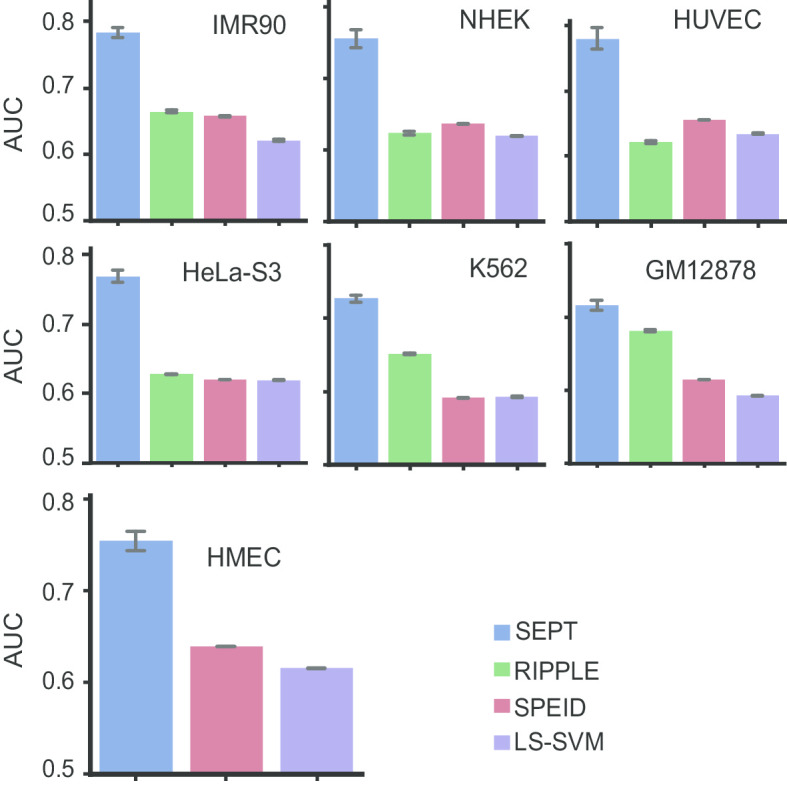
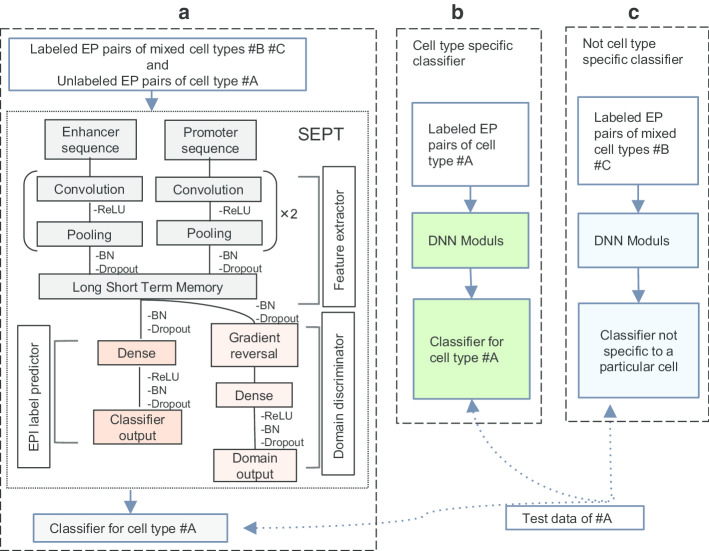
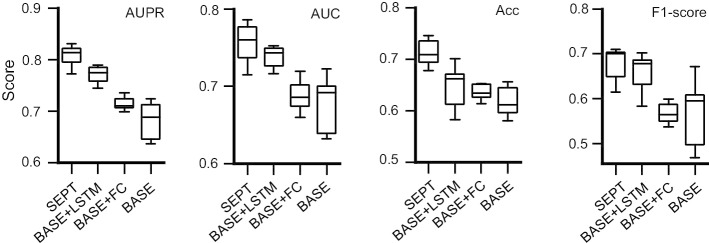
In this work, we present a novel Sequence-based method (called SEPT) to predict the enhancer-promoter interactions in new cell line by using the cross-cell information and Transfer learning. SEPT first learns the features of enhancer and promoter from DNA sequences with convolutional neural network (CNN), then designing the gradient reversal layer of transfer learning to reduce the cell line specific features meanwhile retaining the features associated with EPIs. When the locations of enhancers and promoters are provided in new cell line, SEPT can successfully recognize EPIs in this new cell line based on labeled data of other cell lines. The experiment results show that SEPT can effectively learn the latent import EPIs-related features between cell lines and achieves the best prediction performance in terms of AUC (the area under the receiver operating curves).
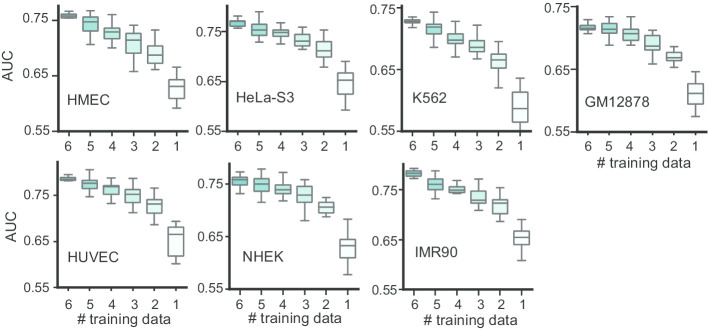
SEPT is an effective method for predicting the EPIs in new cell line. Domain adversarial architecture of transfer learning used in SEPT can learn the latent EPIs shared features among cell lines from all other existing labeled data. It can be expected that SEPT will be of interest to researchers concerned with biological interaction prediction.
增强子-启动子相互作用(EPIs)在转录调控和疾病进展中起着关键作用。尽管已经开发了几种计算方法来预测这种相互作用,但当训练和测试数据来自不同细胞系时,它们的性能并不令人满意。目前,基于序列信息可以在多大程度上进行跨细胞系预测仍不清楚。
在这项工作中,我们提出了一种新的基于序列的方法(称为 SEPT),通过使用跨细胞信息和迁移学习来预测新细胞系中的增强子-启动子相互作用。SEPT 首先使用卷积神经网络(CNN)从 DNA 序列中学习增强子和启动子的特征,然后设计迁移学习的梯度反转层来减少细胞系特有的特征,同时保留与 EPIs 相关的特征。当新细胞系中提供了增强子和启动子的位置时,SEPT 可以基于其他细胞系的标记数据成功识别新细胞系中的 EPIs。实验结果表明,SEPT 可以有效地学习细胞系之间潜在的重要 EPIs 相关特征,并在 AUC(接收者操作曲线下的面积)方面达到最佳的预测性能。
SEPT 是一种预测新细胞系中 EPIs 的有效方法。迁移学习中使用的对抗性域架构可以从所有其他现有标记数据中学习细胞系之间共享的潜在 EPIs 特征。可以预期,SEPT 将引起关注生物相互作用预测的研究人员的兴趣。