Emergency and Critical Care Center, Kurashiki Central Hospital, 1-1-1 Miwa, Kurashiki, Okayama, 710-8602, Japan.
Division of General Internal Medicine, Department of Medicine, Medical College of Wisconsin, Milwaukee, USA.
Crit Care. 2020 Nov 7;24(1):640. doi: 10.1186/s13054-020-03358-8.
Clinical practice guidelines recommend performing a cuff leak test in mechanically ventilated adults who meet extubation criteria to screen those at high risk for post-extubation stridor. Previous systematic reviews demonstrated excellent specificity of the cuff leak test but disagreed with respect to sensitivity. We conducted a systematic review and meta-analysis to assess the diagnostic accuracy of the cuff leak test for predicting post-extubation airway complications in intubated adult patients in critical care settings.
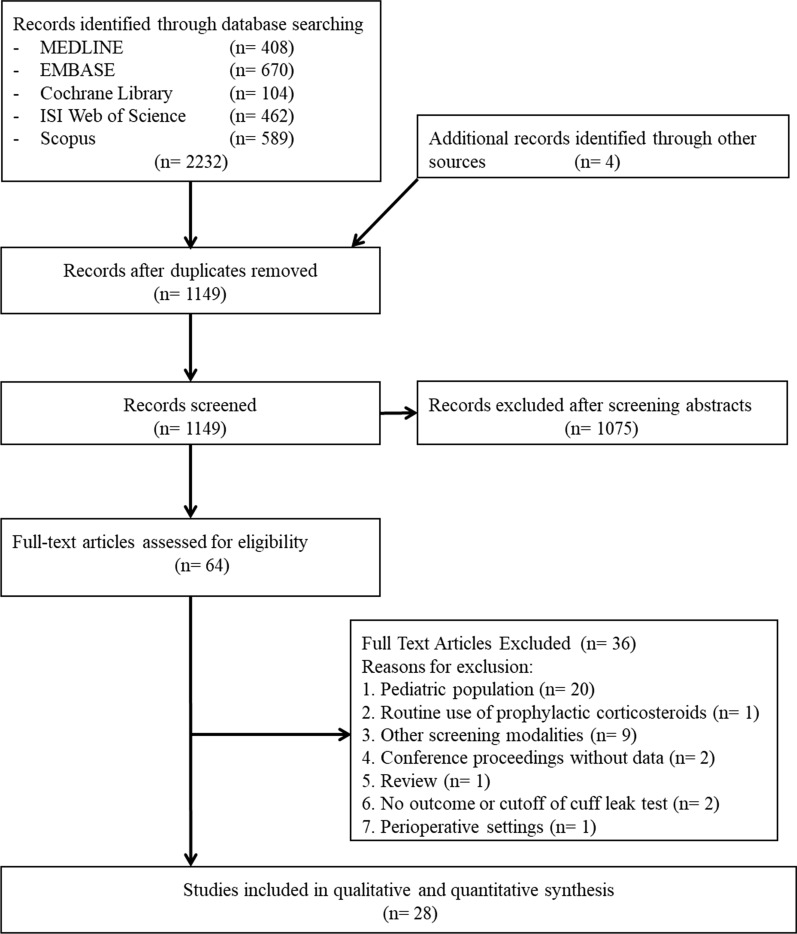
We searched Medline, EMBASE, Scopus, ISI Web of Science, the Cochrane Library for eligible studies from inception to March 16, 2020, without language restrictions. We included studies that examined the diagnostic accuracy of cuff leak test if post-extubation airway obstruction after extubation or reintubation was explicitly reported as the reference standard. Two authors in duplicate and independently assessed the risk of bias using the Quality Assessment for Diagnostic Accuracy Studies-2 tool. We pooled sensitivities and specificities using generalized linear mixed model approach to bivariate random-effects meta-analysis. Our primary outcomes were post-extubation airway obstruction and reintubation.
We included 28 studies involving 4493 extubations. Three studies were at low risk for all QUADAS-2 risk of bias domains. The pooled sensitivity and specificity of cuff leak test for post-extubation airway obstruction were 0.62 (95% CI 0.49-0.73; I = 81.6%) and 0.87 (95% CI 0.82-0.90; I = 97.8%), respectively. The pooled sensitivity and specificity of the cuff leak test for reintubation were 0.66 (95% CI 0.46-0.81; I = 48.9%) and 0.88 (95% CI 0.83-0.92; I = 87.4%), respectively. Subgroup analyses suggested that the type of cuff leak test and length of intubation might be the cause of statistical heterogeneity of sensitivity and specificity, respectively, for post-extubation airway obstruction.
The cuff leak test has excellent specificity but moderate sensitivity for post-extubation airway obstruction. The high specificity suggests that clinicians should consider intervening in patients with a positive test, but the low sensitivity suggests that patients still need to be closely monitored post-extubation.
临床实践指南建议对符合拔管标准的机械通气成人进行套囊漏液试验,以筛选出有拔管后喘鸣风险的高危人群。先前的系统评价显示套囊漏液试验具有很好的特异性,但在敏感性方面存在分歧。我们进行了一项系统评价和荟萃分析,以评估套囊漏液试验在预测重症监护室插管成人患者拔管后气道并发症方面的诊断准确性。
我们从建库到 2020 年 3 月 16 日,在 Medline、EMBASE、Scopus、ISI Web of Science 和 Cochrane 图书馆中,对符合条件的研究进行了无语言限制的检索。我们纳入了明确报告拔管后气道梗阻(作为参考标准)后进行套囊漏液试验的研究。两名作者独立地对偏倚风险使用 QUADAS-2 工具进行了评估。我们使用广义线性混合模型方法对二变量随机效应荟萃分析进行了敏感性和特异性的汇总。我们的主要结局是拔管后气道梗阻和再插管。
我们纳入了 28 项研究,涉及 4493 例拔管。有 3 项研究在 QUADAS-2 的所有偏倚风险领域均为低风险。套囊漏液试验对拔管后气道梗阻的敏感性和特异性分别为 0.62(95%置信区间 0.49-0.73;I=81.6%)和 0.87(95%置信区间 0.82-0.90;I=97.8%)。套囊漏液试验对再插管的敏感性和特异性分别为 0.66(95%置信区间 0.46-0.81;I=48.9%)和 0.88(95%置信区间 0.83-0.92;I=87.4%)。亚组分析表明,套囊漏液试验的类型和插管时间可能是导致拔管后气道梗阻的敏感性和特异性存在统计学异质性的原因。
套囊漏液试验对拔管后气道梗阻具有很好的特异性,但敏感性中等。高特异性提示临床医生应考虑对试验阳性的患者进行干预,但低敏感性提示患者仍需密切监测拔管后情况。