School of Medicine, Vita-Salute San Raffaele University, Milan, Italy.
IRCCS San Raffaele Scientific Institute, Milan, Italy.
Clin Nutr. 2021 Apr;40(4):2420-2426. doi: 10.1016/j.clnu.2020.10.043. Epub 2020 Oct 29.
BACKGROUND & AIMS: Coronavirus disease 2019 (COVID-19) may associate with clinical manifestations, ranging from alterations in smell and taste to severe respiratory distress requiring intensive care, that might associate with weight loss and malnutrition. We aimed to assess the incidence of unintentional weight loss and malnutrition in COVID-19 survivors.
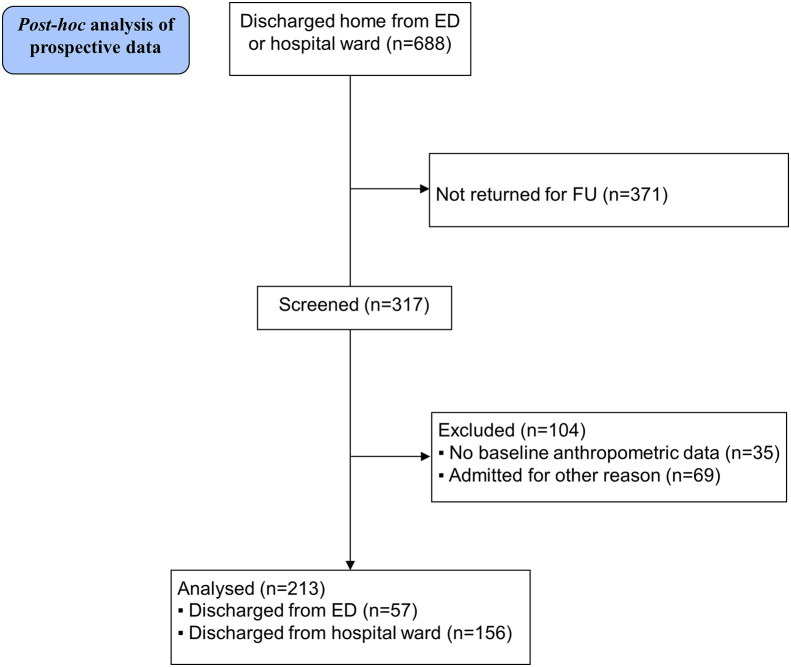
In this post-hoc analysis of a prospective observational cohort study, we enrolled all adult (age ≥18 years) patients with a confirmed diagnosis of COVID-19 who had been discharged home from either a medical ward or the Emergency Department of San Raffaele University Hospital, and were re-evaluated after remission at the Outpatient COVID-19 Follow-Up Clinic of the same Institution from April 7, 2020, to May 11, 2020. Demographic, anthropometric, clinical and biochemical parameters upon admission were prospectively collected. At follow-up, anthropometrics, the mini nutritional assessment screening and a visual analogue scale for appetite were assessed.
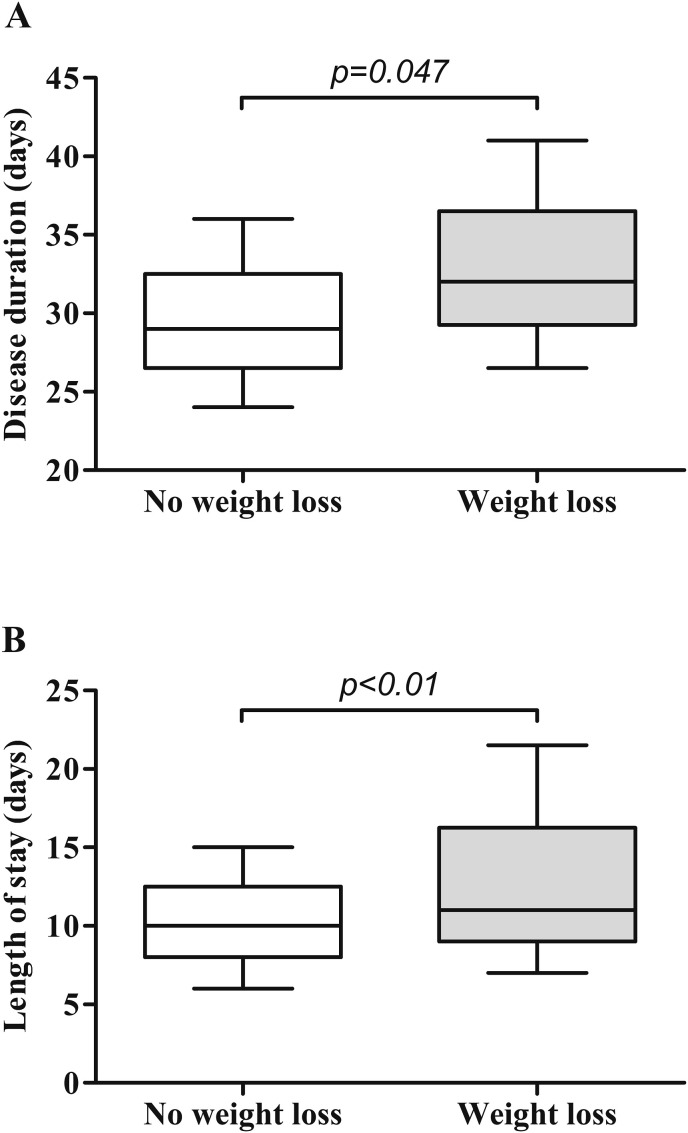
A total of 213 patients were included in the analysis (33% females, median age 59.0 [49.5-67.9] years, 70% overweight/obese upon initial assessment, 73% hospitalised). Sixty-one patients (29% of the total, and 31% of hospitalised patients vs. 21% of patients managed at home, p = 0.14) had lost >5% of initial body weight (median weight loss 6.5 [5.0-9.0] kg, or 8.1 [6.1-10.9]%). Patients who lost weight had greater systemic inflammation (C-reactive protein 62.9 [29.0-129.5] vs.48.7 [16.1-96.3] mg/dL; p = 0.02), impaired renal function (23.7% vs. 8.7% of patients; p = 0.003) and longer disease duration (32 [27-41] vs. 24 [21-30] days; p = 0.047) as compared with those who did not lose weight. At multivariate logistic regression analysis, only disease duration independently predicted weight loss (OR 1.05 [1.01-1.10] p = 0.022).
COVID-19 might negatively impact body weight and nutritional status. In COVID-19 patients, nutritional evaluation, counselling and treatment should be implemented at initial assessment, throughout the course of disease, and after clinical remission. CLINICALTRIALS.
NCT04318366.
新型冠状病毒病 2019(COVID-19)可能与临床症状相关,从嗅觉和味觉改变到需要重症监护的严重呼吸窘迫,这可能与体重减轻和营养不良有关。我们旨在评估 COVID-19 幸存者中意外体重减轻和营养不良的发生率。
在这项前瞻性观察队列研究的事后分析中,我们招募了所有从圣拉斐尔大学医院的内科病房或急诊科出院的成年(年龄≥18 岁)确诊 COVID-19 患者,并在 2020 年 4 月 7 日至 2020 年 5 月 11 日从同一机构的门诊 COVID-19 随访诊所康复后进行随访。前瞻性收集入院时的人口统计学、人体测量、临床和生化参数。在随访时,评估人体测量、微型营养评估筛查和食欲的视觉模拟量表。
共纳入 213 例患者进行分析(33%为女性,中位年龄 59.0[49.5-67.9]岁,70%初始评估时超重/肥胖,73%住院)。61 例患者(占总数的 29%,住院患者占 31%,门诊患者占 21%,p=0.14)体重减轻超过 5%(体重减轻中位数为 6.5[5.0-9.0]kg,或 8.1[6.1-10.9]%)。体重减轻的患者有更高的全身炎症(C 反应蛋白 62.9[29.0-129.5]与 48.7[16.1-96.3]mg/dL;p=0.02)、肾功能受损(23.7%与 8.7%的患者;p=0.003)和更长的疾病持续时间(32[27-41]与 24[21-30]天;p=0.047)。与未体重减轻的患者相比。多元逻辑回归分析显示,只有疾病持续时间独立预测体重减轻(OR 1.05[1.01-1.10],p=0.022)。
COVID-19 可能会对体重和营养状况产生负面影响。在 COVID-19 患者中,应在初始评估时、整个疾病过程中和临床缓解后进行营养评估、咨询和治疗。临床试验。
NCT04318366。