Canada Excellence Research Chair on the Microbiome-Endocannabinoidome Axis in Metabolic Health, Université Laval, Canada; Joint International Unit between Université Laval and Consiglio Nazionale delle Ricerche of Italy on Chemical and Biomolecular Research on the Microbiome and its Impact on Metabolic Health and Nutrition, Istituto di Chimica Biomolecolare, CNR, Pozzuoli (NA), Italy.
Dialogues Clin Neurosci. 2020 Sep;22(3):259-269. doi: 10.31887/DCNS.2020.22.3/vdimarzo.
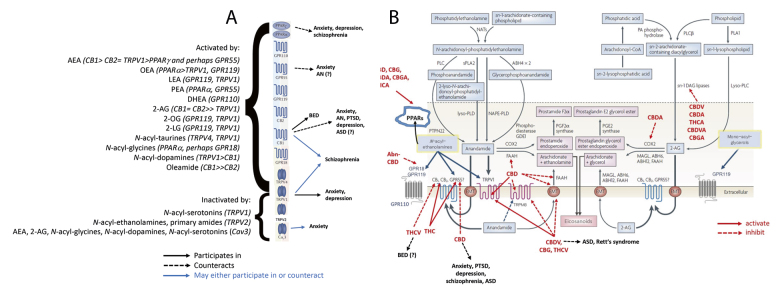
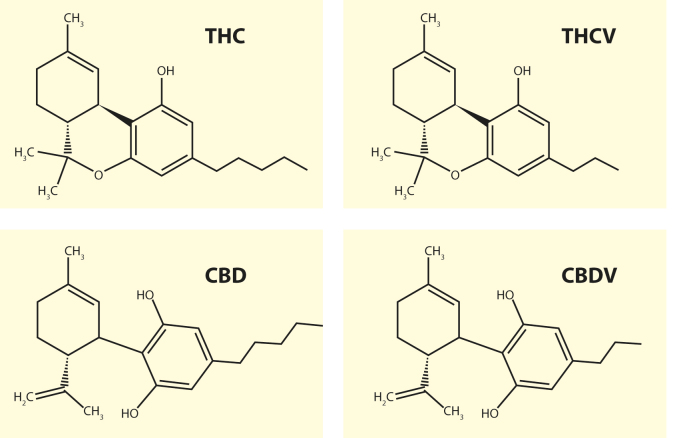
The endocannabinoid (eCB) system encompasses the eCBs anandamide and 2-arachidonoylglycerol, their anabolic/catabolic enzymes, and the cannabinoid CB and CB receptors. Its expansion to include several eCB-like lipid mediators, their metabolic enzymes, and their molecular targets, forms the endocannabinoidome (eCBome). This complex signaling system is deeply involved in the onset, progress, and symptoms of major neuropsychiatric disorders and provides a substrate for future therapeutic drugs against these diseases. Such drugs may include not only THC, the major psychotropic component of cannabis, but also other, noneuphoric plant cannabinoids. These compounds, unlike THC, possess a wide therapeutic window, possibly due to their capability of hitting several eCBome and non-eCBome receptors. This is particularly true for cannabidiol, which is one of the most studied cannabinoids and shows promise for the treatment of a wide range of mental and mood disorders. The eCBome plays a role also in the microbiota-gut-brain axis, which is emerging as an important actor in the control of affective and cognitive functions and in their pathological alterations. .
内源性大麻素(eCB)系统包括内源性大麻素大麻酚和 2-花生四烯酸甘油,它们的合成/分解酶,以及大麻素 CB1 和 CB2 受体。它的扩展包括几种内源性大麻素样脂质介质、它们的代谢酶及其分子靶点,形成了内源性大麻素组(eCBome)。这个复杂的信号系统深深涉及到主要神经精神疾病的发病、进展和症状,并为针对这些疾病的未来治疗药物提供了基础。这类药物不仅可能包括大麻的主要精神活性成分四氢大麻酚(THC),还可能包括其他非致幻的植物大麻素。这些化合物与 THC 不同,具有较宽的治疗窗,可能是由于它们能够作用于多个 eCBome 和非 eCBome 受体。这对于大麻二酚尤其如此,它是研究最多的大麻素之一,有望治疗广泛的精神和情绪障碍。内源性大麻素组还在微生物群-肠道-大脑轴中发挥作用,该轴作为控制情感和认知功能及其病理改变的重要因素正在出现。