Endocannabinoid Research Group, Institute of Biomolecular Chemistry, National Research Council, Via Campi Flegrei 34, 80078 Pozzuoli (NA), Italy.
Department of Biomolecular Sciences, University of Urbino " Carlo Bo", 61029 Urbino, Italy.
Int J Mol Sci. 2020 Feb 25;21(5):1554. doi: 10.3390/ijms21051554.
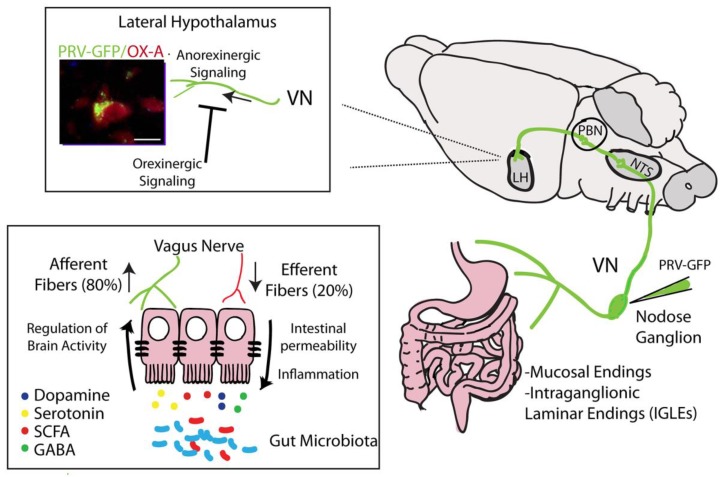
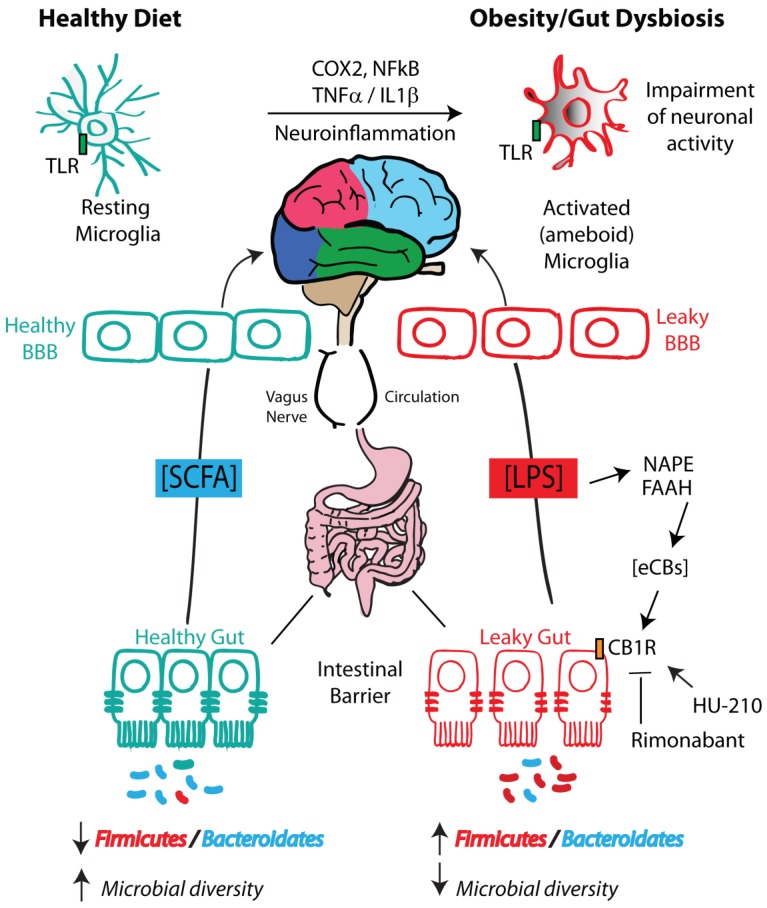
The hypothalamus regulates energy homeostasis by integrating environmental and internal signals to produce behavioral responses to start or stop eating. Many satiation signals are mediated by microbiota-derived metabolites coming from the gastrointestinal tract and acting also in the brain through a complex bidirectional communication system, the microbiota-gut-brain axis. In recent years, the intestinal microbiota has emerged as a critical regulator of hypothalamic appetite-related neuronal networks. Obesogenic high-fat diets (HFDs) enhance endocannabinoid levels, both in the brain and peripheral tissues. HFDs change the gut microbiota composition by altering the Firmicutes:Bacteroidetes ratio and causing endotoxemia mainly by rising the levels of lipopolysaccharide (LPS), the most potent immunogenic component of Gram-negative bacteria. Endotoxemia induces the collapse of the gut and brain barriers, interleukin 1β (IL1β)- and tumor necrosis factor α (TNFα)-mediated neuroinflammatory responses and gliosis, which alter the appetite-regulatory circuits of the brain mediobasal hypothalamic area delimited by the median eminence. This review summarizes the emerging state-of-the-art evidence on the function of the "expanded endocannabinoid (eCB) system" or endocannabinoidome at the crossroads between intestinal microbiota, gut-brain communication and host metabolism; and highlights the critical role of this intersection in the onset of obesity.
下丘脑通过整合环境和内部信号来调节能量稳态,从而产生开始或停止进食的行为反应。许多饱腹感信号是由来自胃肠道的微生物衍生代谢物介导的,这些代谢物通过复杂的双向通讯系统——微生物群-肠-脑轴,在大脑中发挥作用。近年来,肠道微生物群已成为调节下丘脑与食欲相关神经元网络的关键因素。致肥胖的高脂肪饮食(HFD)会增加内源性大麻素水平,无论是在大脑还是外周组织中。HFD 通过改变厚壁菌门:拟杆菌门的比例,以及主要通过提高脂多糖(LPS)水平(革兰氏阴性菌最有效的免疫原性成分)引起内毒素血症,从而改变肠道微生物群的组成。内毒素血症会导致肠道和大脑屏障的崩溃、白细胞介素 1β(IL1β)和肿瘤坏死因子 α(TNFα)介导的神经炎症反应和神经胶质增生,从而改变由中脑内侧下丘脑区(由正中隆起界定)限定的大脑食欲调节回路。这篇综述总结了肠道微生物群、肠-脑通讯和宿主代谢之间的“扩展内源性大麻素(eCB)系统”或内源性大麻素组学的最新功能的新兴证据;并强调了这个交叉点在肥胖症发病中的关键作用。