Department of Biomedical Engineering, Case Western Reserve University, Cleveland, OH, USA.
Department of Biomedical Informatics, Stony Brook University, New York.
Lancet Digit Health. 2020 Nov;2(11):e594-e606. doi: 10.1016/s2589-7500(20)30225-9. Epub 2020 Oct 19.
Intratumoural heterogeneity has been previously shown to be related to clonal evolution and genetic instability and associated with tumour progression. Phenotypically, it is reflected in the diversity of appearance and morphology within cell populations. Computer-extracted features relating to tumour cellular diversity on routine tissue images might correlate with outcome. This study investigated the prognostic ability of computer-extracted features of tumour cellular diversity (CellDiv) from haematoxylin and eosin (H&E)-stained histology images of non-small cell lung carcinomas (NSCLCs).
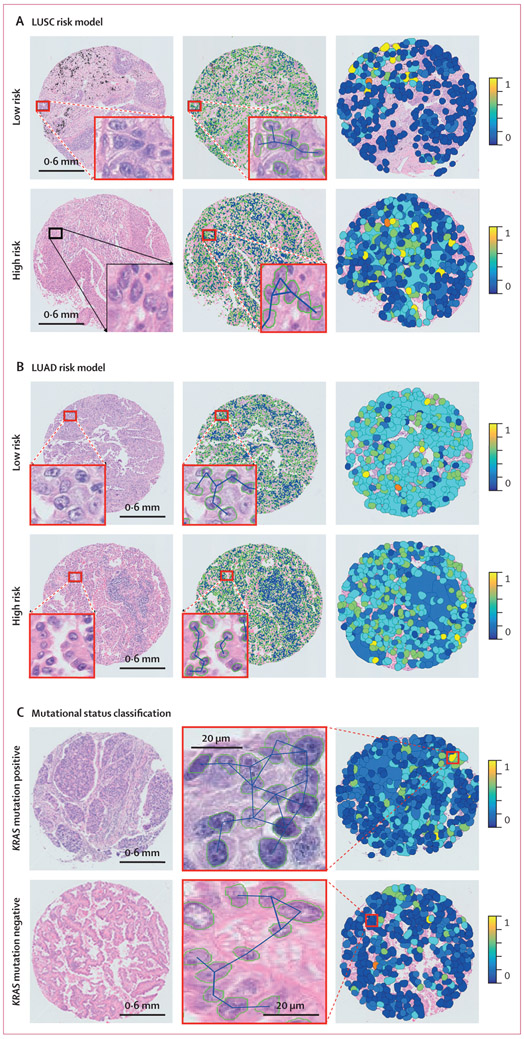
In this multicentre, retrospective study, we included 1057 patients with early-stage NSCLC with corresponding diagnostic histology slides and overall survival information from four different centres. CellDiv features quantifying local cellular morphological diversity from H&E-stained histology images were extracted from the tumour epithelium region. A Cox proportional hazards model based on CellDiv was used to construct risk scores for lung adenocarcinoma (LUAD; 270 patients) and lung squamous cell carcinoma (LUSC; 216 patients) separately using data from two of the cohorts, and was validated in the two remaining independent cohorts (comprising 236 patients with LUAD and 335 patients with LUSC). We used multivariable Cox regression analysis to examine the predictive ability of CellDiv features for 5-year overall survival, controlling for the effects of clinical and pathological parameters. We did a gene set enrichment and Gene Ontology analysis on 405 patients to identify associations with differentially expressed biological pathways implicated in lung cancer pathogenesis.
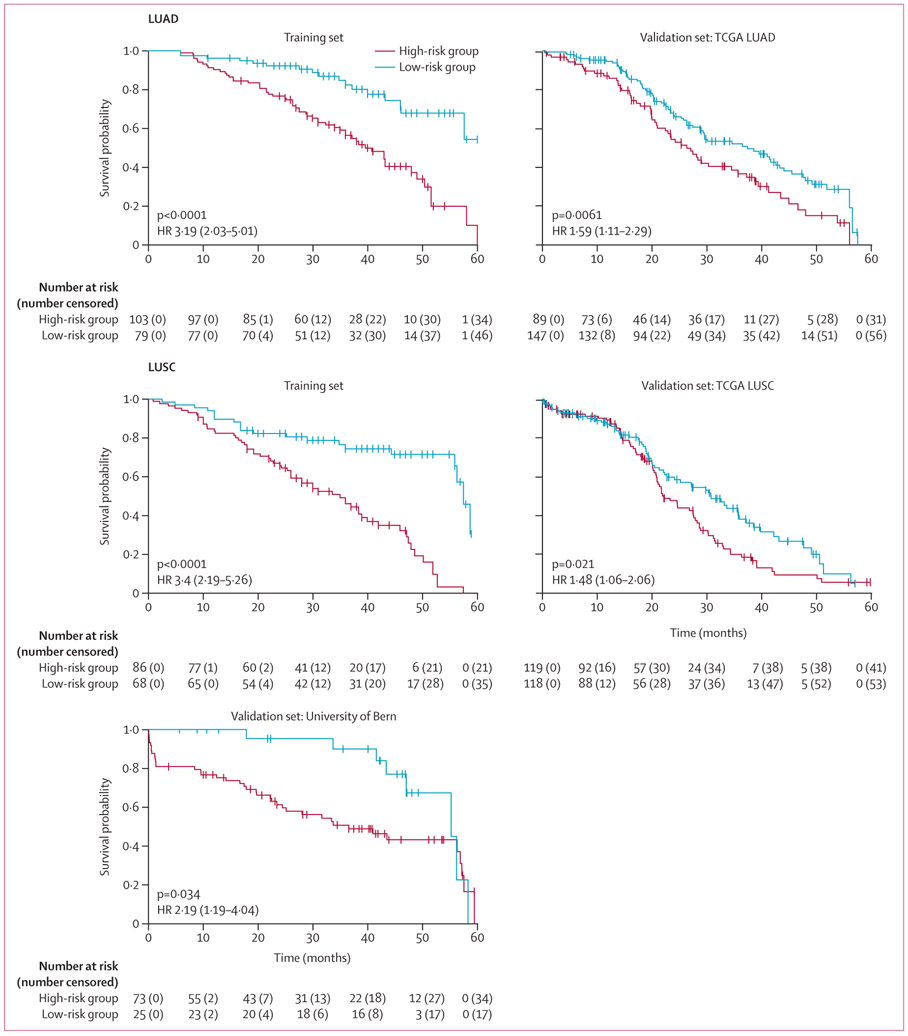
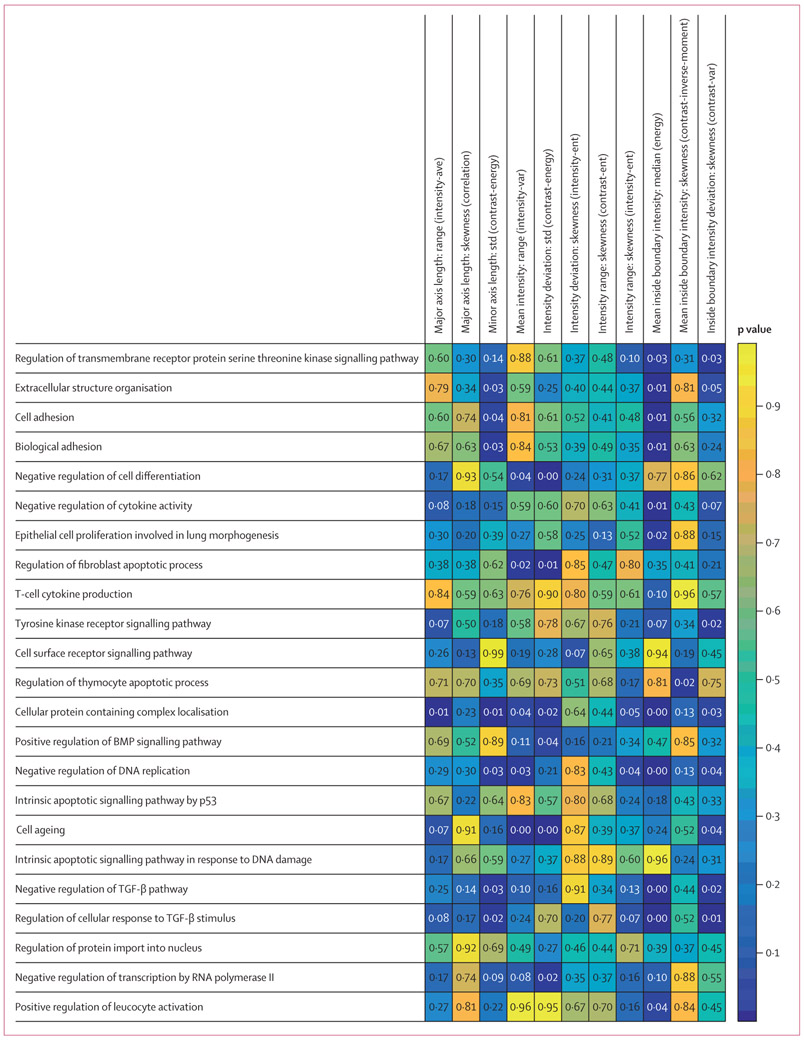
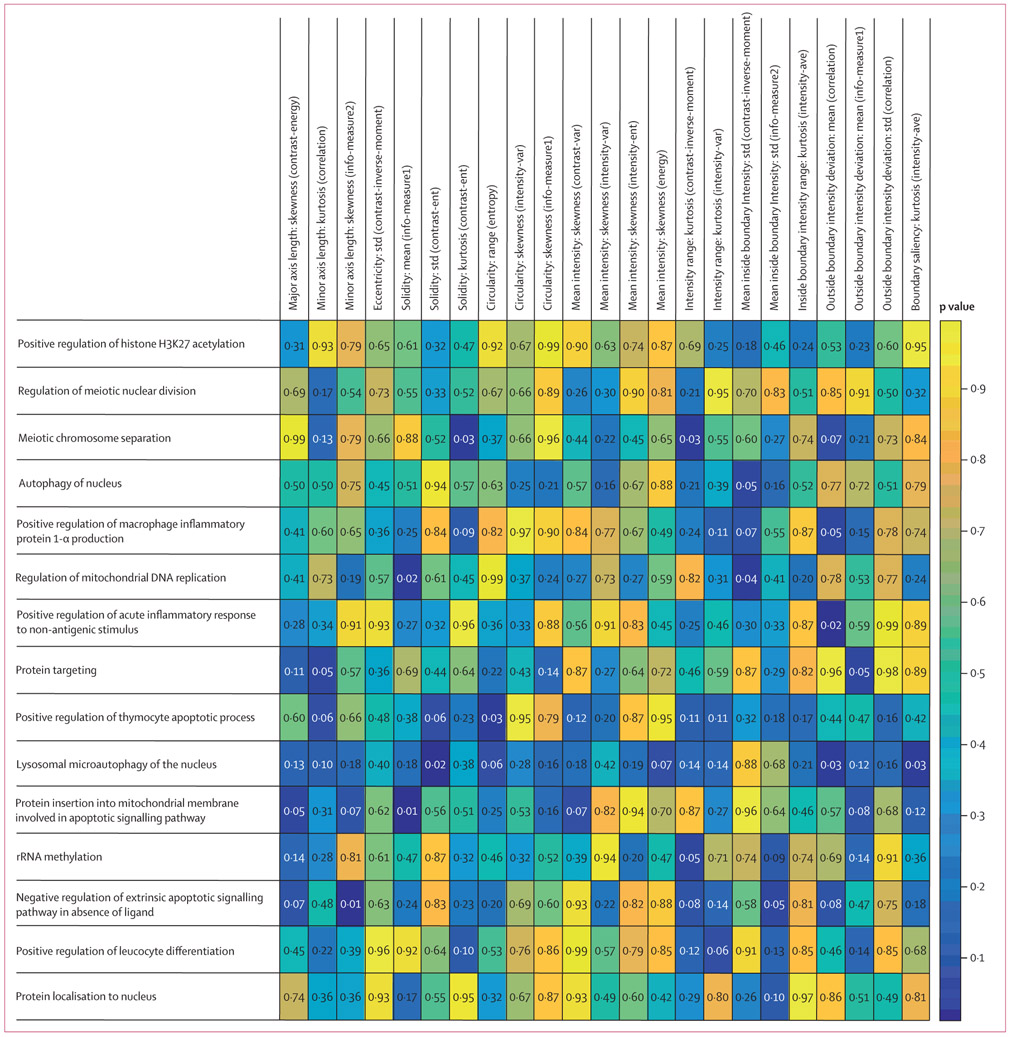
For prognosis of patients with early-stage LUSC, the CellDiv LUSC model included 11 discriminative CellDiv features, whereas for patients with early-stage LUAD, the model included 23 features. In the independent validation cohorts, patients predicted to be at a higher risk by the univariable CellDiv model had significantly worse 5-year overall survival (hazard ratio 1·48 [95% CI 1·06-2·08]; p=0·022 for The Cancer Genome Atlas [TCGA] LUSC group, 2·24 [1·04-4·80]; p=0·039 for the University of Bern LUSC group, and 1·62 [1·15-2·30]; p=0·0058 for the TCGA LUAD group). The identified CellDiv features were also found to be strongly associated with apoptotic signalling and cell differentiation pathways.
CellDiv features were strongly prognostic of 5-year overall survival in patients with early-stage NSCLC and also associated with apoptotic signalling and cell differentiation pathways. The CellDiv-based risk stratification model could potentially help to determine which patients with early-stage NSCLC might receive added benefit from adjuvant therapy.
National Institue of Health and US Department of Defense.
肿瘤内异质性先前已被证明与克隆进化和遗传不稳定性有关,并与肿瘤进展相关。表型上,它反映在细胞群体中外观和形态的多样性上。计算机提取的与肿瘤细胞多样性相关的特征(CellDiv)可能与常规组织图像的肿瘤细胞多样性相关。本研究调查了从非小细胞肺癌(NSCLC)的苏木精和伊红(H&E)染色组织学图像中提取的计算机提取的肿瘤细胞多样性(CellDiv)特征对预后的影响。
在这项多中心回顾性研究中,我们纳入了来自四个中心的 1057 名早期 NSCLC 患者的相应诊断组织学切片和总生存信息。从 H&E 染色组织学图像的肿瘤上皮区域提取量化局部细胞形态多样性的 CellDiv 特征。使用来自两个队列的数据,使用 Cox 比例风险模型基于 CellDiv 分别为肺腺癌(LUAD;270 例)和肺鳞状细胞癌(LUSC;216 例)构建风险评分,并在另外两个独立的队列中进行验证(包含 236 例 LUAD 患者和 335 例 LUSC 患者)。我们使用多变量 Cox 回归分析,控制临床和病理参数的影响,检查 CellDiv 特征对 5 年总生存率的预测能力。我们对 405 名患者进行了基因集富集和基因本体论分析,以确定与肺癌发病机制中涉及的差异表达生物途径的关联。
对于早期 LUSC 患者的预后,CellDiv LUSC 模型包含 11 个有区别的 CellDiv 特征,而对于早期 LUAD 患者,该模型包含 23 个特征。在独立验证队列中,根据单变量 CellDiv 模型预测为高风险的患者,5 年总生存率显著降低(风险比 1.48[95%CI 1.06-2.08];p=0.022 用于癌症基因组图谱[TCGA]LUSC 组,2.24[1.04-4.80];p=0.039 用于伯尔尼大学 LUSC 组,1.62[1.15-2.30];p=0.0058 用于 TCGA LUAD 组)。还发现鉴定的 CellDiv 特征与凋亡信号和细胞分化途径密切相关。
CellDiv 特征强烈预测了早期 NSCLC 患者 5 年的总生存率,并且还与凋亡信号和细胞分化途径有关。基于 CellDiv 的风险分层模型可能有助于确定哪些早期 NSCLC 患者可能从辅助治疗中获益。
美国国立卫生研究院和美国国防部。