Department of Developmental Psychology, Tilburg University, Tilburg, the Netherlands.
Department of Developmental Psychology, Utrecht University, Utrecht, the Netherlands.
Dev Sci. 2021 Jul;24(4):e13062. doi: 10.1111/desc.13062. Epub 2020 Nov 25.
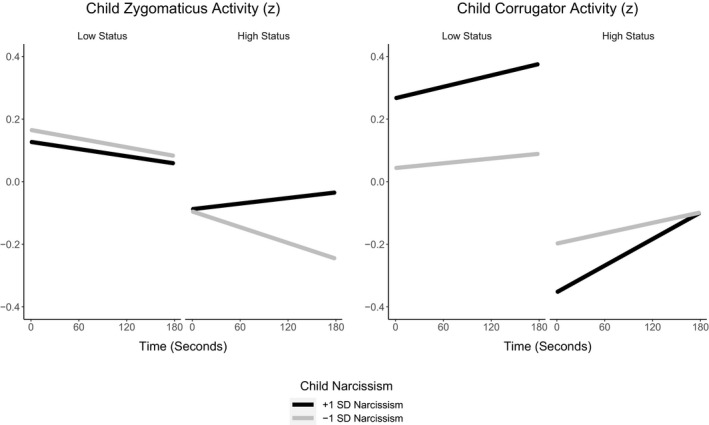
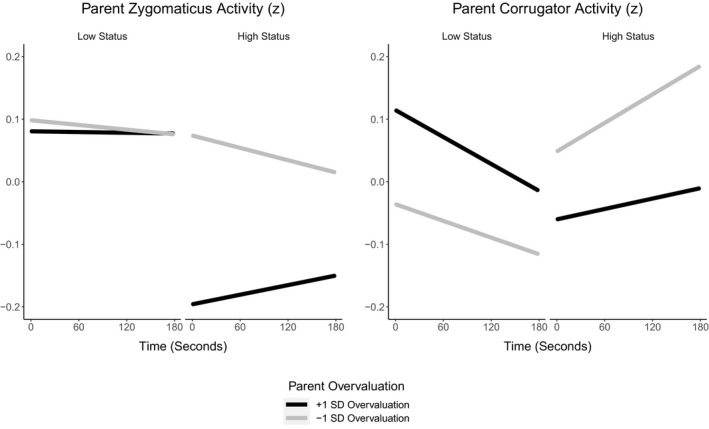
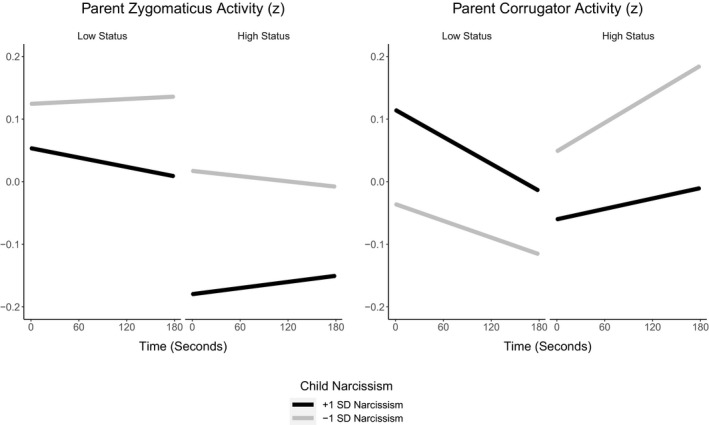
Children's narcissism may be rooted in sensitivity to social status (i.e., prominence, respect, and influence in a social group), and this sensitivity might be shared with parents. Testing this idea, a randomized experiment examined how children with high narcissism levels and their parents respond to gains and losses of social status. On a simulated social media platform, children (N = 123, ages 8-13) competed with fictitious peers for status and were randomly assigned to gain or lose status. Unbeknownst to children, parents viewed the course of the task. Children's and parents' affective reactions during the task were measured with facial electromyography, which detects spontaneous facial muscle activity linked to positive affect (i.e., zygomaticus major activity, involved in smiling) and negative affect (i.e., corrugator supercilii activity, involved in frowning). Children with higher narcissism levels showed steeper increases in negative affect during status loss and steeper increases in both positive and negative affect during status gain. Their parents mirrored the steeper increase in positive affect during their child's status gain, but they did not mirror the increase in negative affect. These results suggest that children with high narcissism levels and their parents show intensified affective-motivational responses to children's status-relevant experiences. These responses may be transmitted from one generation to the other (e.g., genetically or through parent-child socialization).
儿童的自恋可能源于对社会地位的敏感(即社会群体中的突出、尊重和影响力),而这种敏感性可能与父母共有的。为了验证这一观点,一项随机实验研究了高自恋水平的儿童及其父母如何应对社会地位的得失。在一个模拟的社交媒体平台上,孩子们(N=123,年龄 8-13 岁)与虚构的同龄人竞争地位,并被随机分配获得或失去地位。孩子们并不知道,父母观看了任务的过程。通过面部肌电图测量了任务过程中儿童和父母的情感反应,面部肌电图检测到与积极情绪(即颧大肌活动,涉及微笑)和消极情绪(即皱眉肌活动,涉及皱眉)相关的自发面部肌肉活动。自恋水平较高的儿童在失去地位时表现出更强烈的消极情绪增加,在获得地位时表现出更强烈的积极和消极情绪增加。他们的父母在孩子获得地位时反映出积极情绪的增加,但没有反映出消极情绪的增加。这些结果表明,自恋水平较高的儿童及其父母对与孩子地位相关的经历表现出更强烈的情感动机反应。这些反应可能会从一代传递到另一代(例如,通过遗传或通过亲子社会化)。