Department of Cell Biology, Yale University School of Medicine, New Haven, Connecticut 06520, United States.
Nanobiology Institute, Yale University, West Haven, Connecticut 06516, United States.
Nano Lett. 2020 Dec 9;20(12):8890-8896. doi: 10.1021/acs.nanolett.0c03925. Epub 2020 Nov 9.
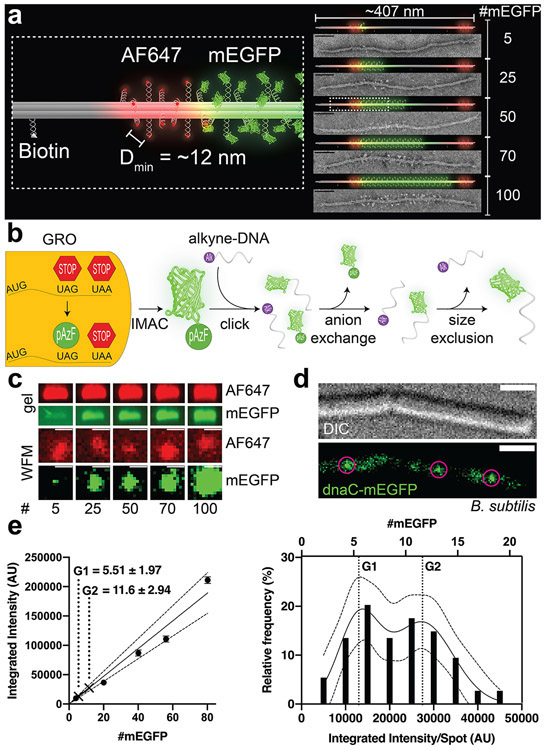
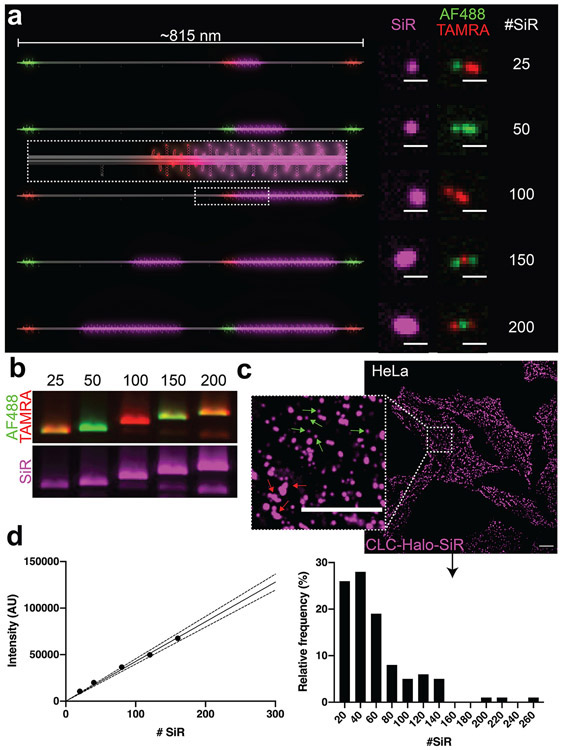
Fluorescence microscopy has been one of the most discovery-rich methods in biology. In the digital age, the discipline is becoming increasingly quantitative. Virtually all biological laboratories have access to fluorescence microscopes, but abilities to quantify biomolecule copy numbers are limited by the complexity and sophistication associated with current quantification methods. Here, we present DNA-origami-based fluorescence brightness standards for counting 5-300 copies of proteins in bacterial and mammalian cells, tagged with fluorescent proteins or membrane-permeable organic dyes. Compared to conventional quantification techniques, our brightness standards are robust, straightforward to use, and compatible with nearly all fluorescence imaging applications, thereby providing a practical and versatile tool to quantify biomolecules via fluorescence microscopy.
荧光显微镜一直是生物学中最富有发现的方法之一。在数字时代,该学科正变得越来越定量。几乎所有的生物实验室都可以使用荧光显微镜,但定量生物分子拷贝数的能力受到与当前定量方法相关的复杂性和复杂性的限制。在这里,我们提出了基于 DNA 折纸的荧光亮度标准品,用于在细菌和哺乳动物细胞中计数 5-300 个拷贝的带有荧光蛋白或膜通透性有机染料的蛋白质。与传统的定量技术相比,我们的亮度标准品稳定、使用简单,几乎与所有荧光成像应用兼容,因此通过荧光显微镜提供了一种实用且通用的定量生物分子的工具。