Zhong Xiaorong, Luo Ting, Deng Ling, Liu Pei, Hu Kejia, Lu Donghao, Zheng Dan, Luo Chuanxu, Xie Yuxin, Li Jiayuan, He Ping, Pu Tianjie, Ye Feng, Bu Hong, Fu Bo, Zheng Hong
Department of Head, Neck and Mammary Gland Oncology, Cancer Center, West China Hospital, Sichuan University, Chengdu, China.
Laboratory of Molecular Diagnosis of Cancer, Clinical Research Center for Breast, West China Hospital, Sichuan University, Chengdu, China.
JMIR Med Inform. 2020 Nov 9;8(11):e19069. doi: 10.2196/19069.
Current online prognostic prediction models for breast cancer, such as Adjuvant! Online and PREDICT, are based on specific populations. They have been well validated and widely used in the United States and Western Europe; however, several validation attempts in non-European countries have revealed suboptimal predictions.
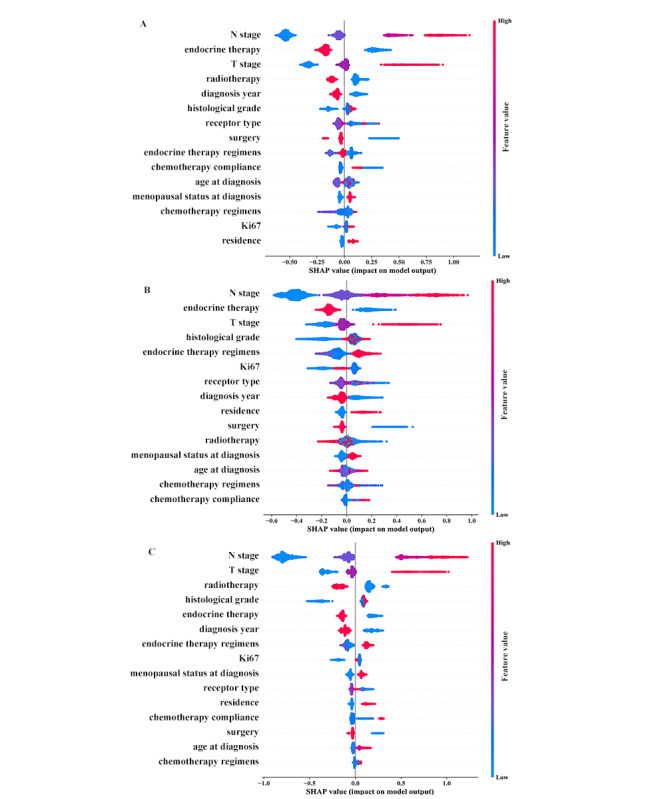
We aimed to develop an advanced breast cancer prognosis model for disease progression, cancer-specific mortality, and all-cause mortality by integrating tumor, demographic, and treatment characteristics from a large breast cancer cohort in China.
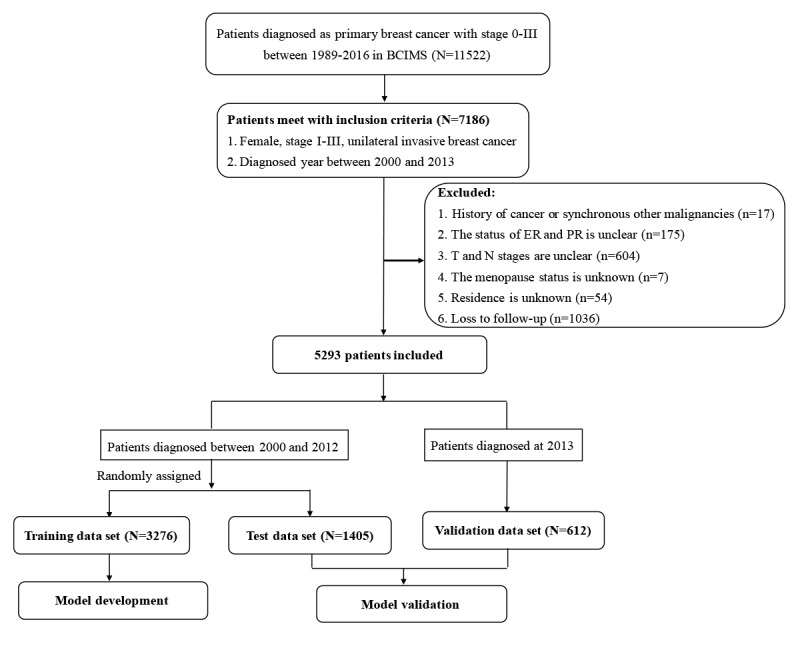
This study was approved by the Clinical Test and Biomedical Ethics Committee of West China Hospital, Sichuan University on May 17, 2012. Data collection for this project was started in May 2017 and ended in March 2019. Data on 5293 women diagnosed with stage I to III invasive breast cancer between 2000 and 2013 were collected. Disease progression, cancer-specific mortality, all-cause mortality, and the likelihood of disease progression or death within a 5-year period were predicted. Extreme gradient boosting was used to develop the prediction model. Model performance was assessed by calculating the area under the receiver operating characteristic curve (AUROC), and the model was calibrated and compared with PREDICT.
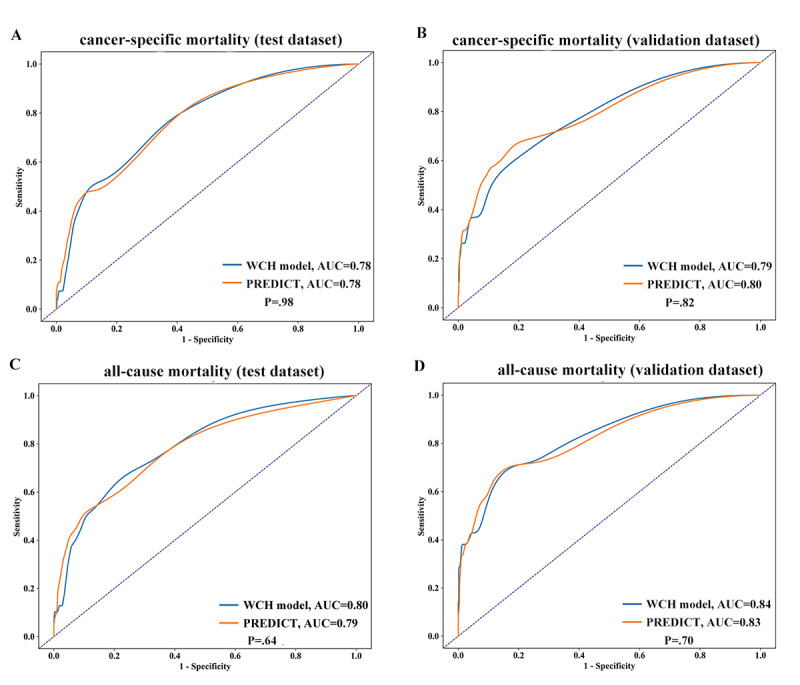
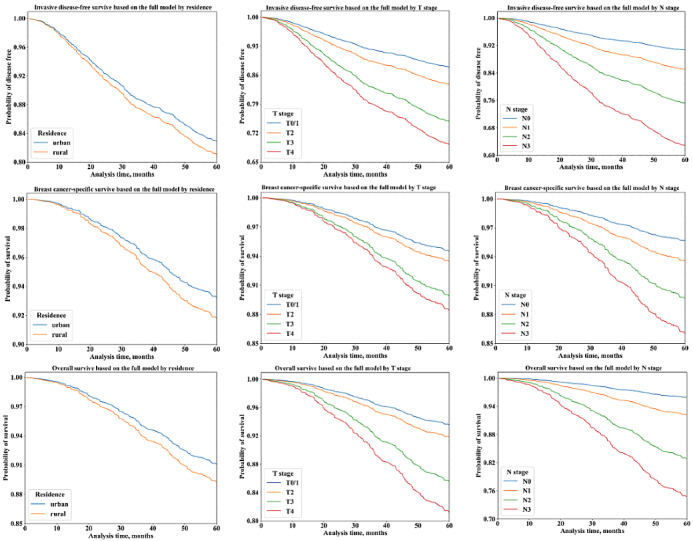
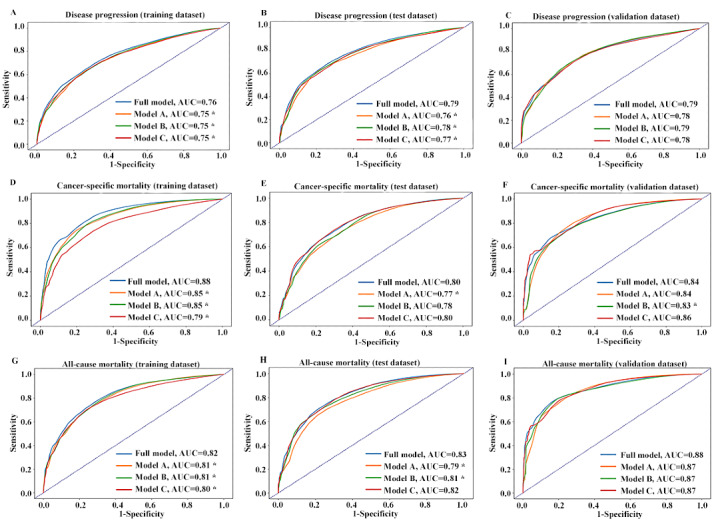
The training, test, and validation sets comprised 3276 (499 progressions, 202 breast cancer-specific deaths, and 261 all-cause deaths within 5-year follow-up), 1405 (211 progressions, 94 breast cancer-specific deaths, and 129 all-cause deaths), and 612 (109 progressions, 33 breast cancer-specific deaths, and 37 all-cause deaths) women, respectively. The AUROC values for disease progression, cancer-specific mortality, and all-cause mortality were 0.76, 0.88, and 0.82 for training set; 0.79, 0.80, and 0.83 for the test set; and 0.79, 0.84, and 0.88 for the validation set, respectively. Calibration analysis demonstrated good agreement between predicted and observed events within 5 years. Comparable AUROC and calibration results were confirmed in different age, residence status, and receptor status subgroups. Compared with PREDICT, our model showed similar AUROC and improved calibration values.
Our prognostic model exhibits high discrimination and good calibration. It may facilitate prognosis prediction and clinical decision making for patients with breast cancer in China.
当前用于乳腺癌的在线预后预测模型,如辅助治疗在线工具(Adjuvant! Online)和PREDICT,是基于特定人群开发的。它们在美国和西欧已经得到了充分验证并被广泛使用;然而,在非欧洲国家进行的几次验证尝试显示预测效果并不理想。
我们旨在通过整合来自中国一个大型乳腺癌队列的肿瘤、人口统计学和治疗特征,开发一种用于疾病进展、癌症特异性死亡率和全因死亡率的先进乳腺癌预后模型。
本研究于2012年5月17日获得四川大学华西医院临床试验与生物医学伦理委员会批准。该项目的数据收集于2017年5月开始,2019年3月结束。收集了2000年至2013年间5293例诊断为I至III期浸润性乳腺癌的女性的数据。预测了疾病进展、癌症特异性死亡率、全因死亡率以及5年内疾病进展或死亡的可能性。使用极端梯度提升算法开发预测模型。通过计算受试者工作特征曲线下面积(AUROC)评估模型性能,并对模型进行校准,与PREDICT进行比较。
训练集、测试集和验证集分别包括3276例(5年随访期间499例疾病进展、202例癌症特异性死亡和261例全因死亡)、1405例(211例疾病进展、94例癌症特异性死亡和129例全因死亡)和612例(109例疾病进展、33例癌症特异性死亡和37例全因死亡)女性。训练集疾病进展、癌症特异性死亡率和全因死亡率的AUROC值分别为0.76、0.88和0.82;测试集分别为0.79、0.80和0.83;验证集分别为0.79、0.84和0.88。校准分析表明5年内预测事件与观察事件之间具有良好的一致性。在不同年龄、居住状态和受体状态亚组中证实了类似的AUROC和校准结果。与PREDICT相比,我们的模型显示出相似的AUROC和更好的校准值。
我们的预后模型具有较高的区分度和良好的校准性。它可能有助于中国乳腺癌患者的预后预测和临床决策。