Centre for Musculoskeletal Surgery, Charité - University Hospital Berlin, Charitéplatz 1, 10117, Berlin, Germany.
Clinic for Orthopaedics, Sports Medicine and Rehabilitation, KH-MOL GmBH, Sonnenburger Weg 3, 16269, Wriezen, Germany.
Knee Surg Sports Traumatol Arthrosc. 2021 Nov;29(11):3641-3647. doi: 10.1007/s00167-020-06344-3. Epub 2020 Nov 9.
Released particles are a major risk of airborne contamination during surgery. The present prospective study investigated the quantitative and qualitative particle load in the operating room (OR) depending on location, time of surgery and use of laminar air flow (LAF) system.
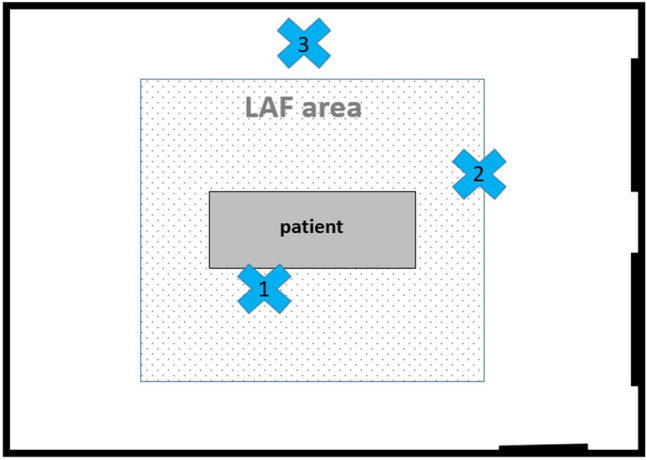
The particle load/m was measured during the implantation of 12 total knee arthroplasties (6 × LAF, 6 × Non-LAF) by using the Met One HHPC 6 + device (Beckmann Coulter GmbH, Germany). Measurement was based on the absorption and scattering of (laser) light by particles and was performed at three different time-points [empty OR, setting up, ongoing operation) at 3 fixed measurement points [OR table (central LAF area), anaesthesia tower (marginal LAF area), surgical image amplifier (outside LAF area)].
Independent of time and location, all measurements showed a significantly higher particle load in the Non-LAF group (p < 0.01). With ongoing surgical procedure both groups showed increasing particle load. While there was a major increase of fine particles (size < 1 µm) with advancing activity in the LAF group, the Non-LAF group showed higher particle gain with increasing particle size. The lowest particle load in the LAF group was measured at the operating column, increasing with greater distance from the operating table. The Non-LAF group presented a significantly higher particle load than the LAF group at all locations.
The use of a LAF system significantly reduces the particle load and therefore potential bacterial contamination regardless of the time or place of measurement and therefore seems to be a useful tool for infection prevention. As LAF leads to a significant decrease of respirable particles, it appears to be a protective factor for the health of the surgical team regardless of its use in infection prevention.
I.
手术过程中释放的颗粒是空气传播污染的主要风险。本前瞻性研究调查了根据位置、手术时间和层流空气(LAF)系统使用情况,手术室(OR)中的定量和定性颗粒负荷。
在使用 Met One HHPC 6+ 设备(Beckmann Coulter GmbH,德国)植入 12 例全膝关节置换术(6×LAF,6×非 LAF)期间,测量每立方米的颗粒负荷(m)。测量基于颗粒对(激光)光的吸收和散射,在三个不同的时间点[空 OR、设置、正在进行的手术)在 3 个固定测量点[OR 表(中央 LAF 区域)、麻醉塔(LAF 区域边缘)、手术图像放大器(LAF 区域外)]进行。
无论时间和位置如何,所有测量结果均显示非 LAF 组的颗粒负荷明显更高(p<0.01)。随着手术的进行,两组的颗粒负荷均呈上升趋势。在 LAF 组,随着活动的进行,细颗粒(尺寸<1μm)大量增加,而非 LAF 组则随着颗粒尺寸的增加而增加颗粒量。LAF 组在手术柱上测量的颗粒负荷最低,随着与手术台距离的增加而增加。非 LAF 组在所有位置的颗粒负荷均明显高于 LAF 组。
无论测量时间或地点如何,使用 LAF 系统均可显著降低颗粒负荷和潜在的细菌污染,因此似乎是预防感染的有用工具。由于 LAF 可显著减少可吸入颗粒,因此无论其在感染预防中的使用情况如何,它似乎都是保护手术团队健康的一个因素。
I