Department of Population and Health, College of Humanities and Legal Studies, University of Cape Coast, Cape Coast, Ghana.
College of Public Health, Medical and Veterinary Sciences, James Cook University, Townsville, Queensland, Australia.
PLoS One. 2020 Nov 9;15(11):e0241409. doi: 10.1371/journal.pone.0241409. eCollection 2020.
Access to healthcare is one of the key global concerns as treasured in the Sustainable Development Goals. This study, therefore, sought to assess the individual and contextual factors associated with barriers to accessing healthcare among women in sub-Saharan Africa (SSA).
Data for this study were obtained from the latest Demographic and Health Surveys (DHS) conducted between January 2010 and December 2018 across 24 countries in SSA. The sample comprised 307,611 women aged 15-49. Data were analysed with STATA version 14.2 using both descriptive and multilevel logistic regression modelling. Statistical significance was set at p<0.05.
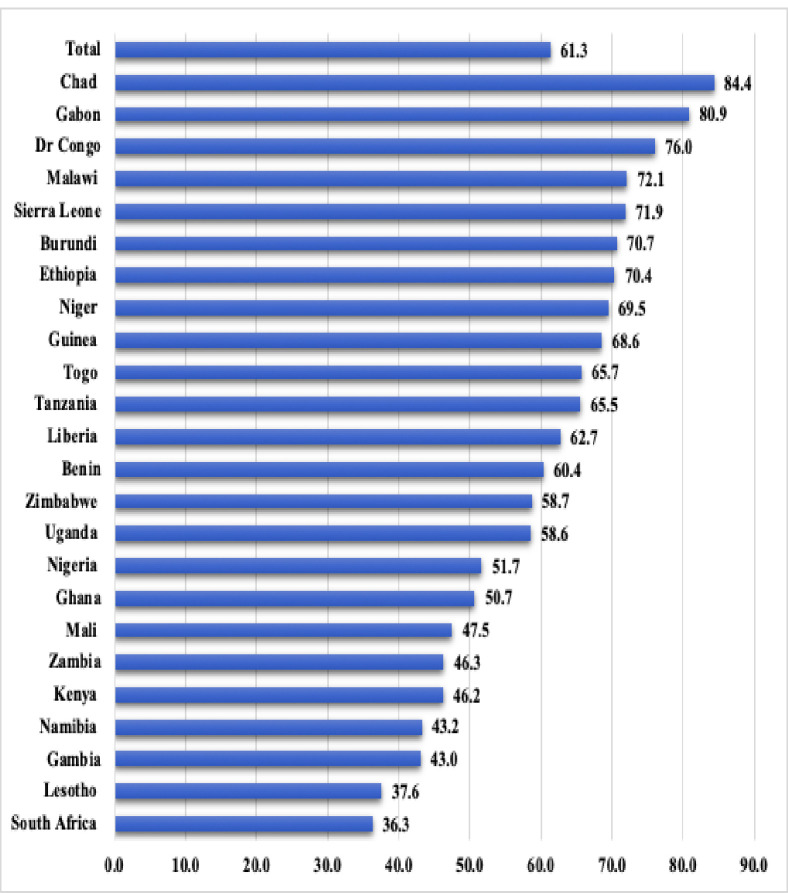
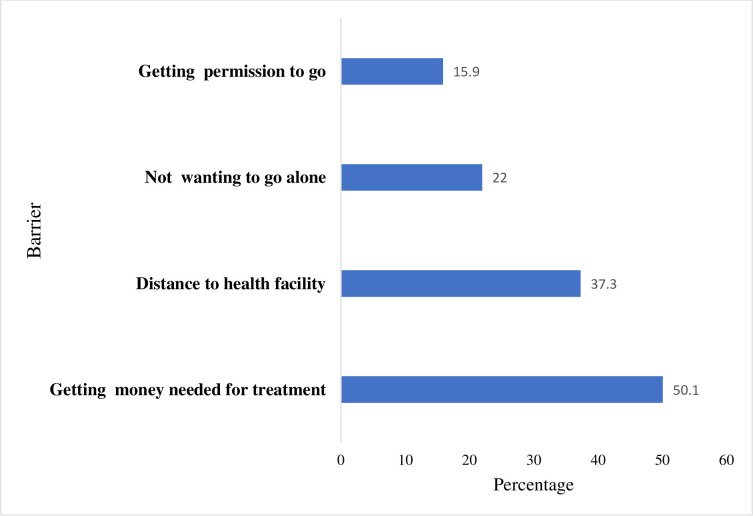
It was found that 61.5% of women in SSA face barriers in accessing healthcare. The predominant barriers were getting money needed for treatment (50.1%) and distance to health facility (37.3%). Women aged 35-39 (AOR = 0.945, CI: 0.911-0.980), married women (AOR = 0.694, CI: 0.658-0.732), richest women (AOR = 0.457, CI:0.443-0.472), and those who read newspaper or magazine at least once a week (AOR = 0.893, CI:0.811-0.983) had lower odds of facing barriers in accessing healthcare. However, those with no formal education (AOR = 1.803, CI:1.718-1.891), those in manual occupations (AOR = 1.551, CI: 1.424-1.689), those with parity 4 or more (AOR = 1.211, CI: 1.169-1.255), those who were not covered by health insurance (AOR = 1.284, CI: 1.248-1.322), and those in rural areas (AOR = 1.235, CI:1.209-1.26) had higher odds of facing barriers to healthcare access.
Both individual and contextual factors are associated with barriers to healthcare accessibility in SSA. Particularly, age, marital status, employment, parity, health insurance coverage, exposure to mass media, wealth status and place of residence are associated with barriers to healthcare accessibility. These factors ought to be considered at the various countries in SSA to strengthen existing strategies and develop new interventions to help mitigate the barriers. Some of the SSA African countries can adopt successful programs in other parts of SSA to suit their context such as the National Health Insurance Scheme (NHIS) and the Community-based Health Planning and Services concepts in Ghana.
在可持续发展目标中,获得医疗保健是全球关注的关键问题之一。因此,本研究旨在评估撒哈拉以南非洲(SSA)妇女获得医疗保健的个人和环境因素。
本研究的数据来自 2010 年 1 月至 2018 年 12 月期间在 SSA 24 个国家进行的最新人口与健康调查(DHS)。样本包括 307611 名 15-49 岁的妇女。使用 STATA 版本 14.2 进行数据分析,采用描述性和多层次逻辑回归建模。统计学意义设定为 p<0.05。
研究发现,61.5%的 SSA 妇女在获得医疗保健方面存在障碍。主要障碍是获得治疗所需的资金(50.1%)和距离医疗机构(37.3%)。年龄在 35-39 岁的妇女(AOR=0.945,CI:0.911-0.980)、已婚妇女(AOR=0.694,CI:0.658-0.732)、最富有妇女(AOR=0.457,CI:0.443-0.472)和每周至少阅读一次报纸或杂志的妇女(AOR=0.893,CI:0.811-0.983)面临获得医疗保健的障碍的可能性较低。然而,没有接受过正规教育的妇女(AOR=1.803,CI:1.718-1.891)、从事体力劳动的妇女(AOR=1.551,CI:1.424-1.689)、生育 4 个及以上子女的妇女(AOR=1.211,CI:1.169-1.255)、没有医疗保险的妇女(AOR=1.284,CI:1.248-1.322)和居住在农村地区的妇女(AOR=1.235,CI:1.209-1.26)面临获得医疗保健的障碍的可能性更高。
个人和环境因素都与 SSA 获得医疗保健的障碍有关。特别是年龄、婚姻状况、就业、生育次数、医疗保险覆盖范围、大众媒体接触、财富状况和居住地与获得医疗保健的障碍有关。这些因素应该在 SSA 的各个国家考虑,以加强现有战略并制定新的干预措施,以帮助减轻这些障碍。一些 SSA 非洲国家可以在其他部分 SSA 采用成功的项目,以适应其国情,例如国家健康保险计划(NHIS)和加纳的社区卫生规划和服务概念。