Program in Global Surgery and Social Change, Harvard Medical School, Boston, Massachusetts, United States of America.
University of Miami Miller School of Medicine, Miami, Florida, United States of America.
PLoS One. 2020 Nov 9;15(11):e0241954. doi: 10.1371/journal.pone.0241954. eCollection 2020.
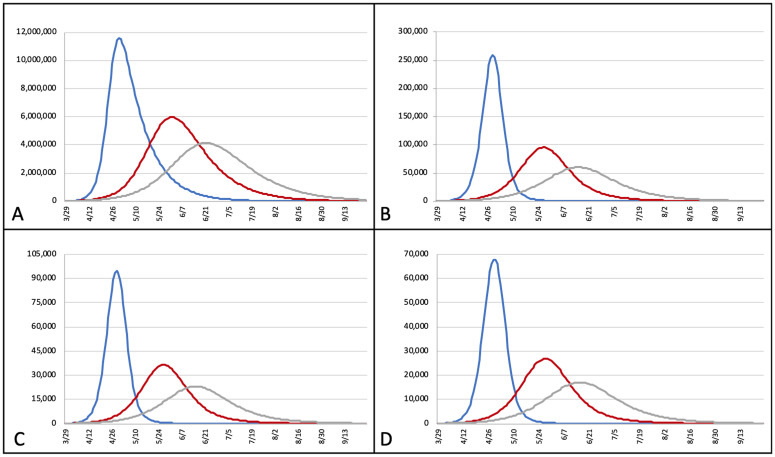
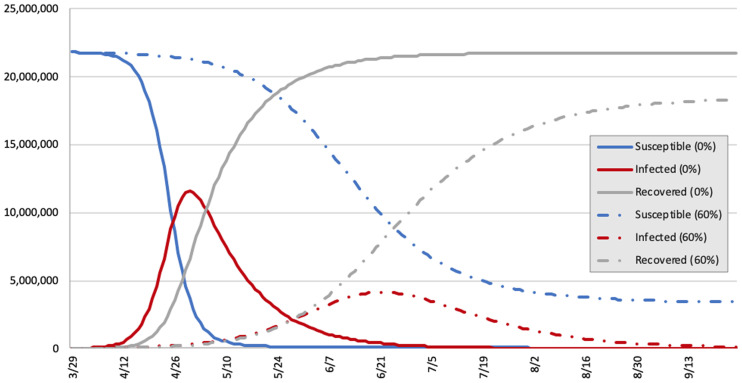
Evidence-based models may assist Mexican government officials and health authorities in determining the safest plans to respond to the coronavirus disease 2019 (COVID-19) pandemic in the most-affected region of the country, the Mexico City Metropolitan Area. This study aims to present the potential impacts of COVID-19 in this region and to model possible benefits of mitigation efforts. The COVID-19 Hospital Impact Model for Epidemics was used to estimate the probable evolution of COVID-19 in three scenarios: (i) no social distancing, (ii) social distancing in place at 50% effectiveness, and (iii) social distancing in place at 60% effectiveness. Projections of the number of inpatient hospitalizations, intensive care unit admissions, and patients requiring ventilators were made for each scenario. Using the model described, it was predicted that peak case volume at 0% mitigation was to occur on April 30, 2020 at 11,553,566 infected individuals. Peak case volume at 50% mitigation was predicted to occur on June 1, 2020 with 5,970,093 infected individuals and on June 21, 2020 for 60% mitigation with 4,128,574 infected individuals. Occupancy rates in hospitals during peak periods at 0%, 50%, and 60% mitigation would be 875.9%, 322.8%, and 203.5%, respectively, when all inpatient beds are included. Under these scenarios, peak daily hospital admissions would be 40,438, 13,820, and 8,650. Additionally, 60% mitigation would result in a decrease in peak intensive care beds from 94,706 to 23,116 beds and a decrease in peak ventilator need from 67,889 to 17,087 units. Mitigating the spread of COVID-19 through social distancing could have a dramatic impact on reducing the number of infected people and minimize hospital overcrowding. These evidence-based models may enable careful resource utilization and encourage targeted public health responses.
循证模型可以帮助墨西哥政府官员和卫生当局确定应对该国受影响最严重地区——墨西哥城大都市区 2019 年冠状病毒病(COVID-19)大流行的最安全计划。本研究旨在展示该地区 COVID-19 的潜在影响,并对缓解措施的可能收益进行建模。使用 COVID-19 传染病医院影响模型来估计三种情况下 COVID-19 的可能演变:(i)无社会隔离,(ii)社会隔离效果为 50%,(iii)社会隔离效果为 60%。对每种情况的住院患者人数、重症监护病房入院人数和需要呼吸机的患者人数进行了预测。使用描述的模型,预测在 0%缓解的情况下,病例数量的峰值将在 2020 年 4 月 30 日达到 11553566 人感染。在 50%缓解的情况下,预计病例数量的峰值将在 2020 年 6 月 1 日达到 5970093 人感染,在 60%缓解的情况下,预计在 2020 年 6 月 21 日达到 4128574 人感染。在 0%、50%和 60%缓解的情况下,高峰期医院的入住率分别为 875.9%、322.8%和 203.5%,当包括所有住院床位时。在这些情况下,每日医院就诊人数的峰值将分别为 40438、13820 和 8650。此外,60%的缓解措施将使高峰期重症监护床位从 94706 张减少到 23116 张,使高峰期呼吸机需求从 67889 台减少到 17087 台。通过社会隔离来减缓 COVID-19 的传播可能会对减少感染人数和最大限度地减少医院过度拥挤产生重大影响。这些循证模型可以帮助谨慎利用资源,并鼓励有针对性的公共卫生应对措施。