Ha Eunjae, Shin Joongchol, Paik Joonki
Department of Image, Chung-Ang University, Seoul 06974, Korea.
Sensors (Basel). 2020 Nov 5;20(21):6311. doi: 10.3390/s20216311.
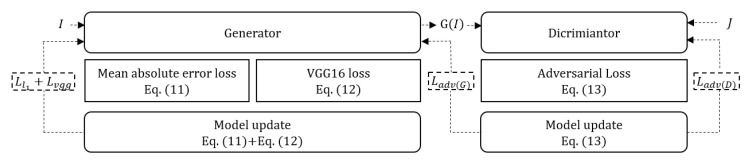
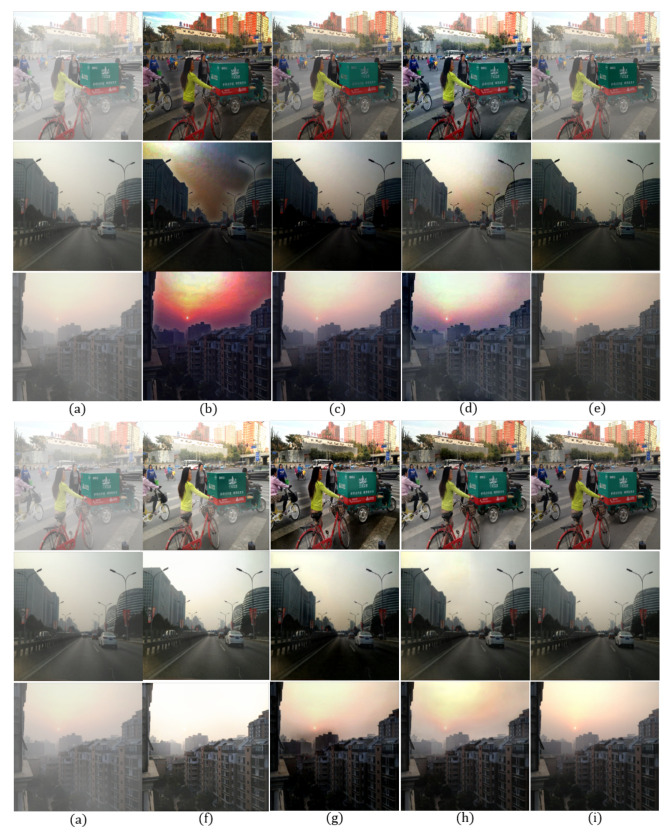
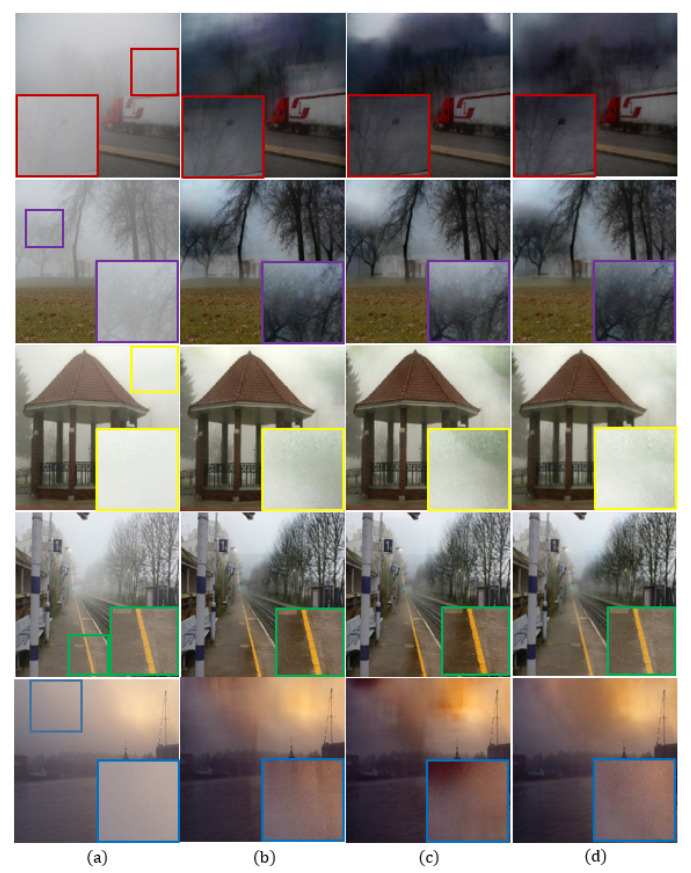
In a hazy environment, visibility is reduced and objects are difficult to identify. For this reason, many dehazing techniques have been proposed to remove the haze. Especially, in the case of the atmospheric scattering model estimation-based method, there is a problem of distortion when inaccurate models are estimated. We present a novel residual-based dehazing network model to overcome the performance limitation in an atmospheric scattering model-based method. More specifically, the proposed model adopted the gate fusion network that generates the dehazed results using a residual operator. To further reduce the divergence between the clean and dehazed images, the proposed discriminator distinguishes dehazed results and clean images, and then reduces the statistical difference via adversarial learning. To verify each element of the proposed model, we hierarchically performed the haze removal process in an ablation study. Experimental results show that the proposed method outperformed state-of-the-art approaches in terms of peak signal-to-noise ratio (PSNR), structural similarity index measure (SSIM), international commission on illumination cie delta e 2000 (CIEDE2000), and mean squared error (MSE). It also gives subjectively high-quality images without color distortion or undesired artifacts for both synthetic and real-world hazy images.
在雾霾环境中,能见度降低,物体难以辨认。因此,人们提出了许多去雾技术来去除雾霾。特别是在基于大气散射模型估计的方法中,当估计的模型不准确时会出现失真问题。我们提出了一种新颖的基于残差的去雾网络模型,以克服基于大气散射模型的方法中的性能限制。更具体地说,所提出的模型采用了门融合网络,该网络使用残差算子生成去雾结果。为了进一步减少清晰图像和去雾图像之间的差异,所提出的判别器区分去雾结果和清晰图像,然后通过对抗学习减少统计差异。为了验证所提出模型的每个元素,我们在消融研究中分层执行了去雾过程。实验结果表明,所提出的方法在峰值信噪比(PSNR)、结构相似性指数测量(SSIM)、国际照明委员会 cie 色差 e 2000(CIEDE2000)和均方误差(MSE)方面优于现有方法。对于合成和真实世界的雾霾图像,它还能给出主观上高质量的图像,且没有颜色失真或不期望的伪影。