Ambreen Ghazala, Duse Lili, Tariq Imran, Ali Uzma, Ali Sajid, Pinnapireddy Shashank R, Bette Michael, Bakowsky Udo, Mandic Robert
Department of Pharmaceutics and Biopharmaceutics, Philipps-Universität Marburg, 35037 Marburg, Germany.
Department of Otorhinolaryngology, Head and Neck Surgery, University Hospital Marburg, Philipps-Universität Marburg, 35033 Marburg, Germany.
Cancers (Basel). 2020 Nov 5;12(11):3278. doi: 10.3390/cancers12113278.
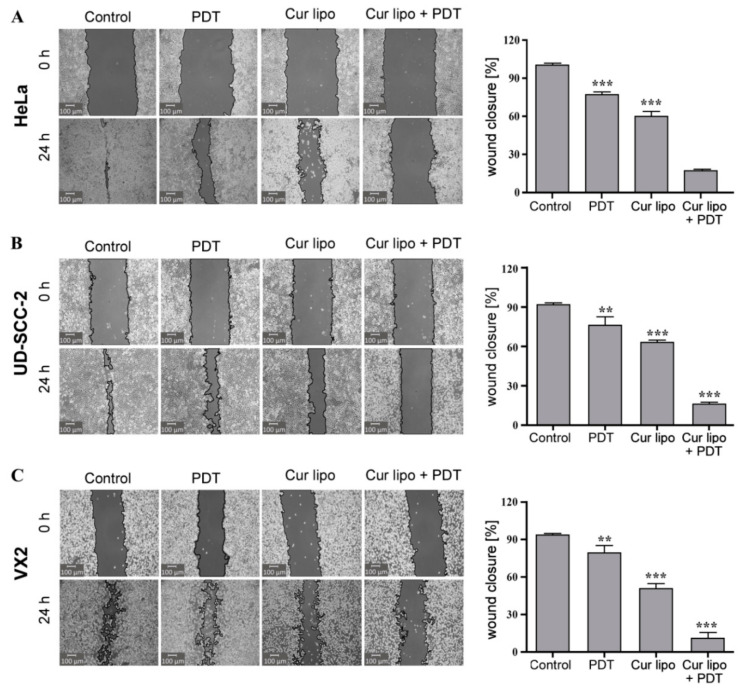
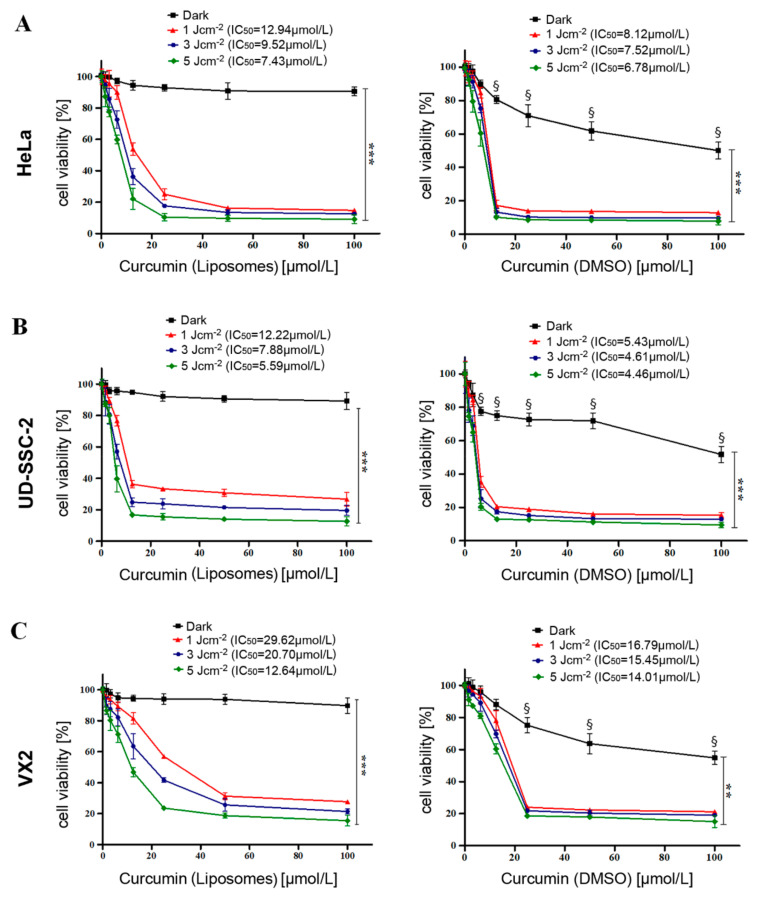
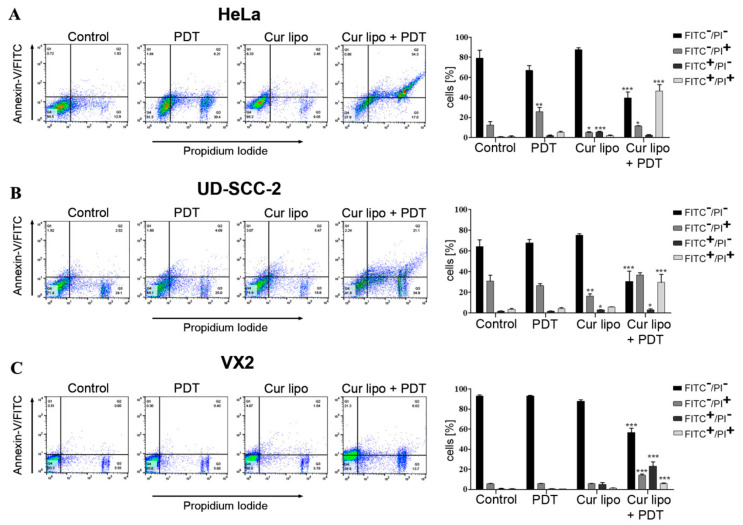
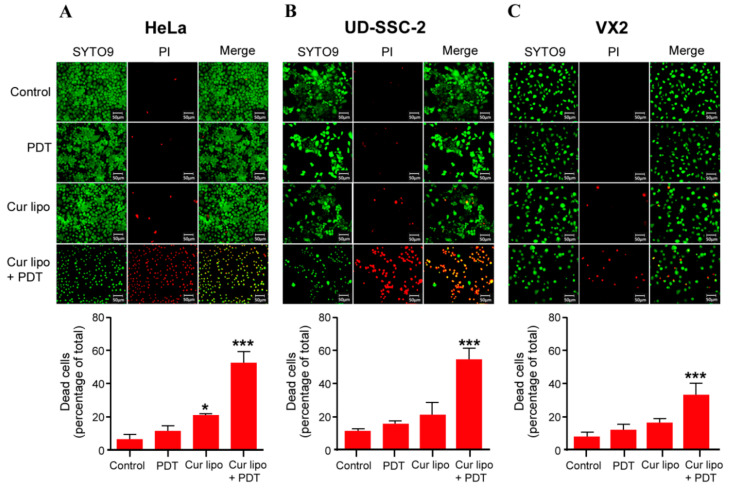
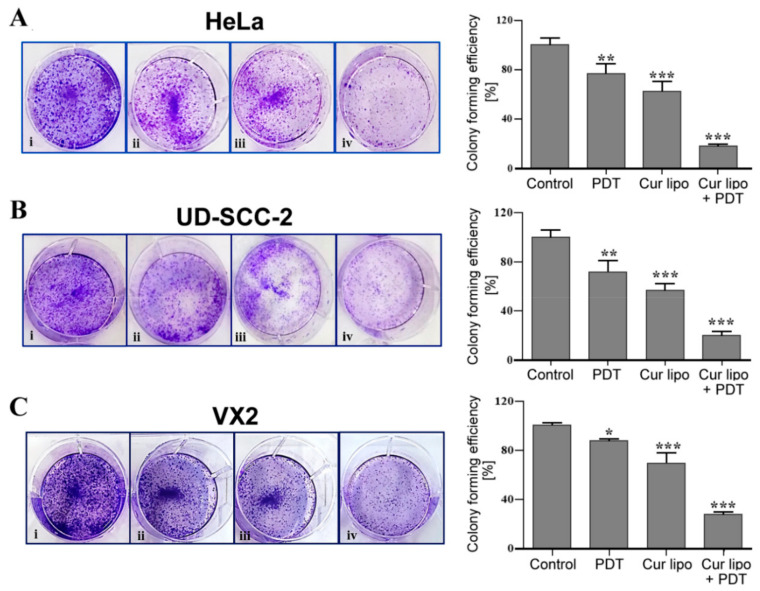
Photodynamic therapy (PDT) is a minimally invasive therapeutic approach used in the treatment of various medical conditions and cancerous diseases, involving light, a photosensitizing substance, and oxygen. Curcumin, a naturally occurring compound, carries antitumor activities and potentially could be exploited as a photosensitizer in PDT. Only little is known about liposomal-encapsulated curcumin that could help in increasing the efficacy, stability, and bioavailability of this compound. This study investigates the in vitro effects of curcumin-loaded liposomes in combination with PDT. Three papilloma virus-associated cell lines were treated with curcumin-loaded liposomes corresponding to a curcumin concentration of 0-100 µmol/L for 4 h followed by illumination at 457 nm (blue) for 45, 136, and 227 s at a fluence of 220.2 W/m (100 mA) corresponding to 1, 3 and 5 J·cm. After 24 h, the biological outcome of the treatment was assessed with the MTT (3-(4,5-dimethylthiazol-2-yl)-2,5-diphenyltetrazolium bromide), SYTO9/PI (propidium iodide), Annexin V-FITC (fluorescein isothiocyanate)/PI, clonogenic survival, and scratch (wound closure) assays. Photoactivation of curcumin-loaded liposomes led to a significant reduction in colony formation and migratory abilities, as well as to an increase in tumor cell death. The results point to the combination of curcumin-loaded liposomes with PDT as a potentially useful tool for the treatment of papillomavirus-associated malignancies.
光动力疗法(PDT)是一种微创治疗方法,用于治疗各种医学病症和癌症疾病,涉及光、光敏物质和氧气。姜黄素是一种天然存在的化合物,具有抗肿瘤活性,有可能被用作光动力疗法中的光敏剂。关于脂质体包裹的姜黄素,人们知之甚少,而这种包裹方式有助于提高该化合物的疗效、稳定性和生物利用度。本研究调查了负载姜黄素的脂质体与光动力疗法联合使用的体外效果。用对应于0 - 100 μmol/L姜黄素浓度的负载姜黄素的脂质体处理三种乳头瘤病毒相关细胞系4小时,然后在457 nm(蓝光)下以220.2 W/m²(100 mA)的通量照射45、136和227秒,分别对应1、3和5 J·cm⁻²。24小时后,使用MTT(3-(4,5-二甲基噻唑-2-基)-2,5-二苯基四氮唑溴盐)、SYTO9/PI(碘化丙啶)、膜联蛋白V-异硫氰酸荧光素(FITC)/PI、克隆形成存活率和划痕(伤口闭合)试验评估治疗的生物学结果。负载姜黄素的脂质体的光激活导致集落形成和迁移能力显著降低,以及肿瘤细胞死亡增加。结果表明,负载姜黄素的脂质体与光动力疗法联合使用可能是治疗乳头瘤病毒相关恶性肿瘤的有用工具。