Department of Medicine, Division of Preventive Medicine, University of Alabama at Birmingham, Medical Towers 62, 1717 11th Avenue South, Birmingham, AL, 35205, USA.
School of Public Health, University of Alabama at Birmingham, 1665 University Blvd, Birmingham, AL, 35233, USA.
BMC Public Health. 2020 Nov 10;20(1):1678. doi: 10.1186/s12889-020-09793-0.
Most studies among Hispanics have focused on individual risk factors of obesity, with less attention on interpersonal, community and environmental determinants. Conducting community based surveys to study these determinants must ensure representativeness of disparate populations. We describe the use of a novel Geographic Information System (GIS)-based population based sampling to minimize selection bias in a rural community based study.
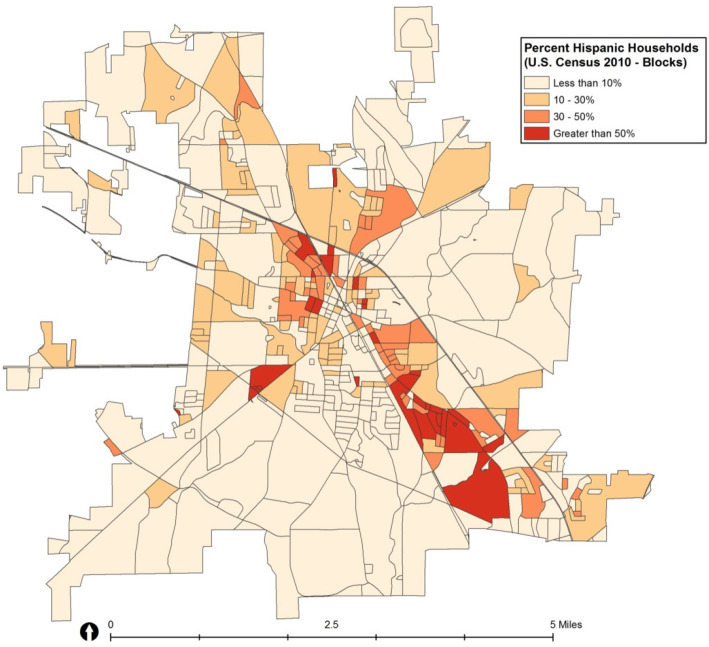
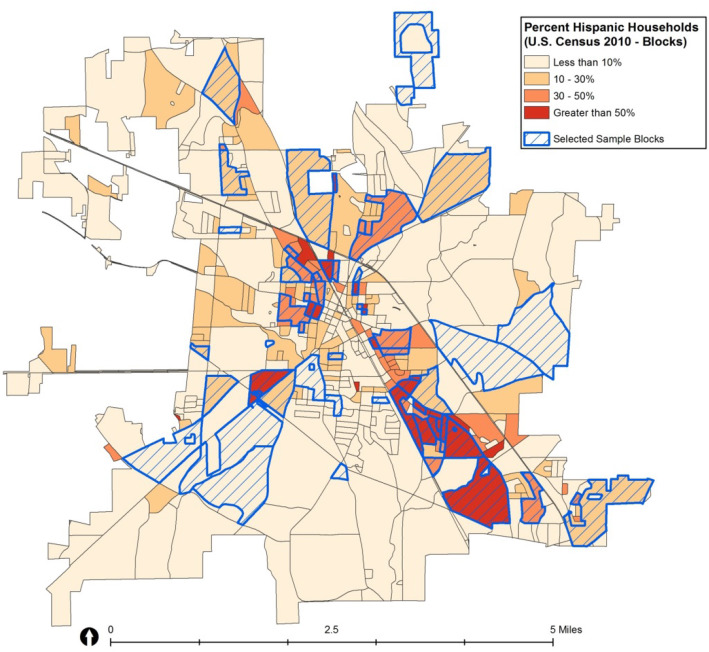
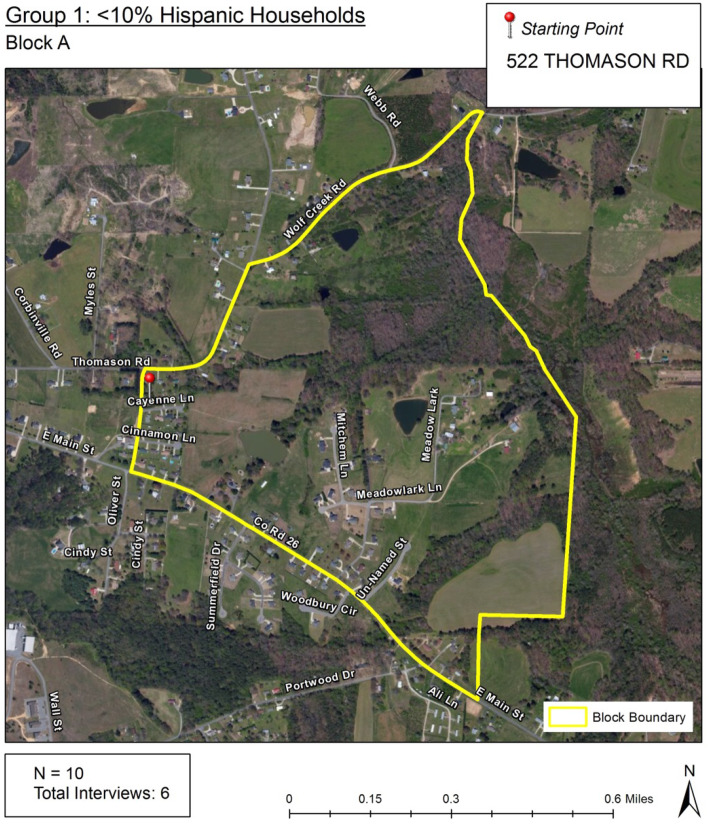
We conducted a community based survey to collect and examine social determinants of health and their association with obesity prevalence among a sample of Hispanics and non-Hispanic whites living in a rural community in the Southeastern United States. To ensure a balanced sample of both ethnic groups, we designed an area stratified random sampling procedure involving three stages: (1) division of the sampling area into non-overlapping strata based on Hispanic household proportion using GIS software; (2) random selection of the designated number of Census blocks from each stratum; and (3) random selection of the designated number of housing units (i.e., survey participants) from each Census block.
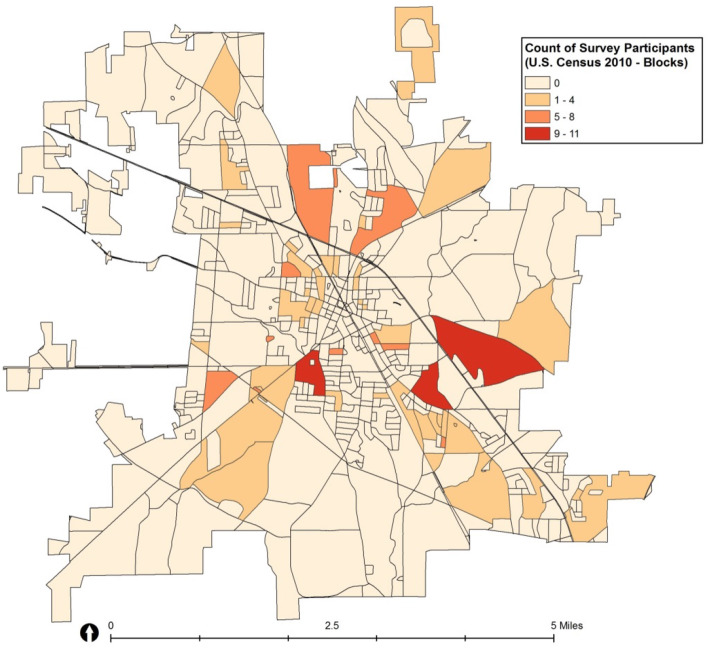
The proposed sample included 109 Hispanic and 107 non-Hispanic participants to be recruited from 44 Census blocks. The final sample included 106 Hispanic and 111 non-Hispanic participants. The proportion of Hispanic surveys completed per strata matched our proposed distribution: 7% for strata 1, 30% for strata 2, 58% for strata 3 and 83% for strata 4.
Utilizing a standardized area based randomized sampling approach allowed us to successfully recruit an ethnically balanced sample while conducting door to door surveys in a rural, community based study. The integration of area based randomized sampling using tools such as GIS in future community-based research should be considered, particularly when trying to reach disparate populations.
大多数针对西班牙裔的研究都集中在肥胖的个体风险因素上,而对人际、社区和环境决定因素的关注较少。进行基于社区的调查以研究这些决定因素必须确保不同人群的代表性。我们描述了一种新的基于地理信息系统(GIS)的基于人群的抽样方法,以最小化基于农村社区的研究中的选择偏差。
我们进行了一项基于社区的调查,以收集和检查健康的社会决定因素及其与生活在美国东南部农村社区的西班牙裔和非西班牙裔白人群体肥胖患病率之间的关系。为了确保两个种族群体的样本平衡,我们设计了一个涉及三个阶段的区域分层随机抽样程序:(1)使用 GIS 软件根据西班牙裔家庭比例将抽样区域划分为不重叠的层;(2)从每个层中随机选择指定数量的普查块;(3)从每个普查块中随机选择指定数量的住房单元(即调查参与者)。
拟议的样本包括从 44 个普查块中招募的 109 名西班牙裔和 107 名非西班牙裔参与者。最终样本包括 106 名西班牙裔和 111 名非西班牙裔参与者。每个层完成的西班牙裔调查比例与我们提出的分布相匹配:第 1 层为 7%,第 2 层为 30%,第 3 层为 58%,第 4 层为 83%。
利用基于区域的标准化随机抽样方法,我们成功地招募了一个种族平衡的样本,同时在农村社区进行了挨家挨户的调查。在未来的基于社区的研究中,应考虑使用 GIS 等工具进行基于区域的随机抽样,特别是在试图接触不同人群时。