Division of Emergency Medicine, Department of Anesthesiology, Clinical Pharmacology, Intensive Care and Emergency Medicine, University of Geneva Hospitals and Faculty of Medicine, Rue Gabrielle-Perret-Gentil 4, 1211, Geneva 14, Switzerland.
Genève TEAM Ambulances, Geneva, Switzerland.
Antimicrob Resist Infect Control. 2020 Nov 10;9(1):185. doi: 10.1186/s13756-020-00849-9.
Prehospital professionals such as emergency physicians or paramedics must be able to choose and adequately don and doff personal protective equipment (PPE) in order to avoid COVID-19 infection. Our aim was to evaluate the impact of a gamified e-learning module on adequacy of PPE in student paramedics.
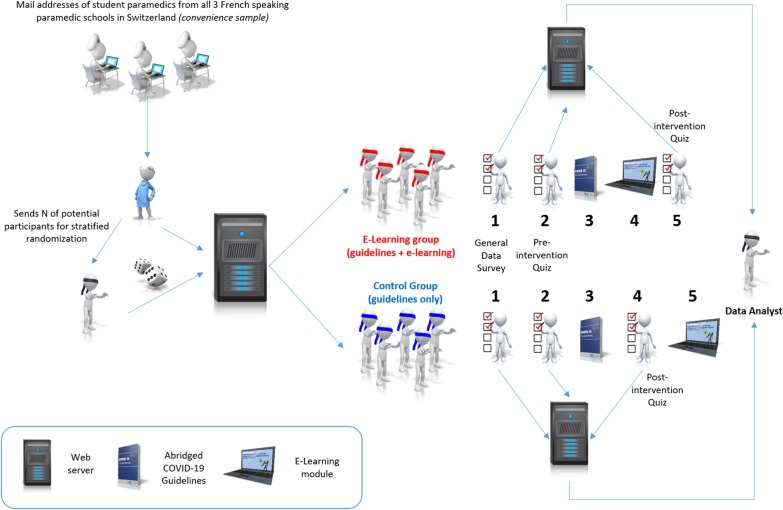
This was a web-based, randomized 1:1, parallel-group, triple-blind controlled trial. Student paramedics from three Swiss schools were invited to participate. They were informed they would be presented with both an e-learning module and an abridged version of the current regional prehospital COVID-19 guidelines, albeit not in which order. After a set of 22 questions designed to assess baseline knowledge, the control group was shown the guidelines before answering a set of 14 post-intervention questions. The e-learning group was shown the gamified e-learning module right after the guidelines, and before answering post-intervention questions. The primary outcome was the difference in the percentage of adequate choices of PPE before and after the intervention.
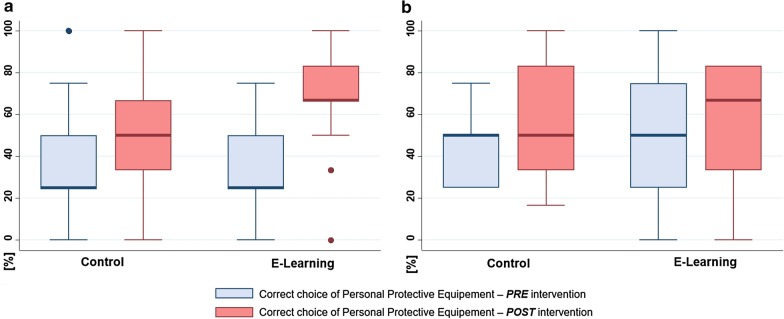
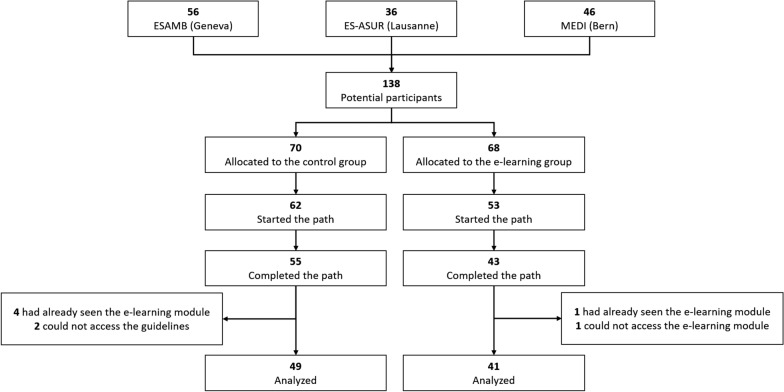
The participation rate was of 71% (98/138). A total of 90 answer sets was analyzed. Adequate choice of PPE increased significantly both in the control (50% [33;83] vs 25% [25;50], P = .013) and in the e-learning group (67% [50;83] vs 25% [25;50], P = .001) following the intervention. Though the median of the difference was higher in the e-learning group, there was no statistically significant superiority over the control (33% [0;58] vs 17% [- 17;42], P = .087). The e-learning module was of greatest benefit in the subgroup of student paramedics who were actively working in an ambulance company (42% [8;58] vs 25% [- 17;42], P = 0.021). There was no significant effect in student paramedics who were not actively working in an ambulance service (0% [- 25;33] vs 17% [- 8;50], P = .584).
The use of a gamified e-learning module increases the rate of adequate choice of PPE only among student paramedics actively working in an ambulance service. In this subgroup, combining this teaching modality with other interventions might help spare PPE and efficiently protect against COVID-19 infection.
为避免 COVID-19 感染,急救医师或护理人员等现场专业人员必须能够选择和正确穿戴个人防护设备 (PPE)。我们的目的是评估一款基于游戏的电子学习模块对学生护理人员 PPE 穿戴是否合适的影响。
这是一项基于网络的、随机 1:1 平行组、三盲对照试验。邀请了来自三所瑞士学校的学生护理人员参加。他们被告知将同时呈现电子学习模块和当前地区现场 COVID-19 指南的简化版,尽管不知道顺序如何。在回答一组 14 个干预后问题之前,对一组 22 个旨在评估基线知识的问题进行了回答。对照组在回答问题之前先观看指南,而电子学习组则在观看完指南后立即观看基于游戏的电子学习模块。主要结果是干预前后 PPE 选择是否合适的百分比差异。
参与率为 71%(98/138)。共分析了 90 个答案。对照组(50%[33;83]与 25%[25;50],P=0.013)和电子学习组(67%[50;83]与 25%[25;50],P=0.001)的 PPE 选择均显著增加。虽然电子学习组的差异中位数更高,但与对照组相比,没有统计学上的优势(33%[0;58]与 17%[-17;42],P=0.087)。电子学习模块对在救护公司工作的学生护理人员最有帮助(42%[8;58]与 25%[-17;42],P=0.021)。对于不在救护服务机构工作的学生护理人员,没有显著影响(0%[-25;33]与 17%[-8;50],P=0.584)。
使用基于游戏的电子学习模块仅能提高在救护公司工作的学生护理人员选择 PPE 的合适率。在这个亚组中,将这种教学模式与其他干预措施相结合,可能有助于节省 PPE 并有效地预防 COVID-19 感染。