Callejas Diana, Echevarría José M, Carrero Yenddy, Rodríguez-Morales Alfonso J, Moreira Ruth
Facultad de Ciencias de la Salud, Universidad Técnica de Manabí, Portoviejo, Manabí Ecuador.
Facultad de Biología, Universidad Complutense, Madrid, Spain.
Curr Trop Med Rep. 2020;7(4):120-125. doi: 10.1007/s40475-020-00219-w. Epub 2020 Nov 3.
Acute respiratory infections of viral etiology (ARIVE) constitute one of the most frequent infectious processes among humans. They cause significant morbidity and mortality every year in all age groups and regions of the world. Their etiology is diverse, and seasonal viruses began their journey, at some point, with an episode of expansion before their annual circulation as seasonal agents. The coronavirus disease 2019 (COVID-19) pandemic is a challenge for Latin America. Understanding dynamics is essential for decision making, to reduce the health, economic, and social impacts of the pandemic.
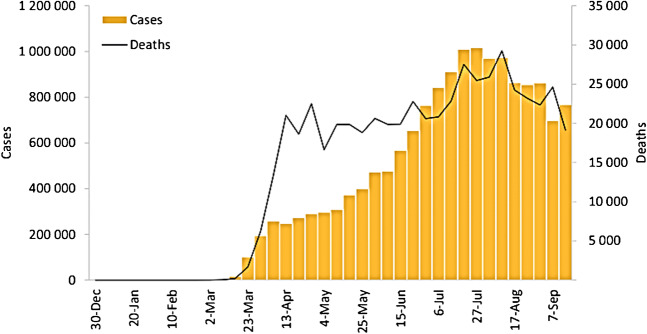
Currently, governments in Latin America have taken measures to mitigate the spread of COVID-19 primarily based on World Health Organization recommendations. However, the potential impact of the virus in Latin America is still unknown. Given the urgency, governments need more accurate estimates of what could happen in Latin America in order to make informed decisions, At the September 20, 2020, cumulative cases 2295 of COVID-19 per 1 million population has been registered in Latin America and the Caribbean. Brazil, Peru, and Chile are the most countries affected by this pandemic, registering a total of cumulative cases per million inhabitants of 21,148, 22,941, and 23,262 respectively. Peru has shown the highest death numbers with 949 per million inhabitants.
The Latin American health authorities should make the most beneficial decisions based in scientific facts for the health and life of citizens, both understood in the broadest and most inclusive sense.Once the epidemic is over, Latin America should begin a profound health reform, at a single and universal health system, integrated and coordinated, where the leading role of the Ministry of Health is resumed, to have a national network of modern, integrated, and excellent quality laboratories for the benefit of the entire society.
病毒性病因的急性呼吸道感染(ARIVE)是人类最常见的感染性疾病之一。每年在世界所有年龄组和地区,它们都会导致显著的发病率和死亡率。其病因多种多样,季节性病毒在作为季节性病原体进行年度传播之前,在某个阶段会经历一次传播扩张期。2019年冠状病毒病(COVID-19)大流行对拉丁美洲构成了挑战。了解其动态对于决策至关重要,以便减少大流行对健康、经济和社会的影响。
目前,拉丁美洲各国政府主要根据世界卫生组织的建议采取措施来减轻COVID-19的传播。然而,该病毒在拉丁美洲的潜在影响仍不明确。鉴于紧迫性,各国政府需要更准确地估计拉丁美洲可能发生的情况,以便做出明智的决策。截至2020年9月20日,拉丁美洲和加勒比地区每百万人口中COVID-19的累计病例数为2295例。巴西、秘鲁和智利是受此次大流行影响最严重的国家,每百万居民的累计病例数分别为21148例、22941例和23262例。秘鲁的死亡人数最高,每百万居民中有949人死亡。
拉丁美洲卫生当局应以科学事实为基础,为公民的健康和生活做出最有利的决策,这应从最广泛和最具包容性的意义上去理解。一旦疫情结束,拉丁美洲应启动一项深刻的卫生改革,建立一个单一、普遍、综合且协调的卫生系统,恢复卫生部的主导作用,建立一个全国性的现代化、综合且高质量的实验室网络,以造福整个社会。