Digestive Surgery Unit, Fondazione Policlinico Universitario "A. Gemelli" IRCCS di Roma, Largo Agostino Gemelli, 8, 00168, Rome, Italy.
Università Cattolica del Sacro Cuore di Roma, Rome, Italy.
Updates Surg. 2021 Jun;73(3):1081-1091. doi: 10.1007/s13304-020-00911-6. Epub 2020 Nov 10.
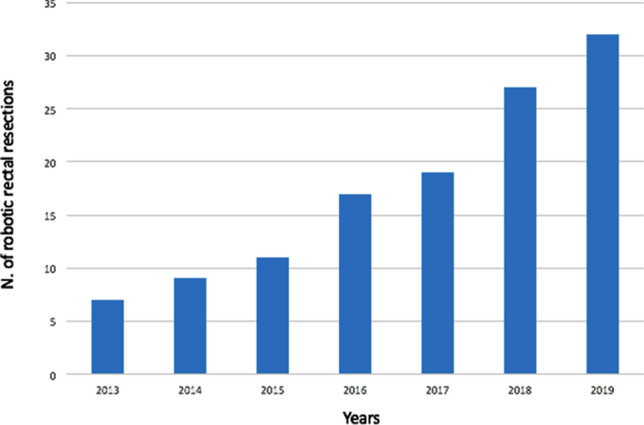
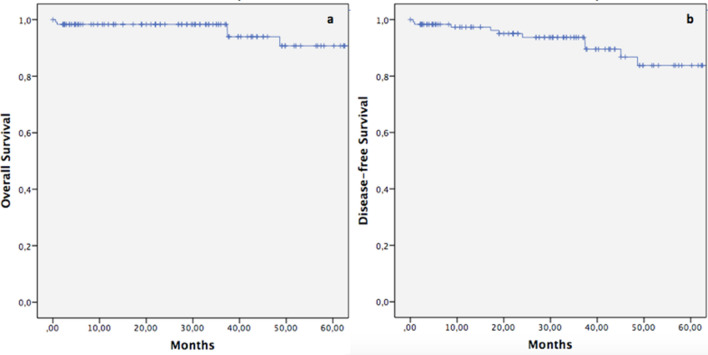
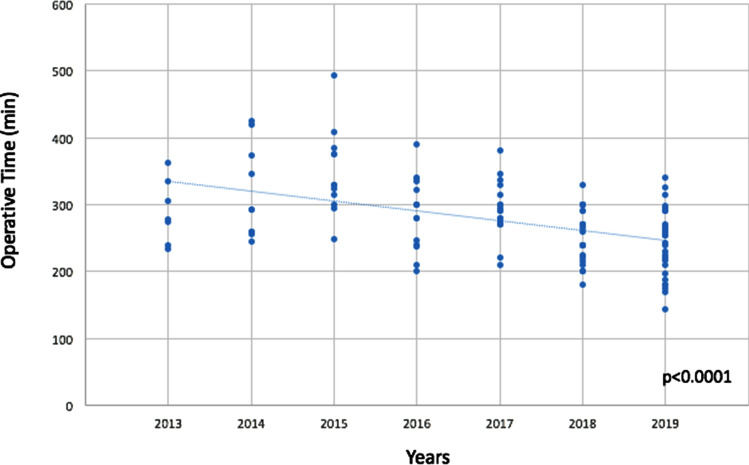
Robotic surgery has progressively gained popularity in the treatment of rectal cancer. However, only a few studies on its oncologic effectiveness are currently present, with contrasting results. The purpose of this study is to report a single surgeon's experience on robotic rectal resection (RRR) for cancer, focusing on the analysis of oncologic outcomes, both in terms of pathological features and long-term results. One-hundred and twenty-two consecutive patients who underwent RRR for rectal cancer from January 2013 to December 2019 were retrospectively enrolled. Patients' characteristics and perioperative outcomes were collected. The analyzed oncologic outcomes were pathological features [distal (DM), circumferential margin (CRM) status and quality of mesorectal excision (TME)] and long-term outcomes [overall (OS) and disease-free survival (DFS)]. The mean operative time was 275 (± 60.5) minutes. Conversion rate was 6.6%. Complications occurred in 27 cases (22.1%) and reoperation was needed in 2 patients (1.5%). The median follow-up was 30.5 (5.9-86.1) months. None presented DM positivity. CRM positivity was 2.5% (2 cases) while a complete TME was reached in 94.3% of cases (115 patients). Recurrence rate was 5.7% (2 local, 4 distant and 1 local plus distant tumor relapse). OS and DFS were 90.7% and 83%, respectively. At the multivariate analysis, both CRM positivity and near complete/incomplete TME were recognized as negative prognostic factors for OS and DFS. Under appropriate logistic and operative conditions, robotic surgery for rectal cancer proves to be oncologically effective, with adequate pathological results and long-term outcomes. It also offers acceptable peri-operative outcomes, further confirming the safety and feasibility of the technique.
机器人手术在直肠癌治疗中逐渐普及。然而,目前仅有少数关于其肿瘤学疗效的研究,结果存在差异。本研究旨在报告一位外科医生在机器人直肠切除术(RRR)治疗直肠癌方面的经验,重点分析肿瘤学结果,包括病理特征和长期结果。2013 年 1 月至 2019 年 12 月,连续 122 例接受 RRR 治疗的直肠癌患者被回顾性纳入研究。收集患者的特征和围手术期结果。分析的肿瘤学结果包括病理特征(远端切缘[DM]、环周切缘[CRM]状态和中直肠系膜切除[TME]质量)和长期结果(总生存期[OS]和无病生存期[DFS])。平均手术时间为 275(±60.5)分钟。中转率为 6.6%。27 例(22.1%)发生并发症,2 例(1.5%)需要再次手术。中位随访时间为 30.5(5.9-86.1)个月。无 DM 阳性病例。CRM 阳性率为 2.5%(2 例),94.3%(115 例)达到完全 TME。复发率为 5.7%(2 例局部复发,4 例远处转移,1 例局部加远处肿瘤复发)。OS 和 DFS 分别为 90.7%和 83%。多因素分析显示,CRM 阳性和近完全/不完全 TME 是 OS 和 DFS 的不良预后因素。在适当的逻辑和手术条件下,机器人手术治疗直肠癌在肿瘤学上是有效的,具有足够的病理结果和长期结果。它还提供了可接受的围手术期结果,进一步证实了该技术的安全性和可行性。