Davis School of Gerontology, University of Southern California, Los Angeles, California, United States of America.
PLoS One. 2020 Nov 10;15(11):e0241950. doi: 10.1371/journal.pone.0241950. eCollection 2020.
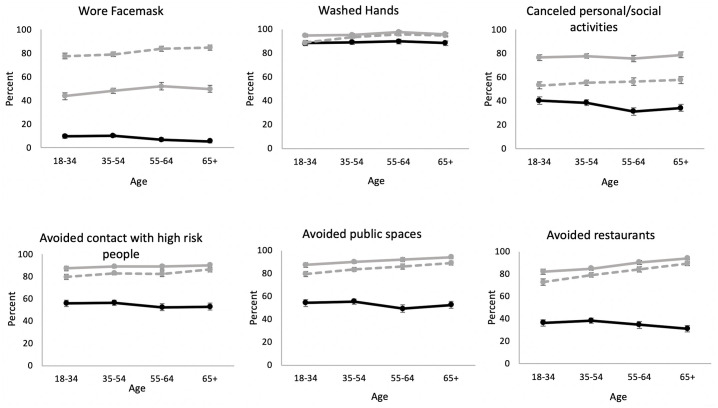
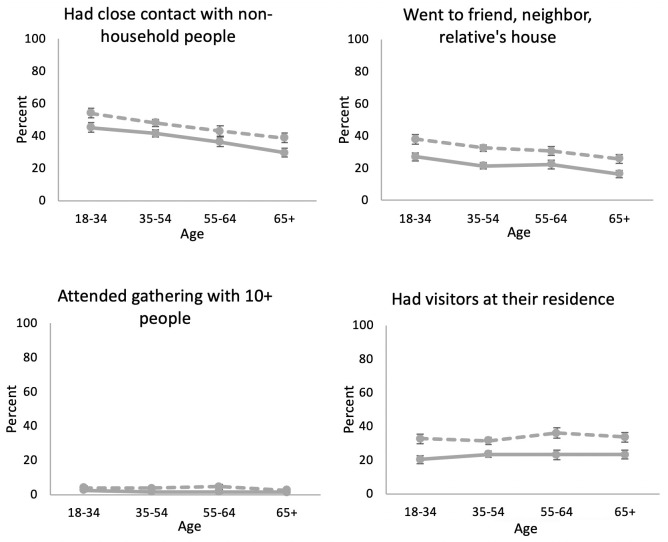
The COVID-19 pandemic has had tremendous impact on Americans' lives including their personal and social behaviors. While people of all ages are affected in some way by the pandemic, older persons have been far more likely to suffer the most severe health consequences. For this reason, how people have responded to mitigating behaviors to COVID-19 may differ by age. Using a nationally representative sample from the longitudinal data of the Understanding America Study (UAS), we examined differentials in behavioral responses to COVID-19 by age and how they changed over the first three months of the pandemic. Behavioral responses and changes in behavior over time differed by age, type of behaviors and time reference. At the beginning of the pandemic (March, 2020), older and younger people were similar in their likelihood of engaging in preventive personal behaviors when controlling for other influences. As the pandemic progressed, however, older people adopted mitigating personal behavioral changes more than younger people, such that about 1-2 months after the pandemic started, older people were more likely to comply with suggested behaviors and regulations including practicing better hygiene, quarantining, and social distancing. One month into the pandemic, older people were less likely than younger people to engage in two of four risky behaviors. The change in risky behavior over time did not differ by age; but both younger and older people were more likely to engage in risky behaviors after two months. Being female, a member of a racial/ethnic minority group, higher socioeconomic status, having more COVID-19 cases in one's state of residence, a higher perceived risk for infection and dying, and a more left-leaning political orientation were related to adopting more pandemic mitigating behaviors.
新冠疫情对美国人的生活产生了巨大影响,包括个人和社会行为。虽然所有年龄段的人都在某种程度上受到疫情的影响,但老年人更有可能遭受最严重的健康后果。因此,人们对减轻新冠疫情行为的反应可能因年龄而异。本研究使用了美国理解研究(UAS)纵向数据的全国代表性样本,我们根据年龄考察了对新冠疫情行为的反应差异,以及这些差异在疫情的前三个月是如何变化的。行为反应和随时间变化的行为因年龄、行为类型和时间参照点而异。在疫情开始时(2020 年 3 月),在控制其他因素的情况下,老年人和年轻人在采取预防个人行为的可能性上相似。然而,随着疫情的发展,老年人采取减轻个人行为变化的可能性超过了年轻人,以至于在疫情开始约 1-2 个月后,老年人更有可能遵守建议的行为和规定,包括更好地保持卫生、隔离和保持社交距离。在疫情开始一个月后,老年人从事四种危险行为的可能性低于年轻人。随时间变化的危险行为变化在年龄上没有差异;但无论是年轻人还是老年人,在两个月后更有可能从事危险行为。女性、种族/少数民族群体成员、较高的社会经济地位、居住州的新冠病例更多、更高的感染和死亡风险感知,以及更倾向于左派的政治取向,都与采取更多的大流行缓解行为有关。