• 文献检索
  • 文档翻译
  • 深度研究
  • 学术资讯
  • Suppr Zotero 插件Zotero 插件
  • 邀请有礼
  • 套餐&价格
  • 历史记录
应用&插件
Suppr Zotero 插件Zotero 插件浏览器插件Mac 客户端Windows 客户端微信小程序
定价
高级版会员购买积分包购买API积分包
服务
文献检索文档翻译深度研究API 文档MCP 服务
关于我们
关于 Suppr公司介绍联系我们用户协议隐私条款
关注我们

Suppr 超能文献

核心技术专利:CN118964589B侵权必究
粤ICP备2023148730 号-1Suppr @ 2026

文献检索

告别复杂PubMed语法,用中文像聊天一样搜索,搜遍4000万医学文献。AI智能推荐,让科研检索更轻松。

立即免费搜索

文件翻译

保留排版,准确专业,支持PDF/Word/PPT等文件格式,支持 12+语言互译。

免费翻译文档

深度研究

AI帮你快速写综述,25分钟生成高质量综述,智能提取关键信息,辅助科研写作。

立即免费体验

美国 COVID-19 大流行期间的媒体信任与感染缓解行为。

Media trust and infection mitigating behaviours during the COVID-19 pandemic in the USA.

机构信息

Leonard Davis School of Gerontology, University of Southern California, Los Angeles, California, USA

Leonard Davis School of Gerontology, University of Southern California, Los Angeles, California, USA.

出版信息

BMJ Glob Health. 2020 Oct;5(10). doi: 10.1136/bmjgh-2020-003323.

DOI:10.1136/bmjgh-2020-003323
PMID:33037063
原文链接:https://pmc.ncbi.nlm.nih.gov/articles/PMC7545496/
Abstract

INTRODUCTION

The COVID-19 pandemic is an unprecedented public health crisis. It is becoming increasingly clear that people's behavioural responses in the USA during this fast-changing pandemic are associated with their preferred media sources. The polarisation of US media has been reflected in politically motivated messaging around the coronavirus by some media outlets, such as Fox News. This resulted in different messaging around the risks of infection and behavioural changes necessary to mitigate that risk. This study determined if COVID-related behaviours differed according to trust in left-leaning or right-leaning media and how differences changed over the first several months of the pandemic.

METHODS

Using the nationally representative Understanding America Study COVID-19 panel, we examine preventive and risky behaviours related to infection from COVID-19 over the period from 10 March to 9 June for people with trust in different media sources: one left-leaning, CNN and another right-leaning, Fox News. People's media preferences are categorised into three groups: (1) those who trust CNN more than Fox News; (2) those who have equal or no preferences and (3) those who trust Fox News more than CNN.

RESULTS

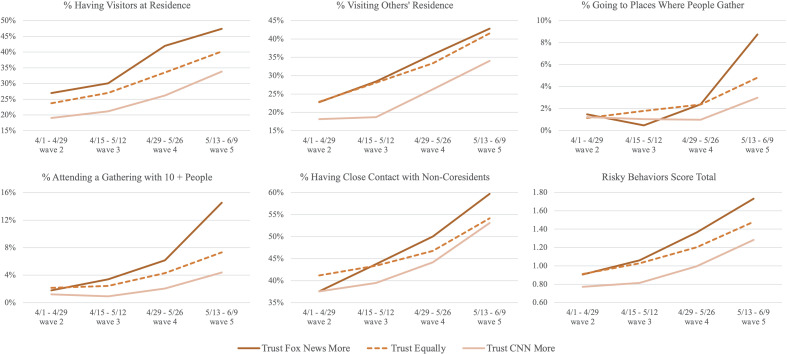
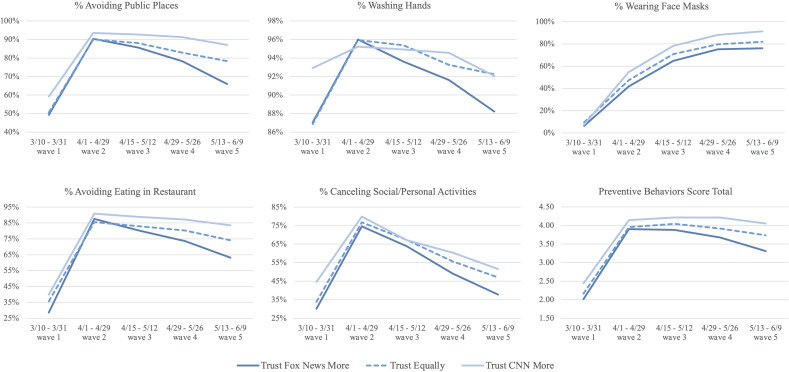
Results showed that compared with those who trust CNN more than Fox news, people who trust Fox News more than CNN engaged in fewer preventive behaviours and more risky behaviours related to COVID-19. Out of five preventive and five risky behaviours examined, people who trust Fox News more than CNN practised an average of 3.41 preventive behaviours and 1.25 risky behaviours, while those who trust CNN more than Fox News engaged in an average of 3.85 preventive and 0.94 risky behaviours, from late March to June. The difference between these two groups widened in the month of May (p≤0.01), even after controlling for access to professional information and overall diversity of information sources.

CONCLUSIONS

Our findings indicate that behavioural responses were divided along media bias lines. In such a highly partisan environment, false information can be easily disseminated, and health messaging, which is one of the few effective ways to slowdown the spread of the virus in the absence of a vaccine, is being damaged by politically biased and economically focused narratives. During a public health crisis, media should reduce their partisan stance on health information, and the health messaging from neutral and professional sources based on scientific findings should be better promoted.

摘要

简介

COVID-19 大流行是一场前所未有的公共卫生危机。越来越明显的是,美国人在这场快速变化的大流行中的行为反应与其偏好的媒体来源有关。美国媒体的两极分化反映在一些媒体机构围绕冠状病毒的政治动机信息传递上,例如福克斯新闻。这导致了关于感染风险和减轻该风险所需的行为改变的不同信息传递。本研究旨在确定对左倾或右倾媒体的信任是否会导致与 COVID 相关的行为差异,以及这种差异在大流行的头几个月是如何变化的。

方法

使用具有全国代表性的理解美国研究 COVID-19 小组,我们检查了从 3 月 10 日至 6 月 9 日期间与感染 COVID-19 相关的预防和危险行为,针对对不同媒体来源有信任的人群:一个是左倾的 CNN,另一个是右倾的福克斯新闻。人们的媒体偏好分为三组:(1)更信任 CNN 而不是福克斯新闻的人;(2)没有或同等偏好的人;(3)更信任福克斯新闻而不是 CNN 的人。

结果

结果表明,与更信任 CNN 而不是福克斯新闻的人相比,更信任福克斯新闻的人采取的预防行为较少,与 COVID-19 相关的危险行为较多。在检查的五项预防行为和五项危险行为中,更信任福克斯新闻的人平均采取 3.41 项预防行为和 1.25 项危险行为,而更信任 CNN 的人则平均采取 3.85 项预防行为和 0.94 项危险行为,从 3 月下旬到 6 月。即使在控制了获取专业信息和整体信息来源多样性之后,这两组之间的差距在 5 月份也有所扩大(p≤0.01)。

结论

我们的研究结果表明,行为反应沿着媒体偏见的界限划分。在这样一个高度党派化的环境中,虚假信息很容易传播,而在缺乏疫苗的情况下,健康信息传递是减缓病毒传播的少数有效方法之一,正受到政治偏见和以经济为中心的叙述的破坏。在公共卫生危机期间,媒体应该减少对健康信息的党派立场,应该更好地宣传基于科学发现的中立和专业来源的健康信息传递。
https://cdn.ncbi.nlm.nih.gov/pmc/blobs/5786/7545496/3a84b0bcb6ba/bmjgh-2020-003323f02.jpg
https://cdn.ncbi.nlm.nih.gov/pmc/blobs/5786/7545496/d3896ce6b053/bmjgh-2020-003323f01.jpg
https://cdn.ncbi.nlm.nih.gov/pmc/blobs/5786/7545496/3a84b0bcb6ba/bmjgh-2020-003323f02.jpg
https://cdn.ncbi.nlm.nih.gov/pmc/blobs/5786/7545496/d3896ce6b053/bmjgh-2020-003323f01.jpg
https://cdn.ncbi.nlm.nih.gov/pmc/blobs/5786/7545496/3a84b0bcb6ba/bmjgh-2020-003323f02.jpg

相似文献

1
Media trust and infection mitigating behaviours during the COVID-19 pandemic in the USA.美国 COVID-19 大流行期间的媒体信任与感染缓解行为。
BMJ Glob Health. 2020 Oct;5(10). doi: 10.1136/bmjgh-2020-003323.
2
Association Between Public Knowledge About COVID-19, Trust in Information Sources, and Adherence to Social Distancing: Cross-Sectional Survey.公众对 COVID-19 的了解、对信息源的信任与遵守社交距离措施之间的关联:横断面调查。
JMIR Public Health Surveill. 2020 Sep 15;6(3):e22060. doi: 10.2196/22060.
3
How does age affect personal and social reactions to COVID-19: Results from the national Understanding America Study.年龄如何影响个人和社会对 COVID-19 的反应:来自全国理解美国研究的结果。
PLoS One. 2020 Nov 10;15(11):e0241950. doi: 10.1371/journal.pone.0241950. eCollection 2020.
4
Intergroup Contact, COVID-19 News Consumption, and the Moderating Role of Digital Media Trust on Prejudice Toward Asians in the United States: Cross-Sectional Study.群体间接触、新冠疫情新闻消费以及数字媒体信任在美国对亚裔偏见的调节作用:横断面研究
J Med Internet Res. 2020 Sep 25;22(9):e22767. doi: 10.2196/22767.
5
Trends and Predictors of COVID-19 Information Sources and Their Relationship With Knowledge and Beliefs Related to the Pandemic: Nationwide Cross-Sectional Study.COVID-19 信息来源的趋势和预测因素及其与大流行相关知识和信念的关系:全国性横断面研究。
JMIR Public Health Surveill. 2020 Oct 8;6(4):e21071. doi: 10.2196/21071.
6
Investigating and Improving the Accuracy of US Citizens' Beliefs About the COVID-19 Pandemic: Longitudinal Survey Study.调查和提高美国公民对新冠疫情的认知准确性:纵向调查研究。
J Med Internet Res. 2021 Jan 12;23(1):e24069. doi: 10.2196/24069.
7
Association of a Public Health Campaign About Coronavirus Disease 2019 Promoted by News Media and a Social Influencer With Self-reported Personal Hygiene and Physical Distancing in the Netherlands.新闻媒体和社交媒体影响者联合开展的关于 2019 冠状病毒病的公共卫生宣传活动与荷兰人自我报告的个人卫生和保持身体距离行为之间的关联。
JAMA Netw Open. 2020 Jul 1;3(7):e2014323. doi: 10.1001/jamanetworkopen.2020.14323.
8
Public perceptions, anxiety and the perceived efficacy of health-protective behaviours to mitigate the spread of the SARS-Cov-2/ COVID-19 pandemic.公众认知、焦虑与健康保护行为在减轻 SARS-CoV-2/COVID-19 大流行传播方面的感知效果。
Public Health. 2020 Oct;187:67-73. doi: 10.1016/j.puhe.2020.08.002. Epub 2020 Aug 8.
9
Partisan Media, Trust, and Media Literacy: Regression Analysis of Predictors of COVID-19 Knowledge.党派媒体、信任与媒体素养:COVID-19知识预测因素的回归分析
JMIR Form Res. 2024 Jul 24;8:e53904. doi: 10.2196/53904.
10
South Africans' understanding of and response to the COVID-19 outbreak: An online survey.南非人对 COVID-19 疫情的理解和反应:一项在线调查。
S Afr Med J. 2020 Aug 11;110(9):894-902.

引用本文的文献

1
Reconsidering Trust and Information Engagement and Unpacking the Role of Emotion in Public Responses During the Early Stage of a Public Health Crisis in China: Web-Based Survey Study.重新审视信任与信息参与,并剖析情感在中国公共卫生危机早期公众反应中的作用:基于网络的调查研究
Online J Public Health Inform. 2025 Aug 25;17:e77790. doi: 10.2196/77790.
2
Trust, trust repair, and public health: a scoping review.信任、信任修复与公共卫生:一项范围综述
Front Public Health. 2025 Jun 11;13:1560089. doi: 10.3389/fpubh.2025.1560089. eCollection 2025.
3
The Understanding America Study (UAS).

本文引用的文献

1
Polarization and public health: Partisan differences in social distancing during the coronavirus pandemic.两极分化与公共卫生:新冠疫情期间社会 distancing 方面的党派差异。 (注:这里“social distancing”常见释义为“社交距离” ,但原文中该词似乎有误,可能是“social distancing measures”之类表述会更准确,直接翻译的话就是“社会距离” )
J Public Econ. 2020 Nov;191:104254. doi: 10.1016/j.jpubeco.2020.104254. Epub 2020 Aug 6.
2
Exposure to coronavirus news on mainstream media: The role of risk perceptions and depression.主流媒体上接触冠状病毒新闻:风险认知和抑郁的作用。
Br J Health Psychol. 2020 Nov;25(4):865-874. doi: 10.1111/bjhp.12427. Epub 2020 May 16.
3
《理解美国研究》(UAS)。
BMJ Open. 2024 Oct 23;14(10):e088183. doi: 10.1136/bmjopen-2024-088183.
4
Political identity and risk politics: Evidence from a pandemic.政治身份与风险政治:来自一场大流行病的证据。
Risk Anal. 2024 Oct 14. doi: 10.1111/risa.17654.
5
Self-rated health of Latino day laborers during the COVID-19 pandemic: a cross-sectional study.新冠疫情期间拉丁裔日工的自评健康状况:一项横断面研究
Res Sq. 2024 Aug 29:rs.3.rs-4810665. doi: 10.21203/rs.3.rs-4810665/v1.
6
Partisan Media, Trust, and Media Literacy: Regression Analysis of Predictors of COVID-19 Knowledge.党派媒体、信任与媒体素养:COVID-19知识预测因素的回归分析
JMIR Form Res. 2024 Jul 24;8:e53904. doi: 10.2196/53904.
7
Assessment of YouTube Videos in Patient Education for Coronary Artery Disease: A DISCERN-Based Cross-Sectional Analysis.基于DISCERN的横断面分析:评估YouTube上关于冠状动脉疾病患者教育的视频
Cureus. 2024 Jun 23;16(6):e62986. doi: 10.7759/cureus.62986. eCollection 2024 Jun.
8
Understanding the associations between information sources, sociodemographics, and views on public health measures: evidence from the COVID-19 pandemic in Austria.了解信息来源、社会人口统计学与对公共卫生措施的看法之间的关联:来自奥地利新冠疫情的证据。
BMC Public Health. 2024 Jun 12;24(1):1576. doi: 10.1186/s12889-024-19061-0.
9
Using narratives to correct politically charged health misinformation and address affective belief echoes.利用叙事来纠正带有政治色彩的健康错误信息,并解决情感共鸣的信仰问题。
J Public Health (Oxf). 2024 Aug 25;46(3):430-436. doi: 10.1093/pubmed/fdae050.
10
Media Trust and the COVID-19 Pandemic: An Analysis of Short-Term Trust Changes, Their Ideological Drivers and Consequences in Switzerland.媒体信任与新冠疫情:瑞士短期信任变化、其意识形态驱动因素及后果分析
Communic Res. 2023 Mar;50(2):205-229. doi: 10.1177/00936502221127484.
YouTube as a source of information on COVID-19: a pandemic of misinformation?
YouTube 上的 COVID-19 信息:信息错误大流行?
BMJ Glob Health. 2020 May;5(5). doi: 10.1136/bmjgh-2020-002604.
4
Identifying and Interrupting Superspreading Events-Implications for Control of Severe Acute Respiratory Syndrome Coronavirus 2.识别和中断超级传播事件——对严重急性呼吸综合征冠状病毒 2 控制的启示。
Emerg Infect Dis. 2020 Jun;26(6):1059-1066. doi: 10.3201/eid2606.200495. Epub 2020 Jun 17.
5
Incorporating media data into a model of infectious disease transmission.将媒体数据纳入传染病传播模型。
PLoS One. 2019 Feb 4;14(2):e0197646. doi: 10.1371/journal.pone.0197646. eCollection 2019.
6
Counterproductive Consequences of a Conservative Ideology: Medicaid Expansion and Personal Responsibility Requirements.保守主义意识形态的适得其反的后果:医疗补助扩大与个人责任要求
Am J Public Health. 2016 Jul;106(7):1181-7. doi: 10.2105/AJPH.2016.303192. Epub 2016 May 19.
7
Crisis and Emergency Risk Messaging in Mass Media News Stories: Is the Public Getting the Information They Need to Protect Their Health?大众媒体新闻报道中的危机与紧急风险信息传递:公众是否获得了保护自身健康所需的信息?
Health Commun. 2016 Oct;31(10):1215-22. doi: 10.1080/10410236.2015.1049728. Epub 2016 Mar 3.
8
Red state, blue state, flu state: media self-selection and partisan gaps in Swine flu vaccinations.红州、蓝州、流感州:媒体的自我选择与猪流感疫苗接种中的党派差距。
J Health Polit Policy Law. 2011 Dec;36(6):1021-59. doi: 10.1215/03616878-1460569. Epub 2011 Sep 26.
9
The polarizing effect of news media messages about the social determinants of health.新闻媒体关于健康社会决定因素的信息所产生的极化效应。
Am J Public Health. 2009 Dec;99(12):2160-7. doi: 10.2105/AJPH.2009.161414. Epub 2009 Oct 15.
10
Effective health risk communication about pandemic influenza for vulnerable populations.针对弱势群体进行有效的大流行性流感健康风险沟通。
Am J Public Health. 2009 Oct;99 Suppl 2(Suppl 2):S324-32. doi: 10.2105/AJPH.2009.162537.