Institute for Medical Microbiology, Immunology and Hygiene, Technische Universität München (TUM), 81675 Munich, Germany.
German Center for Infection Research (DZIF), Partner Site Munich, 81675 Munich, Germany.
Int J Mol Sci. 2020 Nov 6;21(21):8324. doi: 10.3390/ijms21218324.
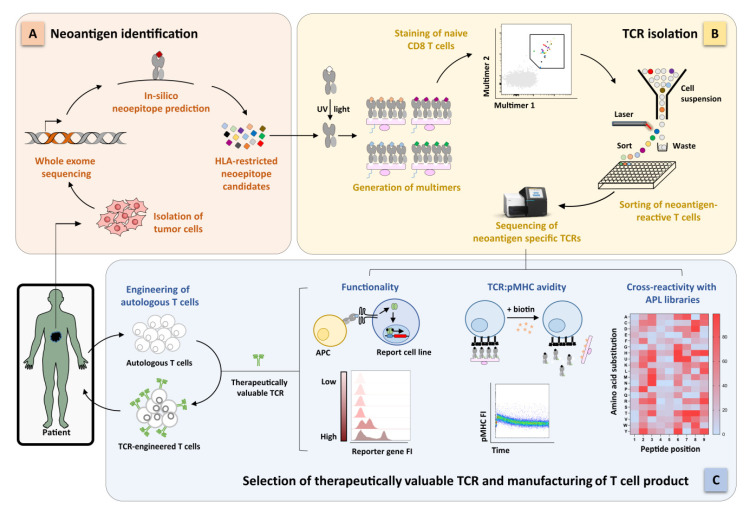
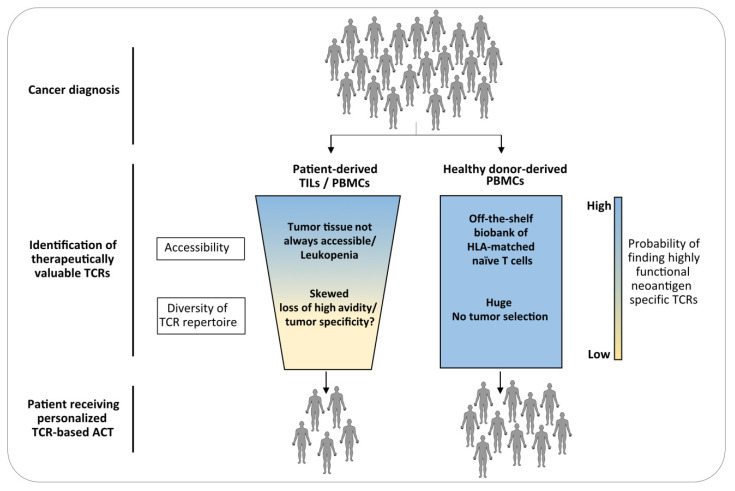
T cell engineering with antigen-specific T cell receptors (TCRs) has allowed the generation of increasingly specific, reliable, and versatile T cell products with near-physiological features. However, a broad applicability of TCR-based therapies in cancer is still limited by the restricted number of TCRs, often also of suboptimal potency, available for clinical use. In addition, targeting of tumor neoantigens with TCR-engineered T cell therapy moves the field towards a highly personalized treatment, as tumor neoantigens derive from somatic mutations and are extremely patient-specific. Therefore, relevant TCRs have to be de novo identified for each patient and within a narrow time window. The naïve repertoire of healthy donors would represent a reliable source due to its huge diverse TCR repertoire, which theoretically entails T cells for any antigen specificity, including tumor neoantigens. As a challenge, antigen-specific naïve T cells are of extremely low frequency and mostly of low functionality, making the identification of highly functional TCRs finding a "needle in a haystack." In this review, we present the technological advancements achieved in high-throughput mapping of patient-specific neoantigens and corresponding cognate TCRs and how these platforms can be used to interrogate the naïve repertoire for a fast and efficient identification of rare but therapeutically valuable TCRs for personalized adoptive T cell therapy.
T 细胞工程与抗原特异性 T 细胞受体(TCRs)的结合,使得具有近乎生理特征的越来越特异性、可靠性和多功能性的 T 细胞产品得以生成。然而,TCR 为基础的治疗在癌症中的广泛适用性仍然受到限制,因为可供临床使用的 TCR 数量有限,而且往往效力也不理想。此外,用 TCR 工程化的 T 细胞疗法靶向肿瘤新生抗原,使该领域朝着高度个性化的治疗方向发展,因为肿瘤新生抗原来源于体细胞突变,且具有极强的患者特异性。因此,必须为每个患者在狭窄的时间窗口内从头鉴定相关 TCR。健康供体的初始 T 细胞库由于其庞大的多样性 TCR 库,将成为可靠的来源,因为理论上它包含了针对任何抗原特异性的 T 细胞,包括肿瘤新生抗原。作为一个挑战,抗原特异性初始 T 细胞的频率极低,且功能大多较低,这使得鉴定高度功能性的 TCR 变得如同“大海捞针”。在这篇综述中,我们介绍了在高通量绘制患者特异性新生抗原和相应的同源 TCR 方面取得的技术进展,以及这些平台如何用于探索初始 T 细胞库,以快速、有效地鉴定用于个性化过继性 T 细胞治疗的稀有但具有治疗价值的 TCR。