Chang Haigang, Gao Caibin, Sun Kuisheng, Xiao Lifei, Li Xinxiao, Jiang Shucai, Zhu Changliang, Sun Tao, Jin Zhe, Wang Feng
Department of Neurosurgery, General Hospital of Ningxia Medical University, Yinchuan, China.
Department of Neurosurgery, The First Affiliated Hospital of Xinxiang Medical University, Weihui, China.
Front Psychiatry. 2020 Oct 14;11:577155. doi: 10.3389/fpsyt.2020.577155. eCollection 2020.
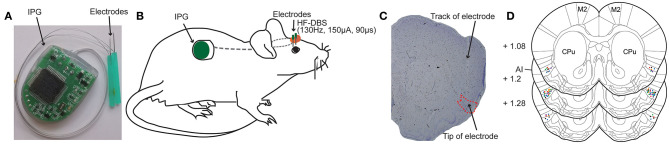
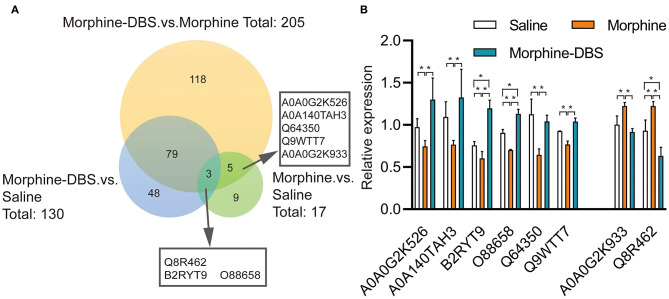
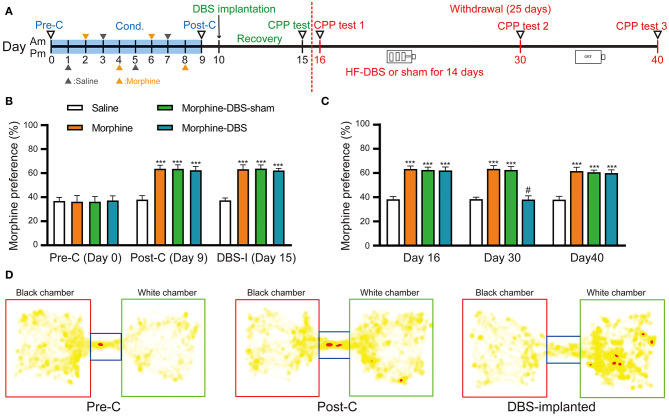
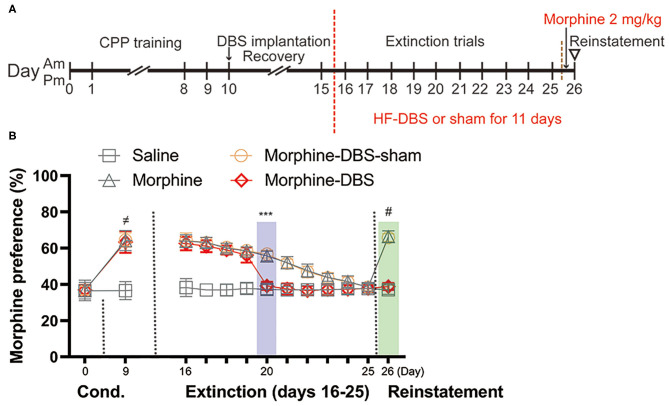
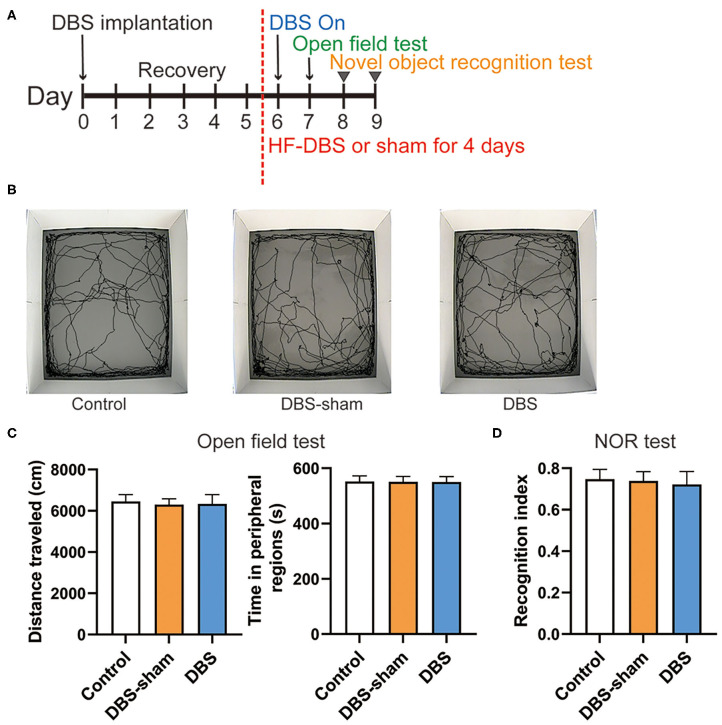
Deep brain stimulation (DBS) modulates the neuronal activity in specific brain circuits and has been recently considered as a promising intervention for refractory addiction. The insula cortex is the hub of interoception and is known to be involved in different aspects of substance use disorder. In the present study, we investigate the effects of continuous high frequency DBS in the anterior insula (AI) on drug-seeking behaviors and examined the molecular mechanisms of DBS action in morphine-addicted rats. Sprague-Dawley rats were trained to the morphine-conditioned place preference (CPP, day 1-8) followed by bilaterally implanted with DBS electrodes in the AI (Day 10) and recovery (Day 10-15). Continuous high-frequency (HF) -DBS (130 Hz, 150 μA, 90 μs) was applied during withdrawal (Day 16-30) or extinction sessions. CPP tests were conducted on days 16, 30, 40 during withdrawal session and several rats were used for proteomic analysis on day 30. Following the complete extinction, morphine-CPP was reinstated by a priming dose of morphine infusion (2 mg/kg). The open field and novel objective recognition tests were also performed to evaluate the DBS side effect on the locomotion and recognition memory. Continuous HF-DBS in the AI attenuated the expression of morphine-CPP post-withdrawal (Day 30), but morphine addictive behavior relapsed 10 days after the cessation of DBS (Day 40). Continuous HF-DBS reduced the period to full extinction of morphine-CPP and blocked morphine priming-induced recurrence of morphine addiction. HF-DBS in the AI had no obvious effect on the locomotor activity and novel objective recognition and did not cause anxiety-like behavior. In addition, our proteomic analysis identified eight morphine-regulated proteins in the AI and their expression levels were reversely changed by HF-DBS. Continuous HF-DBS in the bilateral anterior insula prevents the relapse of morphine place preference after withdrawal, facilitates its extinction, blocks the reinstatement induced by morphine priming and reverses the expression of morphine-regulated proteins. Our findings suggest that manipulation of insular activity by DBS could be a potential intervention to treat substance use disorder, although future research is warranted.
深部脑刺激(DBS)可调节特定脑回路中的神经元活动,最近被认为是一种治疗难治性成瘾的有前景的干预方法。岛叶皮质是内感受的中枢,已知其参与物质使用障碍的不同方面。在本研究中,我们研究了前岛叶(AI)持续高频DBS对觅药行为的影响,并探讨了DBS作用于吗啡成瘾大鼠的分子机制。将Sprague-Dawley大鼠训练至吗啡条件性位置偏爱(CPP,第1 - 8天),随后在第10天双侧植入AI的DBS电极并恢复(第10 - 15天)。在戒断期(第16 - 30天)或消退期施加持续高频(HF)-DBS(130 Hz,150 μA,90 μs)。在戒断期的第16、30、40天进行CPP测试,在第30天使用几只大鼠进行蛋白质组学分析。在完全消退后,通过注射一剂吗啡(2 mg/kg)恢复吗啡-CPP。还进行了旷场试验和新物体识别试验,以评估DBS对运动和识别记忆的副作用。AI持续HF-DBS可减轻戒断后(第30天)吗啡-CPP的表达,但在DBS停止10天后(第40天)吗啡成瘾行为复发。持续HF-DBS缩短了吗啡-CPP完全消退的时间,并阻断了吗啡激发诱导的吗啡成瘾复发。AI中的HF-DBS对运动活动和新物体识别没有明显影响,也不会引起焦虑样行为。此外,我们的蛋白质组学分析确定了AI中8种吗啡调节蛋白,其表达水平被HF-DBS反向改变。双侧前岛叶持续HF-DBS可防止戒断后吗啡位置偏爱的复发,促进其消退,阻断吗啡激发诱导的复吸,并逆转吗啡调节蛋白的表达。我们的研究结果表明,通过DBS操纵岛叶活动可能是治疗物质使用障碍的一种潜在干预方法,尽管未来仍需进一步研究。