Kuznetsova Valentina G, Golub Natalia V
Department of Karyosystematics, Zoological Institute, Russian Academy of Sciences, Universitetskaya emb. 1, St. Petersburg 199034, Russia Zoological Institute, Russian Academy of Sciences St. Petersburg Russia.
Comp Cytogenet. 2020 Oct 22;14(4):501-540. doi: 10.3897/CompCytogen.v14i4.57062. eCollection 2020.
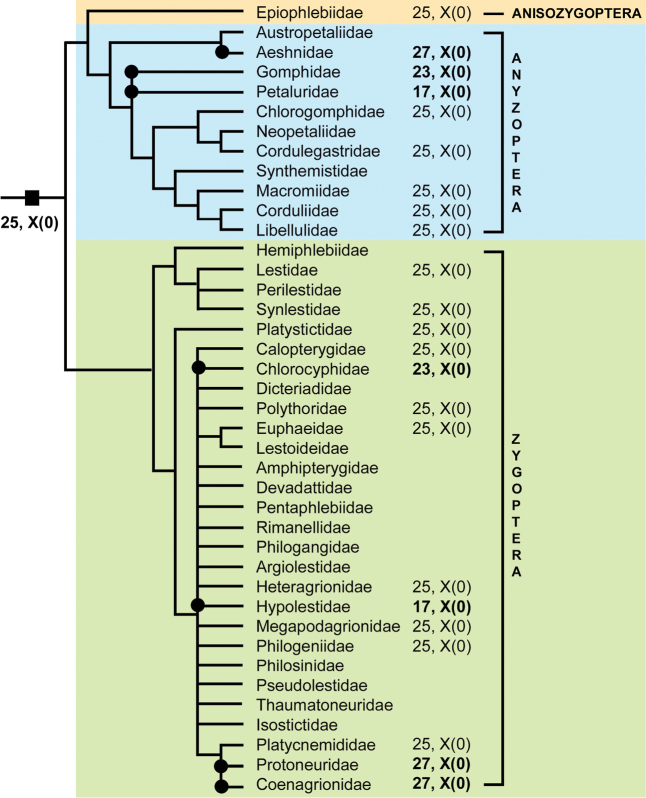
The ancient insect order Odonata is divided into three suborders: Anisoptera and Zygoptera with approximately 3000 species worldwide each, and Anisozygoptera with only four extant species in the relict family Epiophlebiidae. An updated list of Odonata species studied regarding chromosome number, sex chromosome mechanism and the occurrence of m-chromosomes (= microchromosomes) is given. Karyotypes of 607 species (198 genera, 23 families), covering approximately 10% of described species, are reported: 423 species (125 genera, 8 families) of the Anisoptera, 184 species (72 genera, 14 families) of the Zygoptera, and one species of the Anisozygoptera. Among the Odonata, sex determination mechanisms in males can be of X(0), XY and XXY types, and diploid chromosome numbers can vary from 6 to 41, with a clear mode at 2n = 25(60%) and two more local modes at 2n = 27(21%) and 2n = 23(13%). The karyotype 2n = 25(24A + X) is found in each of the three suborders and is the most typical (modal) in many families, including the best-covered Libellulidae, Corduliidae (Anisoptera), Lestidae, Calopterygidae, and Platycnemididae (Zygoptera). This chromosome set is considered ancestral for the Odonata in general. Chromosome rearrangements, among which fusions and fissions most likely predominated, led to independent origins of similar karyotypes within different phylogenetic lineages of the order. The karyotype 2n = 27(26A + X) prevails in Aeshnidae and Coenagrionidae, whereas the karyotype 2n = 23(22A + X) is modal in Gomphidae and Chlorocyphidae, in both pairs of families one being from the Anisoptera while the other from the Zygoptera.
差翅亚目和均翅亚目,全球各有大约3000种,以及间翅亚目,在孑遗科原蟌科中仅存4个物种。给出了一份关于染色体数目、性染色体机制和m染色体(=微染色体)出现情况的蜻蜓目物种研究更新列表。报告了607个物种(198属,23科)的核型,约占已描述物种的10%:差翅亚目423个物种(125属,8科),均翅亚目184个物种(72属,14科),以及间翅亚目1个物种。在蜻蜓目中,雄性的性别决定机制可以是X(0)、XY和XXY类型,二倍体染色体数目可以从6变化到41,明显的模式为2n = 25(占60%),另外两个局部模式为2n = 27(占21%)和2n = 23(占13%)。核型2n = 25(24A + X)在三个亚目中均有发现,并且在许多科中是最典型的(模式),包括覆盖最广的蜻科、大蜓科(差翅亚目)、丝蟌科、丽蟌科和溪蟌科(均翅亚目)。一般认为这个染色体组是蜻蜓目的祖先染色体组。染色体重排,其中融合和裂变最有可能占主导,导致了该目不同系统发育谱系中相似核型的独立起源。核型2n = 27(26A + X)在蜓科和色蟌科中占优势,而核型2n = 23(22A + X)在春蜓科和绿螅科中是模式核型,在这两对科中,一对来自差翅亚目,另一对来自均翅亚目。