Chang Enoch, Joel Marina, Chang Hannah Y, Du Justin, Khanna Omaditya, Omuro Antonio, Chiang Veronica, Aneja Sanjay
Department of Therapeutic Radiology, Yale School of Medicine.
Yale College.
medRxiv. 2020 Nov 6:2020.11.04.20226159. doi: 10.1101/2020.11.04.20226159.
Radiomic feature analysis has been shown to be effective at modeling cancer outcomes. It has not yet been established how to best combine these radiomic features in patients with multifocal disease. As the number of patients with multifocal metastatic cancer continues to rise, there is a need for improving personalized patient-level prognostication to better inform treatment.
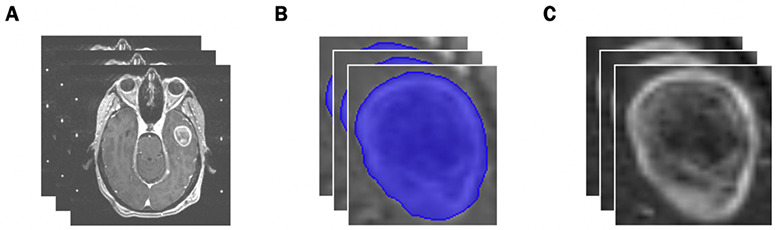
We compared six mathematical methods of combining radiomic features of 3596 tumors in 831 patients with multiple brain metastases and evaluated the performance of these aggregation methods using three survival models: a standard Cox proportional hazards model, a Cox proportional hazards model with LASSO regression, and a random survival forest.
Across all three survival models, the weighted average of the largest three metastases had the highest concordance index (95% confidence interval) of 0.627 (0.595-0.661) for the Cox proportional hazards model, 0.628 (0.591-0.666) for the Cox proportional hazards model with LASSO regression, and 0.652 (0.565-0.727) for the random survival forest model.
Radiomic features can be effectively combined to establish patient-level outcomes in patients with multifocal brain metastases. Future studies are needed to confirm that the volume-weighted average of the largest three tumors is an effective method for combining radiomic features across other imaging modalities and disease sites.
放射组学特征分析已被证明在预测癌症预后方面有效。然而,对于多灶性疾病患者,如何最佳地组合这些放射组学特征尚未明确。随着多灶性转移性癌症患者数量持续增加,需要改进个性化的患者水平预后评估,以便更好地指导治疗。
我们比较了831例多发脑转移患者中3596个肿瘤的放射组学特征的六种数学组合方法,并使用三种生存模型评估了这些汇总方法的性能:标准Cox比例风险模型、带LASSO回归的Cox比例风险模型和随机生存森林模型。
在所有三种生存模型中,最大的三个转移灶的加权平均值在Cox比例风险模型中的一致性指数(95%置信区间)最高,为0.627(0.595-0.661);在带LASSO回归的Cox比例风险模型中为0.628(0.591-0.666);在随机生存森林模型中为0.652(0.565-0.727)。
放射组学特征可以有效地组合起来,以建立多灶性脑转移患者的患者水平预后。未来需要开展研究,以确认最大的三个肿瘤的体积加权平均值是一种跨其他成像模式和疾病部位组合放射组学特征的有效方法。