Department of Medical Oncology, International Oncology Services, Fortis Hospital, UP, India.
Department of Research, Rajiv Gandhi Cancer Institute & Research Centre, Delhi, India.
PLoS One. 2020 Nov 11;15(11):e0242190. doi: 10.1371/journal.pone.0242190. eCollection 2020.
The study assessed the epigenetic regulation and the role of microRNA (miR) expression in locally advanced triple negative breast cancers (TNBC) and comparison with the clinico-pathological variables and survival.
Fifty patients of locally advanced TNBC during the period 2011-2013 were included. Expression level of test microRNA (miR-182 and miR-18a) was determined using Taqman quantitative Real time polymerase chain reaction (qRT-PCR) from formalin fixed paraffin embedded biopsy blocks. Clinical and demographic information and survival data was retrieved from the Hospital medical records.
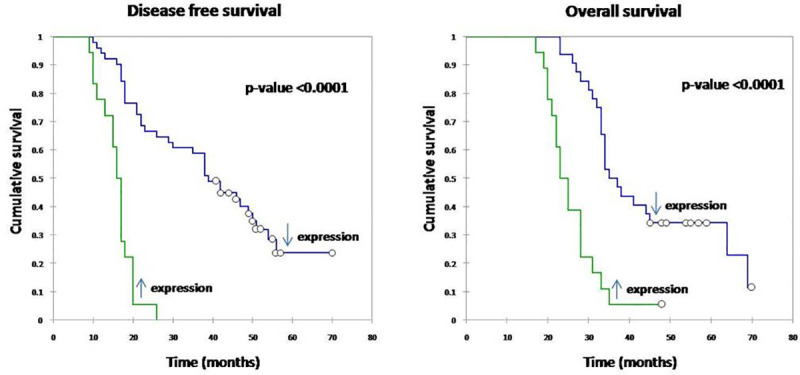
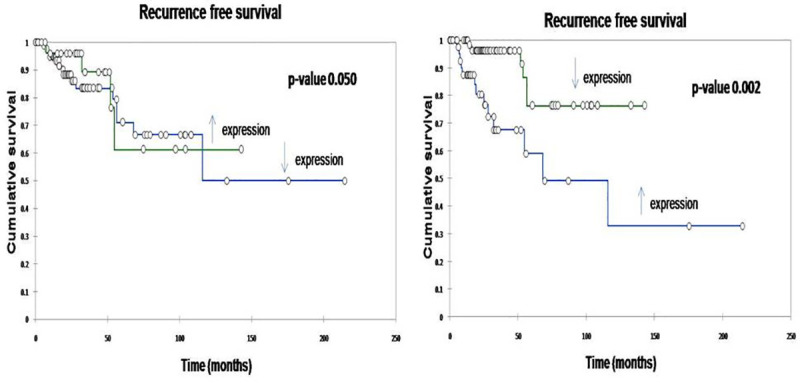
An improved clinical complete response (cCR) was observed in patients with age ≥ 45 years (80%), premenopausal status (70%), tumor size < 6 cms (80%), nodal status N0-N1 (95%) and grade II-III tumor (80%). A statistically significant correlation was observed on comparison of cCR with menopausal status (p-value 0.020), T category (p-value 0.018) and the clinical nodal status (p-value 0.003). pCR also correlated with clinical nodal status (p-value 0.008). Epigenetically, miR-18a under expression (< 8.84) was most commonly associated with tumor size < 6 cms (76.7%), clinical nodal status N0-N1 (90%), cCR (60%) and pCR (53.3%). A similar trend was observed with miR-182. Statistical significance was observed with T category (p-values 0.003 and 0.004), clinical nodal status (p-values 0.001 and 0.001), clinical response (p-values 0.002 and 0.002) and pathological response (p-values 0.007 and 0.006) with respect to miR-18a and miR-182, respectively. Also, the menopausal status significantly correlated with the miR-182 expression (p-value 0.009). miR-182 overexpression (≥ 6.32) was not observed in any of the postmenopausal patients. A univariate cox proportional hazard regression model also showed statistical interactions (p-values <0.004).
miR-182 and miR-18a overexpression correlates with worse clinical and pathological tumor characteristics in locally advanced TNBC and hence could be used to predict the outcomes and prognosis in these patients.
本研究评估了局部晚期三阴性乳腺癌(TNBC)中的表观遗传调控和 microRNA(miR)表达的作用,并与临床病理变量和生存进行了比较。
纳入了 2011 年至 2013 年期间的 50 例局部晚期 TNBC 患者。使用 Taqman 定量实时聚合酶链反应(qRT-PCR)从福尔马林固定石蜡包埋活检块中测定测试 microRNA(miR-182 和 miR-18a)的表达水平。从医院病历中检索临床和人口统计学信息及生存数据。
年龄≥45 岁(80%)、绝经前状态(70%)、肿瘤大小<6cm(80%)、淋巴结状态 N0-N1(95%)和 II-III 级肿瘤(80%)的患者观察到临床完全缓解(cCR)有改善。比较 cCR 与绝经状态(p 值 0.020)、T 分类(p 值 0.018)和临床淋巴结状态(p 值 0.003)时,观察到具有统计学意义的相关性。pCR 也与临床淋巴结状态相关(p 值 0.008)。表观遗传上,miR-18a 表达水平<8.84 与肿瘤大小<6cm(76.7%)、临床淋巴结状态 N0-N1(90%)、cCR(60%)和 pCR(53.3%)最相关。miR-182 也表现出类似的趋势。miR-18a 和 miR-182 分别与 T 分类(p 值分别为 0.003 和 0.004)、临床淋巴结状态(p 值分别为 0.001 和 0.001)、临床反应(p 值分别为 0.002 和 0.002)和病理反应(p 值分别为 0.007 和 0.006)均具有统计学意义。此外,绝经状态与 miR-182 的表达显著相关(p 值 0.009)。在任何绝经后患者中均未观察到 miR-182 的过表达(≥6.32)。单变量 Cox 比例风险回归模型也显示出统计学相互作用(p 值均<0.004)。
miR-182 和 miR-18a 的过表达与局部晚期 TNBC 中更差的临床和病理肿瘤特征相关,因此可用于预测这些患者的结局和预后。