The First Affiliated Hospital of Xi'an Medical University, Xi'an, China.
Department of Scientific Research, the Second Affiliated Hospital of Xi' an Medical University, Xi'an, China.
BMC Infect Dis. 2020 Nov 11;20(1):832. doi: 10.1186/s12879-020-05556-9.
Carvacrol, as the major components of aromatic plants used for treating human skin diseases including origanum, Satureja, thymus, and coridothymus species, presented a kind of antiviral activity. To explore the mechanisms of carvacrol against herpes simplex virus (HSV) in vitro.
The BSC-1 cells model of HSV infection was established, and from the two aspects of viral replication level and cell death pathway, the antiviral effects of carvacrol on HSV infected cells were also evaluated by plaque assay under the three modes including prevention, treatment, and direct inactivation.
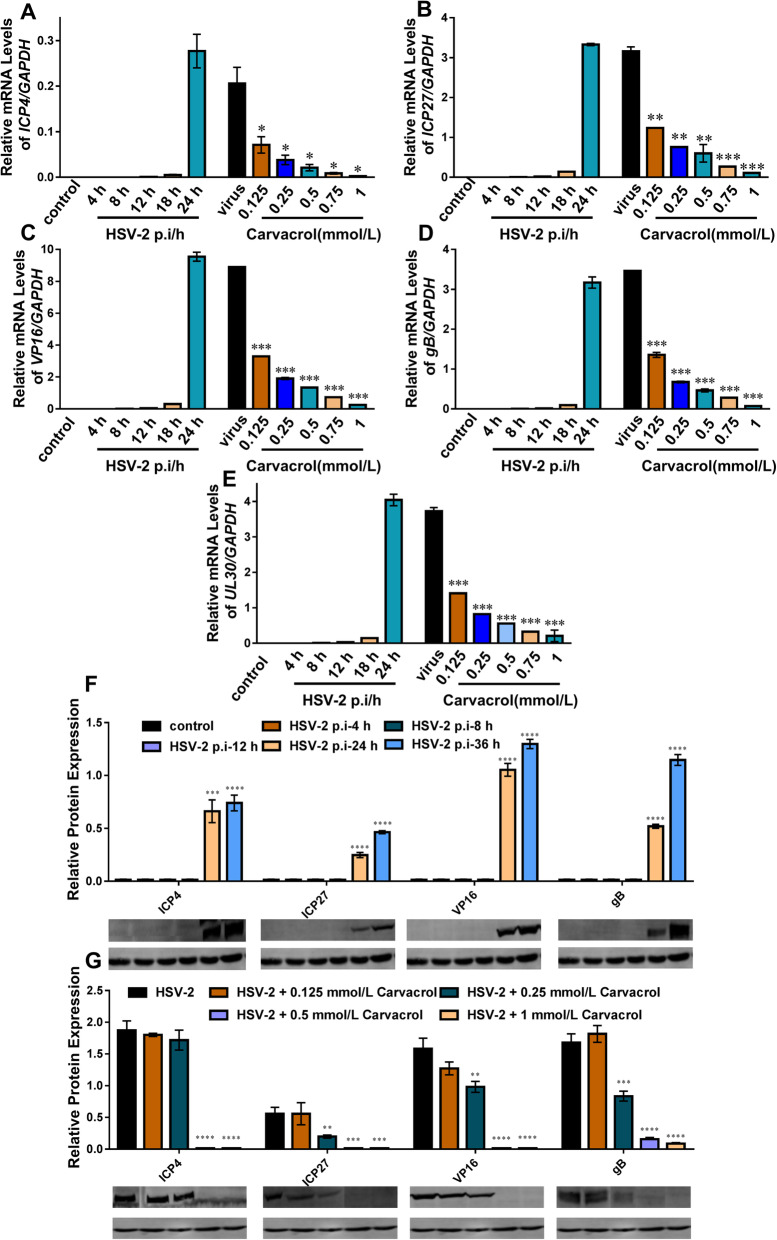
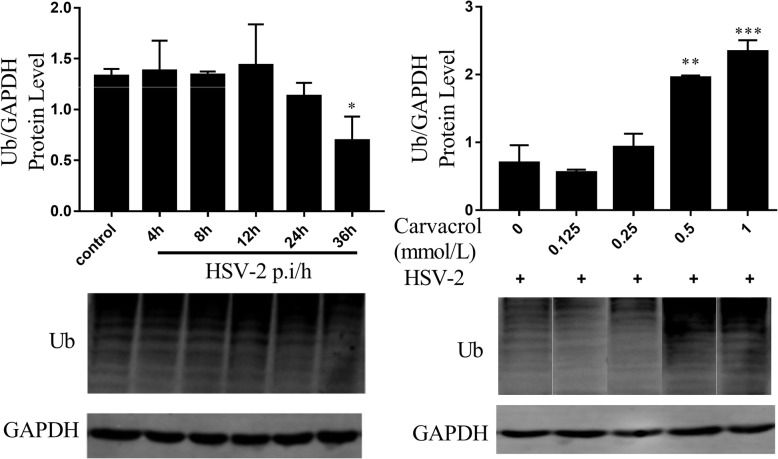
In the three ways, the half-maximal effective concentration (EC) of 2% true carvacrol solution on HSV-2 infected cells were severally 0.43, 0.19 and 0.51 mmol/L, and the corresponding therapeutic index (TI) were 4.02, 9.11 and 3.39, respectively. It's the opposite of the increased levels caused by HSV-2 infection, that both the expressions at the transcription genes and protein levels of virus own replication key factors (including ICP4, ICP27, VP16, gB, and UL30) and cytokines (including RIP3, TNF-α, and MLKL) of infected cells treated with carvacrol were dose-dependently inhibited. Besides, HSV-2 infection can cause the decrease of intracellular protein ubiquitination level, and carvacrol can reverse the ubiquitination decrease level caused by HSV-2 infection.
Carvacrol exhibits significant antiviral activity by inhibiting the HSV-2 proliferation process and HSV-2-induced TNF-α increasing levels, decreasing RIP3 and MLKL protein expressions through the intracellular RIP3-mediated programmed cell necrosis pathway. In addition, carvacrol also may exhibit anti-HSV-2 activity by reversing the ubiquitination decrease level caused by HSV-2 infection on the ubiquitin-proteasome system, which provides insights into the molecular mechanism.
香芹酚是唇形科植物的主要成分之一,用于治疗人类皮肤病,包括牛至、香薄荷、百里香和科里多蒂姆斯属物种,具有抗病毒活性。为了探讨香芹酚体外抗单纯疱疹病毒(HSV)的机制。
建立 HSV 感染的 BSC-1 细胞模型,通过病毒复制水平和细胞死亡途径两个方面,采用空斑实验,从预防、治疗和直接灭活三种模式评估香芹酚对 HSV 感染细胞的抗病毒作用。
在三种方式下,2%香芹酚溶液对 HSV-2 感染细胞的半效浓度(EC)分别为 0.43、0.19 和 0.51mmol/L,相应的治疗指数(TI)分别为 4.02、9.11 和 3.39。这与 HSV-2 感染引起的水平升高相反,用香芹酚处理的感染细胞中病毒自身复制关键因子(包括 ICP4、ICP27、VP16、gB 和 UL30)和细胞因子(包括 RIP3、TNF-α和 MLKL)的转录基因和蛋白水平的表达均呈剂量依赖性抑制。此外,HSV-2 感染可导致细胞内蛋白泛素化水平降低,香芹酚可逆转 HSV-2 感染引起的泛素化降低水平。
香芹酚通过抑制 HSV-2 的增殖过程和 HSV-2 诱导的 TNF-α水平升高,以及通过细胞内 RIP3 介导的程序性细胞坏死途径降低 RIP3 和 MLKL 蛋白表达,显示出显著的抗病毒活性。此外,香芹酚还可能通过逆转 HSV-2 感染对泛素-蛋白酶体系统引起的泛素化降低水平发挥抗 HSV-2 活性,为其分子机制提供了新的见解。