Ortblad Katrina F, Mogere Peter, Roche Stephanie, Kamolloh Kevin, Odoyo Josephine, Irungu Elizabeth, Mugo Nelly R, Pintye Jillian, Baeten Jared M, Bukusi Elizabeth, Ngure Kenneth
Department of Global Health, International Clinical Research Center, University of Washington, 908 Jefferson St, 12th floor, Seattle, WA, 98104, USA.
Partners in Health and Research Development, Thika, Kenya.
BMC Health Serv Res. 2020 Nov 12;20(1):1034. doi: 10.1186/s12913-020-05898-9.
In Kenya, pre-exposure prophylaxis (PrEP) for HIV prevention is almost exclusively delivered at HIV clinics. Developing novel PrEP delivery models is important for increasing the reach of PrEP. Delivery of PrEP through pharmacies is one approach utilized in the US to improve accessibility. Retail pharmacies are commonly used as a first-line access point for medical care in Kenya, but have not been utilized for PrEP delivery. We conducted a collaborative consultative meeting of stakeholders to develop a care pathway for pharmacy-based PrEP delivery in Kenya.
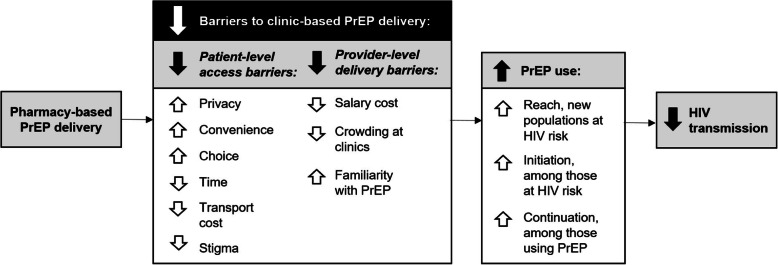
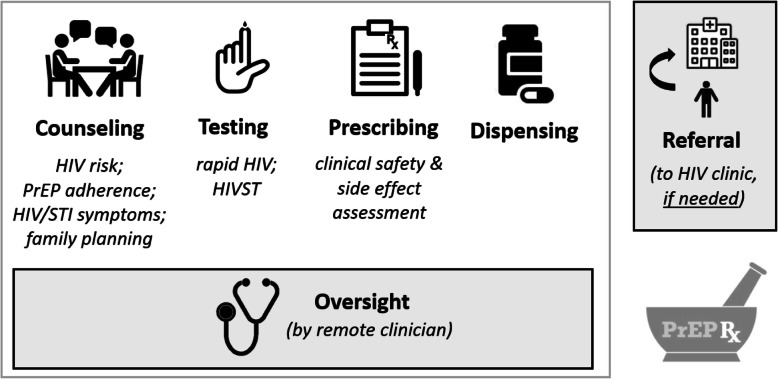
In January 2020, we held a one-day meeting in Nairobi with 36 stakeholders from PrEP regulatory, professional, healthcare service delivery, civil society, and research organizations. Attendees reviewed a theory of change model, results from formative qualitative research with pharmacy providers and clients, and anticipated core components of pharmacy-based PrEP delivery: counseling, HIV testing, prescribing, and dispensing. Stakeholders participated in small and large group discussions to identify potential challenges and solutions. We synthesized the key findings from these discussions.
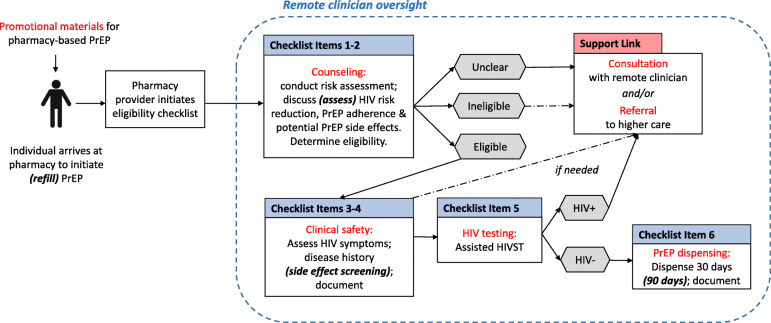
Stakeholders were enthusiastic about a model for pharmacy-based PrEP delivery. Potential challenges identified included insufficient pharmacy provider knowledge and skills, regulatory hurdles to providing affordable HIV testing at pharmacies, and undefined pathways for PrEP procurement. Potential solutions identified included having pharmacy providers complete the Kenya Ministry of Health-approved PrEP training, use of a PrEP prescribing checklist with remote clinician oversight and provider-assisted HIV self-testing, and having the government provide PrEP and HIV self-testing kits to pharmacies during a pilot test. A care pathway was developed over the course of the meeting.
PrEP delivery stakeholders in Kenya were strongly supportive of developing and testing a model for pharmacy-based PrEP delivery to increase PrEP access. We collaboratively developed a care pathway for pilot testing that has the potential to expand PrEP delivery options in Kenya and other similar settings.
在肯尼亚,用于预防艾滋病毒的暴露前预防(PrEP)几乎完全在艾滋病毒诊所提供。开发新型PrEP交付模式对于扩大PrEP的覆盖范围至关重要。通过药房提供PrEP是美国采用的一种提高可及性的方法。零售药房在肯尼亚通常被用作医疗保健的一线接入点,但尚未用于PrEP的交付。我们召开了一次利益相关者协作协商会议,以制定肯尼亚基于药房的PrEP交付护理路径。
2020年1月,我们在内罗毕举行了为期一天的会议,有来自PrEP监管、专业、医疗服务提供、民间社会和研究组织的36名利益相关者参加。与会者审查了一个变革理论模型、对药房提供者和客户进行的形成性定性研究结果,以及基于药房的PrEP交付的预期核心组成部分:咨询、艾滋病毒检测、开处方和配药。利益相关者参与了小组和大组讨论,以确定潜在挑战和解决方案。我们综合了这些讨论的主要发现。
利益相关者对基于药房的PrEP交付模式充满热情。确定的潜在挑战包括药房提供者的知识和技能不足、在药房提供负担得起的艾滋病毒检测的监管障碍,以及PrEP采购途径不明确。确定的潜在解决方案包括让药房提供者完成肯尼亚卫生部批准的PrEP培训、使用带有远程临床医生监督和提供者协助的艾滋病毒自我检测的PrEP开处方清单,以及在试点测试期间让政府向药房提供PrEP和艾滋病毒自我检测试剂盒。在会议过程中制定了一条护理路径。
肯尼亚的PrEP交付利益相关者强烈支持开发和测试一种基于药房的PrEP交付模式,以增加PrEP的可及性。我们共同制定了一条用于试点测试的护理路径,该路径有可能扩大肯尼亚和其他类似环境中的PrEP交付选择。