Programa de Computação Científica, Fundação Oswaldo Cruz, Avenida Brasil, 4365, Manguinhos, 21040-900, Rio de Janeiro, Brazil.
Malar J. 2020 Nov 11;19(1):404. doi: 10.1186/s12936-020-03474-4.
To achieve malaria elimination, it is important to determine the role of human mobility in parasite transmission maintenance. The Alto Juruá basin (Brazil) exhibits one of the largest vivax and falciparum malaria prevalence in the Amazon. The goal of this study was to estimate the contribution of human commutes to malaria persistence in this region, using data from an origin-destination survey.
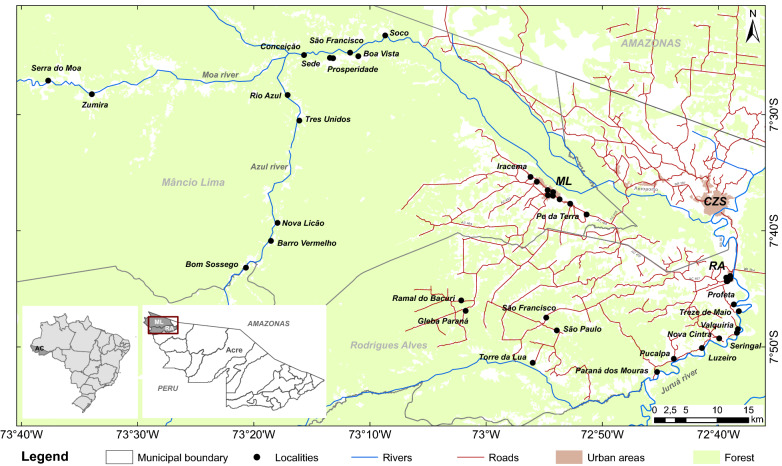
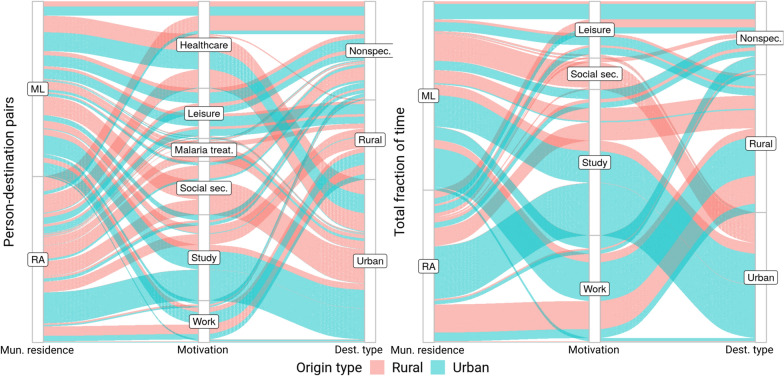
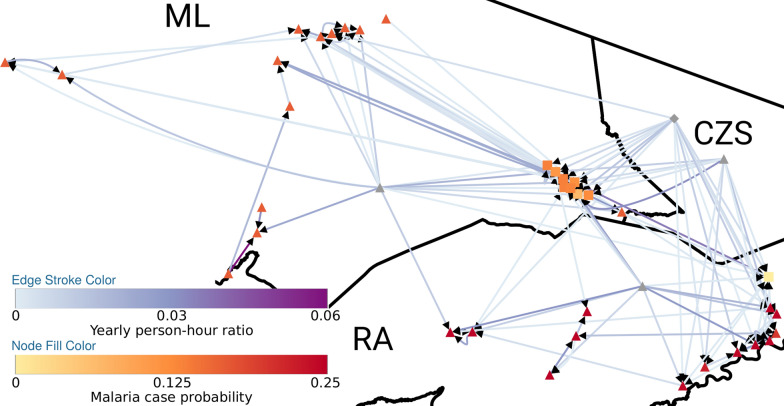
Data from an origin-destination survey were used to describe the intensity and motivation for commutations between rural and urban areas in two Alto Juruá basin (Brazil) municipalities, Mâncio Lima and Rodrigues Alves. The relative time-person spent in each locality per household was estimated. A logistic model was developed to estimate the effect of commuting on the probability of contracting malaria for a certain residence zone inhabitant commuting to another zone.
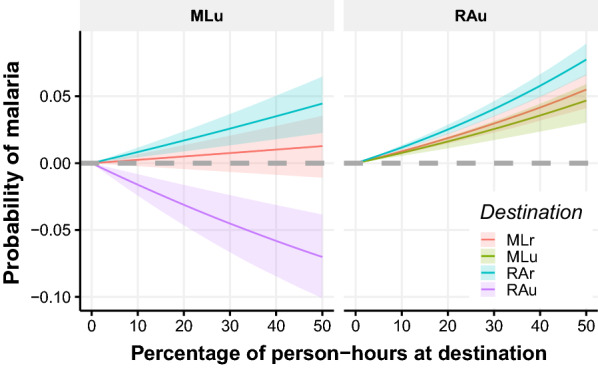
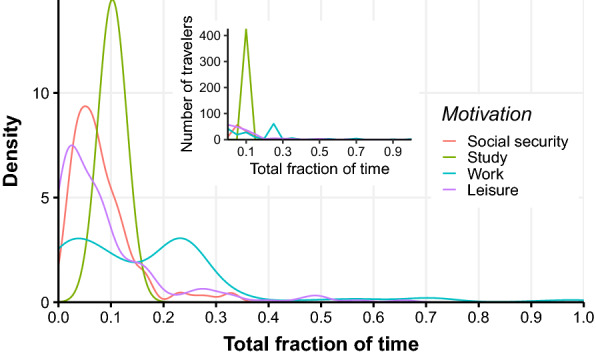
The main results suggest that the assessed population is not very mobile. A total of [Formula: see text] households reported spending over [Formula: see text] of their annual person-hour in areas within the same residence zone. Study and work were the most prevalent commuting motivations, calculated at [Formula: see text] and [Formula: see text] respectively. Spending person-hours in urban Rodrigues Alves conferred relative protection to urban Mâncio Lima residents. The opposite effect was observed for those spending time in rural areas of both municipalities.
Residence area is a stronger determinant for contracting malaria than commuting zones in the Alto Juruá region. As these municipalities are a hotspot for Plasmodium transmission, understanding the main local human fluxes is essential for planning control strategies, since the probability of contracting malaria is dependent on the transmission intensity of both the origin and the displacement area. The natural conditions for the circulation of certain pathogens, such as Plasmodium spp., combined with the Amazon human mobility pattern indicate the need for disease control perspective changes. Therefore, intersectoral public policies should become the basis for health mitigation actions.
为实现消除疟疾的目标,确定人类流动在寄生虫传播维持中的作用非常重要。上茹鲁瓦流域(巴西)是亚马逊地区间日疟原虫和恶性疟原虫流行率最高的地区之一。本研究的目的是利用来源-目的地调查数据,评估人类通勤对该地区疟疾持续存在的贡献。
利用来源-目的地调查数据,描述上茹鲁瓦流域(巴西)两个城市马西尼奥利马和罗德里格斯阿尔维斯之间农村和城市地区通勤的强度和动机。估计每个家庭在每个地方花费的相对时间-人时。建立逻辑模型来估计通勤对居住在一个区域的居民前往另一个区域的疟疾感染概率的影响。
主要结果表明,评估人口的流动性不大。共有[公式:见文本]户报告其每年的人时超过[公式:见文本]花费在同一居住区域内。学习和工作是最常见的通勤动机,分别计算为[公式:见文本]和[公式:见文本]。在城市罗德里格斯阿尔维斯度过的人时会给城市马西尼奥利马居民带来相对保护。而在两个城市的农村地区度过时间的人则观察到相反的效果。
在上茹鲁瓦地区,居住区域是感染疟疾的更强决定因素,而不是通勤区域。由于这些城市是疟疾传播的热点地区,了解主要的本地人类流动对于规划控制策略至关重要,因为感染疟疾的概率取决于起源和迁移区域的传播强度。某些病原体(如疟原虫)循环的自然条件,加上亚马逊地区的人类流动模式,表明需要改变疾病控制的观点。因此,跨部门公共政策应成为健康缓解行动的基础。