Department of Epidemiology, Fielding School of Public Health, University of California, Los Angeles, CA 90095;
California Center for Population Research, University of California, Los Angeles, CA 90095.
Proc Natl Acad Sci U S A. 2020 Dec 1;117(48):30285-30294. doi: 10.1073/pnas.2014297117. Epub 2020 Nov 11.
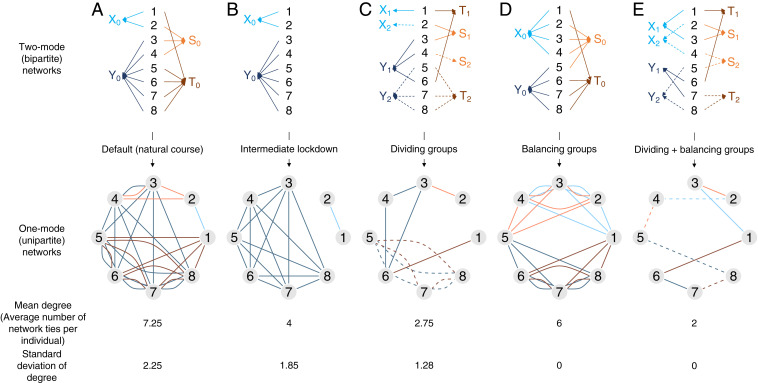
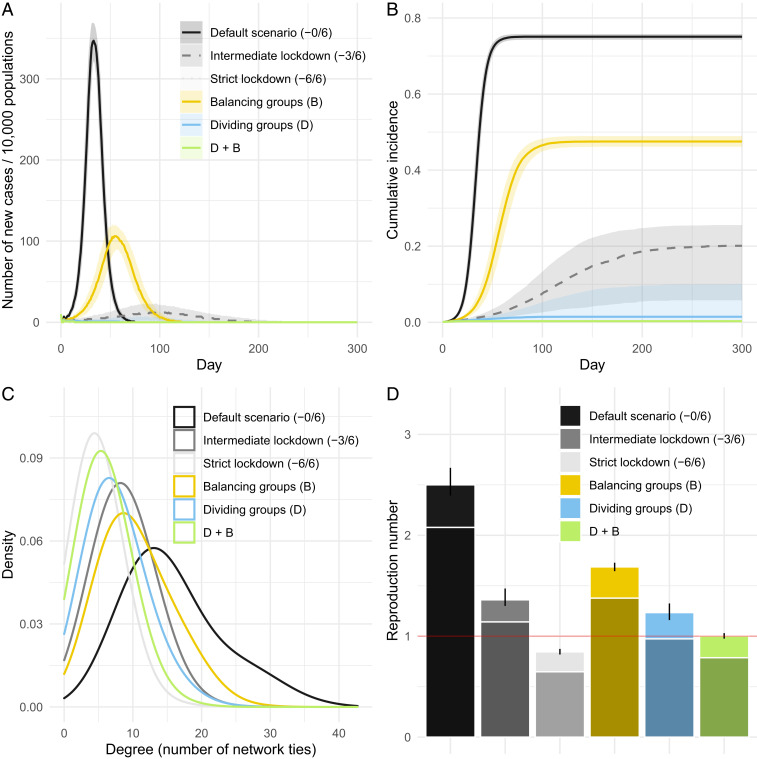
Sustaining economic activities while curbing the number of new coronavirus disease 2019 (COVID-19) cases until effective vaccines or treatments become available is a major public health and policy challenge. In this paper, we use agent-based simulations of a network-based susceptible-exposed-infectious-recovered (SEIR) model to investigate two network intervention strategies for mitigating the spread of transmission while maintaining economic activities. In the simulations, we assume that people engage in group activities in multiple sectors (e.g., going to work, going to a local grocery store), where they interact with others in the same group and potentially become infected. In the first strategy, each group is divided into two subgroups (e.g., a group of customers can only go to the grocery store in the morning, while another separate group of customers can only go in the afternoon). In the second strategy, we balance the number of group members across different groups within the same sector (e.g., every grocery store has the same number of customers). The simulation results show that the dividing groups strategy substantially reduces transmission, and the joint implementation of the two strategies could effectively bring the spread of transmission under control (i.e., effective reproduction number ≈ 1.0).
在有效疫苗或疗法问世之前,维持经济活动的同时遏制 2019 年冠状病毒病(COVID-19)病例的数量,是一项重大的公共卫生和政策挑战。在本文中,我们使用基于网络的易感-暴露-感染-恢复(SEIR)模型的基于代理的模拟,研究了两种网络干预策略,以在维持经济活动的同时减轻传播的蔓延。在模拟中,我们假设人们在多个部门(例如,上班、去当地杂货店)中进行群体活动,他们与同一群体中的其他人互动并可能被感染。在第一种策略中,每个群体分为两个小组(例如,一群顾客只能在早上去杂货店,而另一组顾客只能在下午去)。在第二种策略中,我们在同一部门内的不同群体之间平衡群体成员的数量(例如,每个杂货店都有相同数量的顾客)。模拟结果表明,分组策略大大降低了传播,两种策略的联合实施可以有效地控制传播的蔓延(即有效繁殖数≈1.0)。