Group of Neuropharmacology and Neurophysiology, Division of Neuroscience, The Bonoi Academy of Science and Education, Chapel Hill, NC, USA.
International Scientific Information, Inc., Melville, NY, USA.
Med Sci Monit. 2020 Nov 1;26:e928996. doi: 10.12659/MSM.928996.
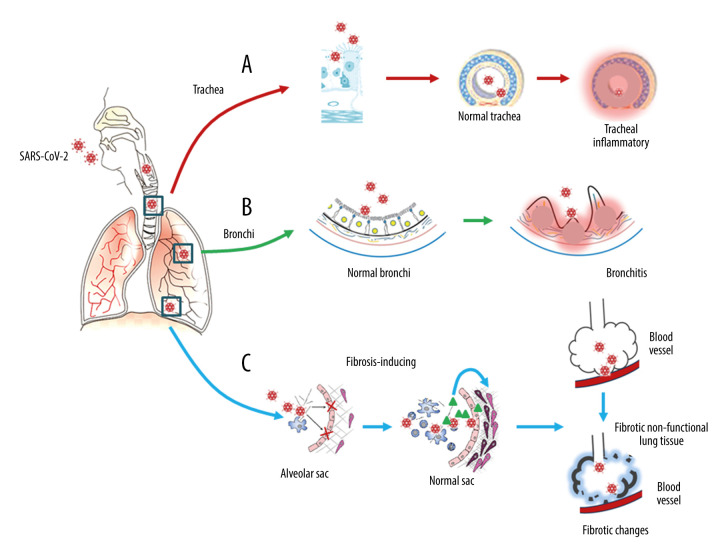
Since the initial reports of coronavirus disease 2019 (COVID-19) in China in late 2019, infections from severe acute respiratory syndrome coronavirus 2 (SARS-CoV-2) have spread rapidly, resulting in a global pandemic that has caused millions of deaths. Initially, the large number of infected people required the direction of global healthcare resources to provide supportive care for the acutely ill population in an attempt to reduce mortality. While clinical trials for safe and effective antiviral agents are ongoing, and vaccine development programs are being accelerated, long-term sequelae of SARS-CoV-2 infection have become increasingly recognized and concerning. Although the upper and lower respiratory tracts are the main sites of entry of SARS-CoV-2 into the body, resulting in COVID-19 pneumonia as the most common presentation, acute lung damage may be followed by pulmonary fibrosis and chronic impairment of lung function, with impaired quality of life. Also, increasing reports have shown that SARS-CoV-2 infection involves the central nervous system (CNS) and the peripheral nervous system (PNS) and directly or indirectly damages neurons, leading to long-term neurological sequelae. This review aims to provide an update on the mechanisms involved in the development of the long-term sequelae of SARS-CoV-2 infection in the 3 main areas of lung injury, neuronal injury, and neurodegenerative diseases, including Alzheimer disease, Parkinson disease, and multiple sclerosis, and highlights the need for patient monitoring following the acute stage of infection with SARS-CoV-2 to provide a rationale for the prevention, diagnosis, and management of these potential long-term sequelae.
自 2019 年末中国首次报告 2019 冠状病毒病(COVID-19)以来,严重急性呼吸综合征冠状病毒 2(SARS-CoV-2)的感染迅速蔓延,导致了一场全球性大流行,造成数百万人死亡。最初,大量感染者需要全球医疗资源的支持,为急性疾病患者提供支持性护理,以降低死亡率。虽然正在进行安全有效的抗病毒药物的临床试验,并且疫苗开发计划正在加速,但 SARS-CoV-2 感染的长期后遗症越来越受到关注。虽然上呼吸道和下呼吸道是 SARS-CoV-2 进入人体的主要部位,导致 COVID-19 肺炎是最常见的表现,但急性肺损伤可能随后发展为肺纤维化和肺功能慢性损害,导致生活质量受损。此外,越来越多的报告表明,SARS-CoV-2 感染涉及中枢神经系统(CNS)和周围神经系统(PNS),并直接或间接损害神经元,导致长期的神经后遗症。本综述旨在提供 SARS-CoV-2 感染后 3 个主要领域(肺损伤、神经元损伤和神经退行性疾病,包括阿尔茨海默病、帕金森病和多发性硬化症)中涉及的长期后遗症的发病机制的最新进展,并强调需要对 SARS-CoV-2 感染的急性阶段后进行患者监测,为预防、诊断和管理这些潜在的长期后遗症提供依据。