Department of Ophthalmology, Université de Montréal, Montreal, QC, Canada.
Department of Ophthalmology, Centre Hospitalier de l'Université de Montréal (CHUM), Montreal, QC, Canada.
Sci Rep. 2020 Nov 11;10(1):19528. doi: 10.1038/s41598-020-76665-3.
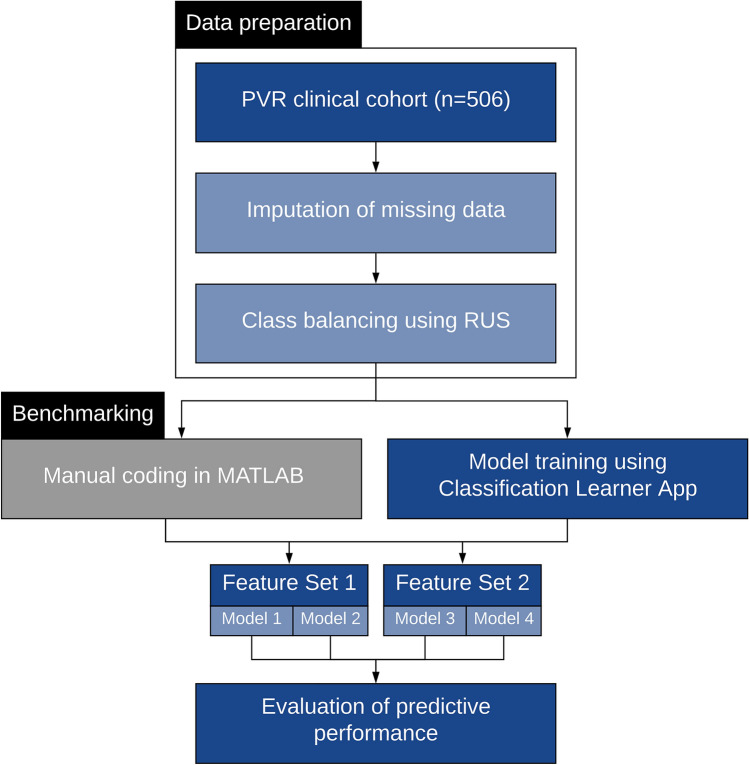
We aimed to assess the feasibility of machine learning (ML) algorithm design to predict proliferative vitreoretinopathy (PVR) by ophthalmologists without coding experience using automated ML (AutoML). The study was a retrospective cohort study of 506 eyes who underwent pars plana vitrectomy for rhegmatogenous retinal detachment (RRD) by a single surgeon at a tertiary-care hospital between 2012 and 2019. Two ophthalmologists without coding experience used an interactive application in MATLAB to build and evaluate ML algorithms for the prediction of postoperative PVR using clinical data from the electronic health records. The clinical features associated with postoperative PVR were determined by univariate feature selection. The area under the curve (AUC) for predicting postoperative PVR was better for models that included pre-existing PVR as an input. The quadratic support vector machine (SVM) model built using all selected clinical features had an AUC of 0.90, a sensitivity of 63.0%, and a specificity of 97.8%. An optimized Naïve Bayes algorithm that did not include pre-existing PVR as an input feature had an AUC of 0.81, a sensitivity of 54.3%, and a specificity of 92.4%. In conclusion, the development of ML models for the prediction of PVR by ophthalmologists without coding experience is feasible. Input from a data scientist might still be needed to tackle class imbalance-a common challenge in ML classification using real-world clinical data.
我们旨在评估机器学习 (ML) 算法设计的可行性,即通过无需编码经验的眼科医生使用自动化 ML (AutoML) 来预测增殖性玻璃体视网膜病变 (PVR)。这项研究是一项回顾性队列研究,纳入了 2012 年至 2019 年期间,由一名外科医生在一家三级保健医院对 506 只接受了标准经睫状体平坦部玻璃体切除术的孔源性视网膜脱离 (RRD) 的眼睛。两名没有编码经验的眼科医生使用 MATLAB 中的交互式应用程序,使用来自电子健康记录的临床数据,为预测术后 PVR 构建和评估 ML 算法。通过单变量特征选择,确定与术后 PVR 相关的临床特征。将术前 PVR 作为输入的模型在预测术后 PVR 方面的 AUC 更好。使用所有选定的临床特征构建的二次支持向量机 (SVM) 模型的 AUC 为 0.90,灵敏度为 63.0%,特异性为 97.8%。不将术前 PVR 作为输入特征的优化 Naïve Bayes 算法的 AUC 为 0.81,灵敏度为 54.3%,特异性为 92.4%。总之,无需编码经验的眼科医生开发用于预测 PVR 的 ML 模型是可行的。可能仍然需要数据科学家的输入来解决机器学习分类中常见的现实世界临床数据的类别不平衡问题。