• 文献检索
  • 文档翻译
  • 深度研究
  • 学术资讯
  • Suppr Zotero 插件Zotero 插件
  • 邀请有礼
  • 套餐&价格
  • 历史记录
应用&插件
Suppr Zotero 插件Zotero 插件浏览器插件Mac 客户端Windows 客户端微信小程序
定价
高级版会员购买积分包购买API积分包
服务
文献检索文档翻译深度研究API 文档MCP 服务
关于我们
关于 Suppr公司介绍联系我们用户协议隐私条款
关注我们

Suppr 超能文献

核心技术专利:CN118964589B侵权必究
粤ICP备2023148730 号-1Suppr @ 2026

文献检索

告别复杂PubMed语法,用中文像聊天一样搜索,搜遍4000万医学文献。AI智能推荐,让科研检索更轻松。

立即免费搜索

文件翻译

保留排版,准确专业,支持PDF/Word/PPT等文件格式,支持 12+语言互译。

免费翻译文档

深度研究

AI帮你快速写综述,25分钟生成高质量综述,智能提取关键信息,辅助科研写作。

立即免费体验

自动机器学习在预测气体视网膜固定术结果中的表现

Performance of Automated Machine Learning in Predicting Outcomes of Pneumatic Retinopexy.

作者信息

Nisanova Arina, Yavary Arefeh, Deaner Jordan, Ali Ferhina S, Gogte Priyanka, Kaplan Richard, Chen Kevin C, Nudleman Eric, Grewal Dilraj, Gupta Meenakashi, Wolfe Jeremy, Klufas Michael, Yiu Glenn, Soltani Iman, Emami-Naeini Parisa

机构信息

School of Medicine, University of California Davis, Davis, California.

Department of Computer Science, University of California Davis, Davis, California.

出版信息

Ophthalmol Sci. 2024 Jan 19;4(5):100470. doi: 10.1016/j.xops.2024.100470. eCollection 2024 Sep-Oct.

DOI:10.1016/j.xops.2024.100470
PMID:38827487
原文链接:https://pmc.ncbi.nlm.nih.gov/articles/PMC11141253/
Abstract

PURPOSE

Automated machine learning (AutoML) has emerged as a novel tool for medical professionals lacking coding experience, enabling them to develop predictive models for treatment outcomes. This study evaluated the performance of AutoML tools in developing models predicting the success of pneumatic retinopexy (PR) in treatment of rhegmatogenous retinal detachment (RRD). These models were then compared with custom models created by machine learning (ML) experts.

DESIGN

Retrospective multicenter study.

PARTICIPANTS

Five hundred and thirty nine consecutive patients with primary RRD that underwent PR by a vitreoretinal fellow at 6 training hospitals between 2002 and 2022.

METHODS

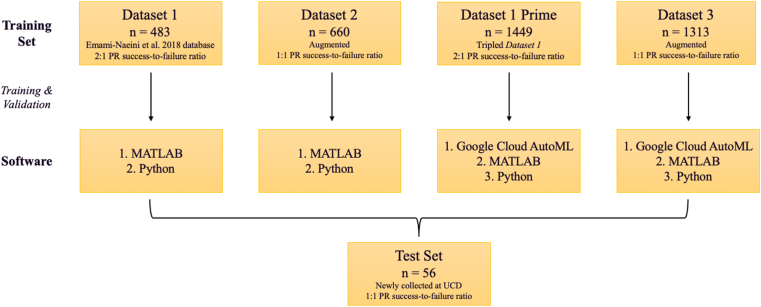
We used 2 AutoML platforms: MATLAB Classification Learner and Google Cloud AutoML. Additional models were developed by computer scientists. We included patient demographics and baseline characteristics, including lens and macula status, RRD size, number and location of breaks, presence of vitreous hemorrhage and lattice degeneration, and physicians' experience. The dataset was split into a training (n = 483) and test set (n = 56). The training set, with a 2:1 success-to-failure ratio, was used to train the MATLAB models. Because Google Cloud AutoML requires a minimum of 1000 samples, the training set was tripled to create a new set with 1449 datapoints. Additionally, balanced datasets with a 1:1 success-to-failure ratio were created using Python.

MAIN OUTCOME MEASURES

Single-procedure anatomic success rate, as predicted by the ML models. F2 scores and area under the receiver operating curve (AUROC) were used as primary metrics to compare models.

RESULTS

The best performing AutoML model (F2 score: 0.85; AUROC: 0.90; MATLAB), showed comparable performance to the custom model (0.92, 0.86) when trained on the balanced datasets. However, training the AutoML model with imbalanced data yielded misleadingly high AUROC (0.81) despite low F2-score (0.2) and sensitivity (0.17).

CONCLUSIONS

We demonstrated the feasibility of using AutoML as an accessible tool for medical professionals to develop models from clinical data. Such models can ultimately aid in the clinical decision-making, contributing to better patient outcomes. However, outcomes can be misleading or unreliable if used naively. Limitations exist, particularly if datasets contain missing variables or are highly imbalanced. Proper model selection and data preprocessing can improve the reliability of AutoML tools.

FINANCIAL DISCLOSURES

Proprietary or commercial disclosure may be found in the Footnotes and Disclosures at the end of this article.

摘要

目的

自动机器学习(AutoML)已成为缺乏编码经验的医学专业人员的一种新型工具,使他们能够开发用于预测治疗结果的预测模型。本研究评估了AutoML工具在开发预测气性视网膜固定术(PR)治疗孔源性视网膜脱离(RRD)成功率模型方面的性能。然后将这些模型与机器学习(ML)专家创建的定制模型进行比较。

设计

回顾性多中心研究。

参与者

2002年至2022年期间,6家培训医院的539例连续接受玻璃体视网膜专科医生进行PR治疗的原发性RRD患者。

方法

我们使用了2个AutoML平台:MATLAB分类学习器和谷歌云AutoML。计算机科学家开发了其他模型。我们纳入了患者的人口统计学和基线特征,包括晶状体和黄斑状态、RRD大小、裂孔数量和位置、玻璃体出血和格子样变性的存在情况以及医生的经验。数据集被分为训练集(n = 483)和测试集(n = 56)。训练集以2:1的成功与失败比例用于训练MATLAB模型。由于谷歌云AutoML至少需要1000个样本,因此将训练集增加两倍以创建一个包含1449个数据点的新集。此外,使用Python创建了成功与失败比例为1:1的平衡数据集。

主要观察指标

ML模型预测的单次手术解剖成功率。F2分数和受试者工作特征曲线下面积(AUROC)用作比较模型的主要指标。

结果

表现最佳的AutoML模型(F2分数:0.85;AUROC:0.90;MATLAB)在平衡数据集上训练时,与定制模型(0.92,0.86)表现相当。然而,使用不平衡数据训练AutoML模型时,尽管F2分数低(0.2)和灵敏度低(0.17),但AUROC却高得出人意料(0.81)。

结论

我们证明了使用AutoML作为医学专业人员从临床数据开发模型的一种可及工具的可行性。此类模型最终可有助于临床决策,为改善患者预后做出贡献。然而,如果盲目使用,结果可能会产生误导或不可靠。存在局限性,特别是如果数据集包含缺失变量或高度不平衡。正确的模型选择和数据预处理可以提高AutoML工具的可靠性。

财务披露

在本文末尾的脚注和披露中可能会找到专有或商业披露信息。

https://cdn.ncbi.nlm.nih.gov/pmc/blobs/d2be/11141253/eaf6bee96011/gr1.jpg

相似文献

1
Performance of Automated Machine Learning in Predicting Outcomes of Pneumatic Retinopexy.自动机器学习在预测气体视网膜固定术结果中的表现
Ophthalmol Sci. 2024 Jan 19;4(5):100470. doi: 10.1016/j.xops.2024.100470. eCollection 2024 Sep-Oct.
2
Pneumatic Retinopexy for Rhegmatogenous Retinal Detachment in Elderly Patients.老年人孔源性视网膜脱离的气动性视网膜固定术。
Ophthalmol Retina. 2023 Nov;7(11):959-964. doi: 10.1016/j.oret.2023.07.010. Epub 2023 Jul 17.
3
Automated Machine Learning Model Development for Intracranial Aneurysm Treatment Outcome Prediction: A Feasibility Study.用于颅内动脉瘤治疗结果预测的自动化机器学习模型开发:一项可行性研究。
Front Neurol. 2021 Nov 29;12:735142. doi: 10.3389/fneur.2021.735142. eCollection 2021.
4
Expanded criteria for pneumatic retinopexy and potential cost savings.扩大气液交换术的适应证和潜在的成本节约。
Ophthalmology. 2014 Jan;121(1):318-326. doi: 10.1016/j.ophtha.2013.06.037. Epub 2013 Aug 14.
5
Performance of Automated Machine Learning for Diabetic Retinopathy Image Classification from Multi-field Handheld Retinal Images.基于多视场手持视网膜图像的糖尿病性视网膜病变图像分类的自动化机器学习性能。
Ophthalmol Retina. 2023 Aug;7(8):703-712. doi: 10.1016/j.oret.2023.03.003. Epub 2023 Mar 15.
6
Pneumatic Retinopexy Experience and Outcomes of Vitreoretinal Fellows in the United States: A Multicenter Study.美国玻璃体视网膜专科住院医师的气体视网膜固定术经验与结果:一项多中心研究
Ophthalmol Retina. 2019 Feb;3(2):140-145. doi: 10.1016/j.oret.2018.09.010. Epub 2018 Sep 20.
7
The Pneumatic Retinopexy versus Vitrectomy for the Management of Primary Rhegmatogenous Retinal Detachment Outcomes Randomized Trial (PIVOT).原发性孔源性视网膜脱离经气液交换与玻璃体切割手术治疗效果的随机临床试验(PIVOT)。
Ophthalmology. 2019 Apr;126(4):531-539. doi: 10.1016/j.ophtha.2018.11.014. Epub 2018 Nov 22.
8
Using Automated Machine Learning to Predict the Mortality of Patients With COVID-19: Prediction Model Development Study.利用自动化机器学习预测 COVID-19 患者的死亡率:预测模型开发研究。
J Med Internet Res. 2021 Feb 26;23(2):e23458. doi: 10.2196/23458.
9
Evaluation of the performance of traditional machine learning algorithms, convolutional neural network and AutoML Vision in ultrasound breast lesions classification: a comparative study.传统机器学习算法、卷积神经网络和自动机器学习视觉在超声乳腺病变分类中的性能评估:一项比较研究。
Quant Imaging Med Surg. 2021 Apr;11(4):1381-1393. doi: 10.21037/qims-20-922.
10
Testing the applicability and performance of Auto ML for potential applications in diagnostic neuroradiology.测试 Auto ML 在诊断神经放射学中的潜在应用的适用性和性能。
Sci Rep. 2022 Aug 11;12(1):13648. doi: 10.1038/s41598-022-18028-8.

本文引用的文献

1
Developments in Artificial Intelligence for Ophthalmology: Federated Learning.眼科人工智能的发展:联邦学习
Asia Pac J Ophthalmol (Phila). 2022 Nov 1;11(6):500-502. doi: 10.1097/APO.0000000000000582.
2
Automated Machine Learning (AutoML)-Derived Preconception Predictive Risk Model to Guide Early Intervention for Gestational Diabetes Mellitus.基于自动化机器学习(AutoML)的孕前预测风险模型,用于指导妊娠期糖尿病的早期干预。
Int J Environ Res Public Health. 2022 Jun 1;19(11):6792. doi: 10.3390/ijerph19116792.
3
Federated Learning for Multicenter Collaboration in Ophthalmology: Improving Classification Performance in Retinopathy of Prematurity.
多中心协作的眼科学联邦学习:提高早产儿视网膜病变的分类性能。
Ophthalmol Retina. 2022 Aug;6(8):657-663. doi: 10.1016/j.oret.2022.02.015. Epub 2022 Mar 14.
4
Development of a code-free machine learning model for the classification of cataract surgery phases.开发一种无代码机器学习模型,用于分类白内障手术阶段。
Sci Rep. 2022 Feb 14;12(1):2398. doi: 10.1038/s41598-022-06127-5.
5
Photoreceptor Layer Thinning Is an Early Biomarker for Age-Related Macular Degeneration: Epidemiologic and Genetic Evidence from UK Biobank OCT Data.光感受器层变薄是年龄相关性黄斑变性的早期生物标志物:来自英国生物银行OCT数据的流行病学和遗传学证据。
Ophthalmology. 2022 Jun;129(6):694-707. doi: 10.1016/j.ophtha.2022.02.001. Epub 2022 Feb 8.
6
Evaluating an automated machine learning model that predicts visual acuity outcomes in patients with neovascular age-related macular degeneration.评估一种自动机器学习模型,该模型预测新生血管性年龄相关性黄斑变性患者的视力结果。
Graefes Arch Clin Exp Ophthalmol. 2022 Aug;260(8):2461-2473. doi: 10.1007/s00417-021-05544-y. Epub 2022 Feb 5.
7
Deep Learning of the Retina Enables Phenome- and Genome-Wide Analyses of the Microvasculature.深度学习视网膜使微血管的表型和全基因组分析成为可能。
Circulation. 2022 Jan 11;145(2):134-150. doi: 10.1161/CIRCULATIONAHA.121.057709. Epub 2021 Nov 8.
8
Accuracy of automated machine learning in classifying retinal pathologies from ultra-widefield pseudocolour fundus images.基于超广角伪彩眼底图像的自动机器学习对视网膜病变分类的准确性。
Br J Ophthalmol. 2023 Jan;107(1):90-95. doi: 10.1136/bjophthalmol-2021-319030. Epub 2021 Aug 3.
9
F*: an interpretable transformation of the F-measure.F*:F 度量的一种可解释变换。
Mach Learn. 2021;110(3):451-456. doi: 10.1007/s10994-021-05964-1. Epub 2021 Mar 15.
10
Predicting the risk of developing diabetic retinopathy using deep learning.利用深度学习预测糖尿病视网膜病变的风险。
Lancet Digit Health. 2021 Jan;3(1):e10-e19. doi: 10.1016/S2589-7500(20)30250-8. Epub 2020 Nov 26.