Santamaría Ricardo, González-Álvarez María, Delgado Raquel, Esteban Sergio, Arroyo Alicia G
Department of Vascular Pathophysiology, Centro Nacional de Investigaciones Cardiovasculares (CNIC), Madrid, Spain.
Department of Molecular Biomedicine, Centro de Investigaciones Biológicas Margarita Salas (CIB-CSIC), Madrid, Spain.
Front Physiol. 2020 Oct 15;11:586852. doi: 10.3389/fphys.2020.586852. eCollection 2020.
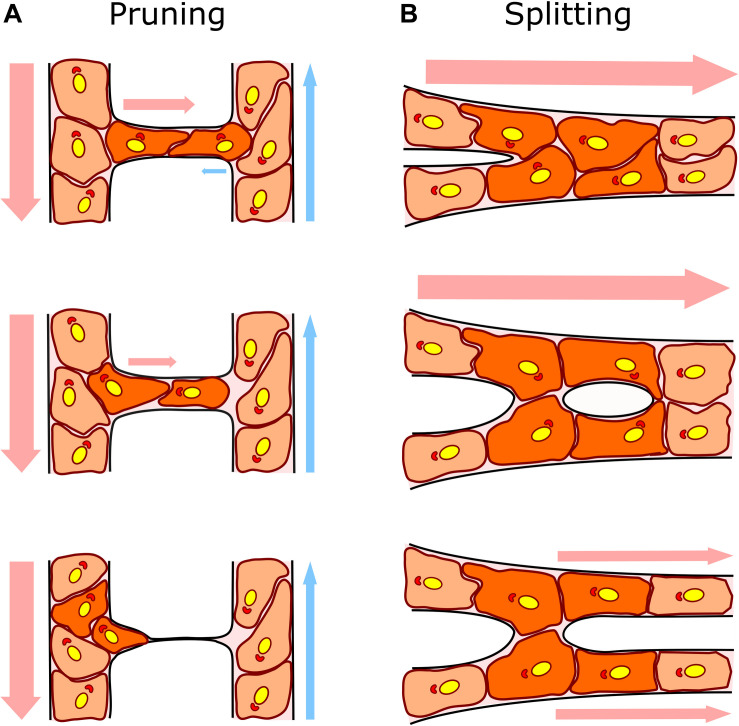
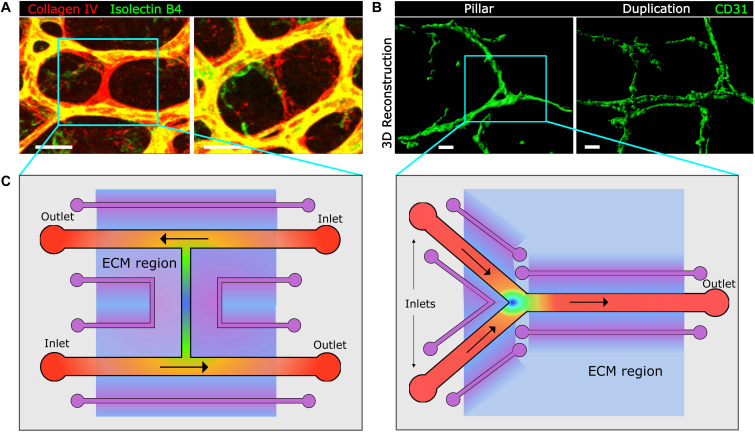
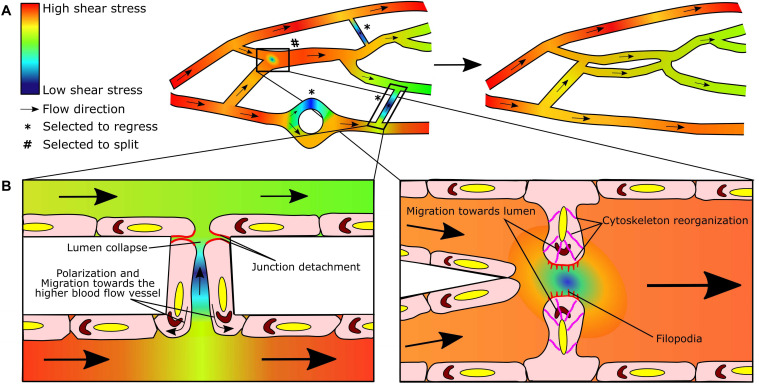
The vasculature ensures optimal delivery of nutrients and oxygen throughout the body, and to achieve this function it must continually adapt to varying tissue demands. Newly formed vascular plexuses during development are immature and require dynamic remodeling to generate well-patterned functional networks. This is achieved by remodeling of the capillaries preserving those which are functional and eliminating other ones. A balanced and dynamically regulated capillary remodeling will therefore ensure optimal distribution of blood and nutrients to the tissues. This is particularly important in pathological contexts in which deficient or excessive vascular remodeling may worsen tissue perfusion and hamper tissue repair. Blood flow is a major determinant of microvascular reshaping since capillaries are pruned when relatively less perfused and they split when exposed to high flow in order to shape the microvascular network for optimal tissue perfusion and oxygenation. The molecular machinery underlying blood flow sensing by endothelial cells is being deciphered, but much less is known about how this translates into endothelial cell responses as alignment, polarization and directed migration to drive capillary remodeling, particularly . Part of this knowledge is theoretical from computational models since blood flow hemodynamics are not easily recapitulated by or approaches. Moreover, these events are difficult to visualize due to their infrequency and briefness. Studies had been limited to postnatal mouse retina and vascular beds in zebrafish but new tools as advanced microscopy and image analysis are strengthening our understanding of capillary remodeling. In this review we introduce the concept of remodeling of the microvasculature and its relevance in physiology and pathology. We summarize the current knowledge on the mechanisms contributing to capillary regression and to capillary splitting highlighting the key role of blood flow to orchestrate these processes. Finally, we comment the potential and possibilities that microfluidics offers to this field. Since capillary remodeling mechanisms are often reactivated in prevalent pathologies as cancer and cardiovascular disease, all this knowledge could be eventually used to improve the functionality of capillary networks in diseased tissues and promote their repair.
脉管系统确保营养物质和氧气在全身的最佳输送,为实现这一功能,它必须不断适应不同的组织需求。发育过程中新生的血管丛不成熟,需要动态重塑以形成结构良好的功能网络。这通过毛细血管的重塑来实现,保留有功能的毛细血管,消除其他毛细血管。因此,平衡且动态调节的毛细血管重塑将确保血液和营养物质向组织的最佳分配。这在病理情况下尤为重要,因为血管重塑不足或过度可能会恶化组织灌注并阻碍组织修复。血流是微血管重塑的主要决定因素,因为毛细血管在灌注相对较少时会被修剪,而在高血流状态下会分支,从而塑造微血管网络以实现最佳的组织灌注和氧合。内皮细胞感知血流的分子机制正在被破解,但对于这如何转化为内皮细胞的反应,如排列、极化和定向迁移以驱动毛细血管重塑,尤其是 ,人们了解得还很少。部分知识来自计算模型的理论推测,因为血流动力学很难通过 或 方法重现。此外,由于这些事件发生频率低且持续时间短,很难可视化 。此前的研究仅限于出生后小鼠视网膜和斑马鱼的血管床,但先进显微镜和图像分析等新工具正在加深我们对毛细血管重塑的理解。在这篇综述中,我们介绍了微血管重塑的概念及其在生理学和病理学中的相关性。我们总结了目前关于毛细血管消退和毛细血管分支机制的知识,强调了血流在协调这些过程中的关键作用。最后,我们评论了微流控技术在该领域的潜力和可能性。由于毛细血管重塑机制在癌症和心血管疾病等常见病理情况下常常被重新激活,所有这些知识最终可能用于改善患病组织中毛细血管网络的功能并促进其修复。