Zaher Naoir, Urban Alexandra, Antony Arun, Plummer Cheryl, Bagić Anto, Richardson R Mark, Kokkinos Vasileios
Department of Neurology, University of Pittsburgh, Pittsburgh, PA, United States.
University of Pittsburgh Comprehensive Epilepsy Center, Pittsburgh, PA, United States.
Front Neurol. 2020 Oct 15;11:595454. doi: 10.3389/fneur.2020.595454. eCollection 2020.
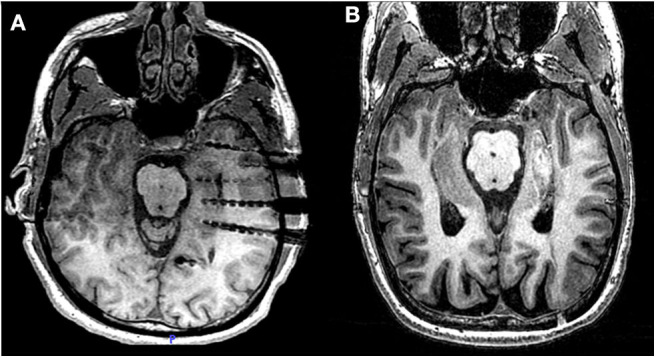
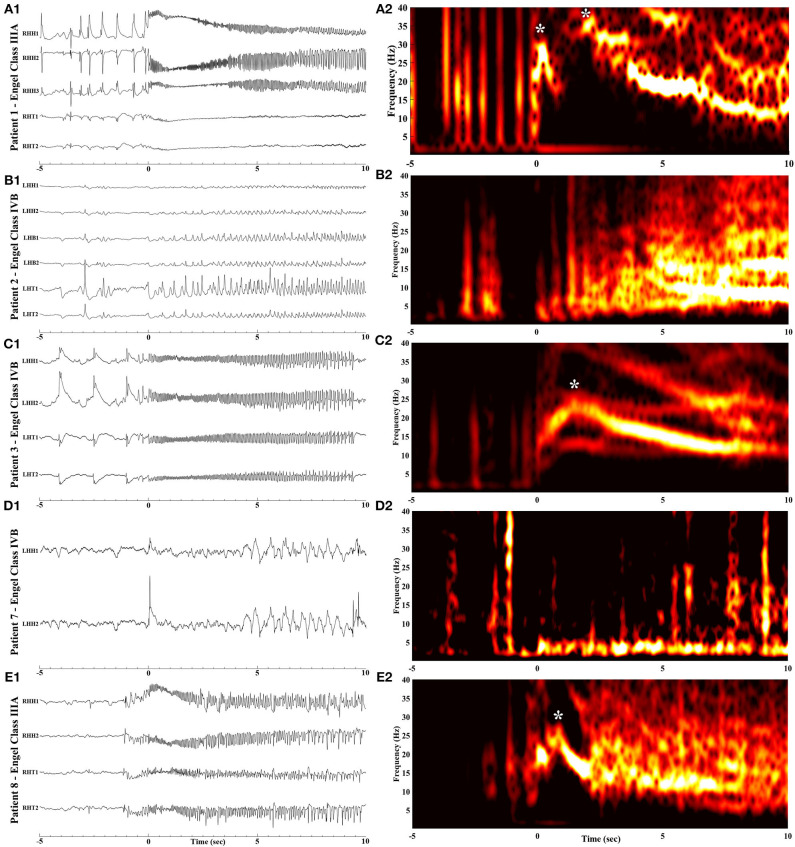
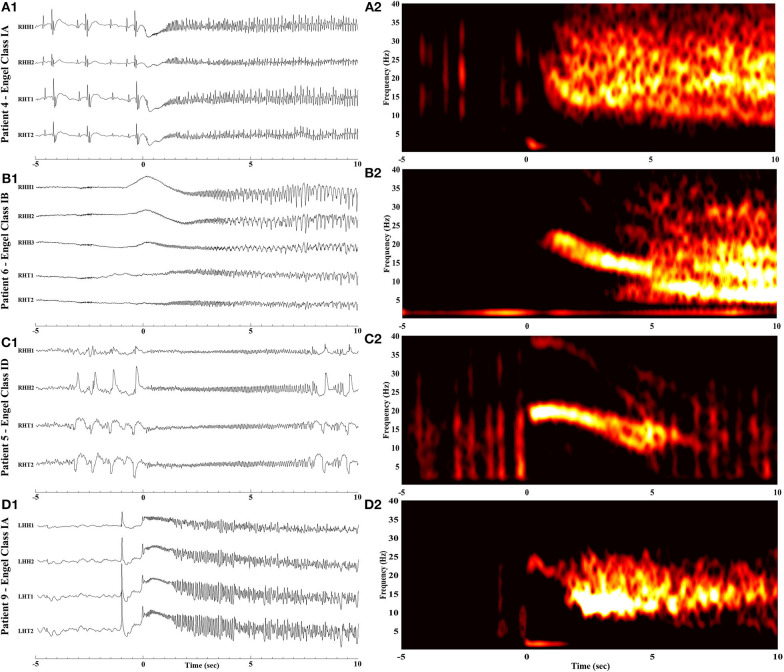
Laser interstitial thermal therapy (LiTT) has emerged as a minimally invasive option for surgical treatment of refractory epilepsy. However, LiTT of the mesial temporal (MT) structures is still inferior to anterior temporal lobectomy (ATL) in terms of postoperative outcome. In this pilot study, we identify intracranial EEG (iEEG) biomarkers that distinguish patients with favorable outcome from those with poor outcome after MT LiTT. We performed a retrospective review of 9 adult refractory epilepsy patients who underwent stereotactic electroencephalography (sEEG) followed by LiTT of MT structures. Their iEEG was retrospectively reviewed in both time and frequency domains. In the time-domain, the presence of sustained 14-30 Hz in MT electrodes coupled with its absence from extra-MT electrodes at ictal onset was highly correlated with favorable outcomes, whereas the appearance of sustained 14-30 Hz or >30 Hz activity in extra-MT sites was negatively correlated to favorable outcomes. In the frequency domain, a declining spectral phase, beginning at the high frequency range (>14 Hz) at ictal onset and following a smooth progressive decline toward lower frequencies as the seizure further evolved, was positively correlated with improved outcomes. On the contrary, low frequency (<14 Hz) patterns and "crescendo-decrescendo" patterns with an early increasing frequency component at ictal onset that reaches the high-beta and low gamma bands before decreasing smoothly, were both correlated with poor surgical outcomes. This pilot study demonstrates the first evidence that iEEG analysis can provide neurophysiological markers for successful MT LiTT and therefore we strongly advocate for systematic sEEG investigations before offering MT LiTT to TLE and MTLE patients.
激光间质热疗法(LiTT)已成为难治性癫痫手术治疗的一种微创选择。然而,就术后效果而言,内侧颞叶(MT)结构的LiTT仍不如前颞叶切除术(ATL)。在这项初步研究中,我们确定了颅内脑电图(iEEG)生物标志物,这些标志物可区分MT LiTT术后预后良好和预后不良的患者。我们对9例接受立体定向脑电图(sEEG)检查后进行MT结构LiTT的成年难治性癫痫患者进行了回顾性研究。对他们的iEEG在时域和频域进行了回顾性分析。在时域中,MT电极在发作起始时持续出现14 - 30 Hz且额外MT电极未出现这种情况与良好预后高度相关,而额外MT部位出现持续的14 - 30 Hz或>30 Hz活动与良好预后呈负相关。在频域中,发作起始时高频范围(>14 Hz)开始的频谱相位下降,并随着癫痫发作进一步发展向低频平稳渐进下降,与预后改善呈正相关。相反,低频(<14 Hz)模式以及发作起始时频率早期增加并在平稳下降之前达到高β和低γ频段的“渐强 - 渐弱”模式,均与手术效果不佳相关。这项初步研究首次证明iEEG分析可为成功的MT LiTT提供神经生理标志物,因此我们强烈主张在为颞叶癫痫(TLE)和内侧颞叶癫痫(MTLE)患者提供MT LiTT之前进行系统的sEEG检查。