Lanius Ruth A, Terpou Braeden A, McKinnon Margaret C
Department of Neuroscience, Western University, London, Ontario, Canada.
Department of Psychiatry, Western University, London, Ontario, Canada.
Eur J Psychotraumatol. 2020 Oct 23;11(1):1807703. doi: 10.1080/20008198.2020.1807703.
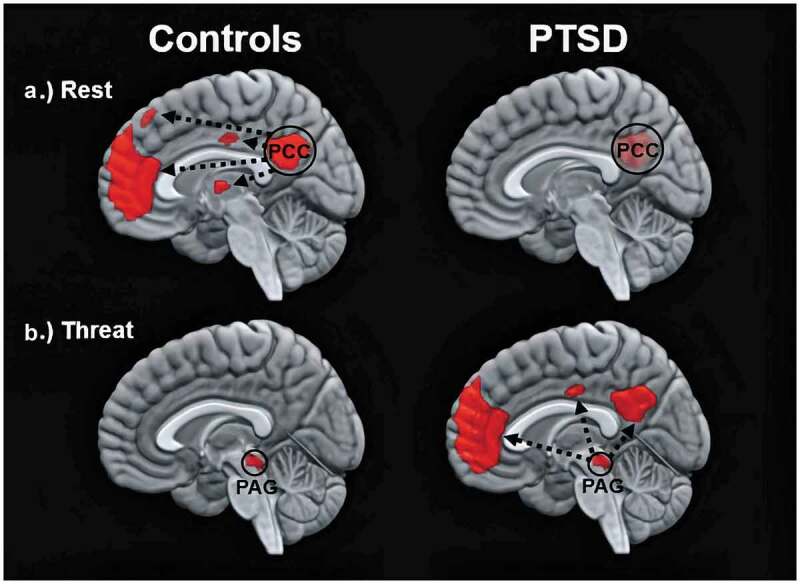
Trauma can profoundly affect the sense of self, where both cognitive and somatic disturbances to the sense of self are reported clinically by individuals with posttraumatic stress disorder (PTSD). These disturbances are captured eloquently by clinical accounts, such as, 'I do not know myself anymore,' 'I will never be able to experience normal emotions again,' and, 'I feel dead inside.' Self-related thoughts and experiences are represented neurobiologically by a large-scale, cortical network located along the brain's mid-line and referred to as the default mode network (DMN). Recruited predominantly during rest in healthy participants, the DMN is also active during self-referential and autobiographical memory processing - processes which, collectively, are thought to provide the foundation for a stable sense of self that persists across time and may be available for conscious access. In participants with PTSD, however, the DMN shows substantially reduced resting-state functional connectivity as compared to healthy individuals, with greater reductions associated with heightened PTSD symptom severity. Critically, individuals with PTSD describe frequently that their traumatic experiences have become intimately linked to their perceived sense of self, a perception which may be mediated, in part, by alterations in the DMN. Accordingly, identification of alterations in the functional connectivity of the DMN during rest, and during subliminal, trauma-related stimulus conditions, has the potential to offer critical insight into the dynamic interplay between trauma- and self-related processing in PTSD. Here, we discuss DMN-related alterations during these conditions, pointing further towards the clinical significance of these findings in relation to past- and present-centred therapies for the treatment of PTSD.
创伤会深刻影响自我意识,创伤后应激障碍(PTSD)患者在临床上报告了对自我意识的认知和躯体方面的干扰。这些干扰在临床描述中得到了生动体现,比如“我不再认识自己了”“我再也无法体验正常的情绪了”以及“我内心感觉像死了一样”。与自我相关的思想和体验在神经生物学上由一个位于大脑中线的大规模皮层网络来表征,这个网络被称为默认模式网络(DMN)。在健康参与者休息时,DMN主要被激活,在自我参照和自传体记忆加工过程中也会活跃——这些过程被认为共同为一种跨越时间持续存在且可供意识获取的稳定自我意识提供了基础。然而,与健康个体相比,PTSD患者的DMN在静息状态下的功能连接性显著降低,且PTSD症状严重程度越高,连接性降低越明显。关键的是,PTSD患者经常描述他们的创伤经历与他们感知到的自我意识紧密相连,这种感知可能部分由DMN的改变介导。因此,识别静息状态下以及阈下创伤相关刺激条件下DMN功能连接性的改变,有可能为深入了解PTSD中创伤与自我相关加工之间的动态相互作用提供关键见解。在此,我们讨论这些条件下与DMN相关的改变,并进一步指出这些发现在以过去和现在为中心的PTSD治疗疗法中的临床意义。